
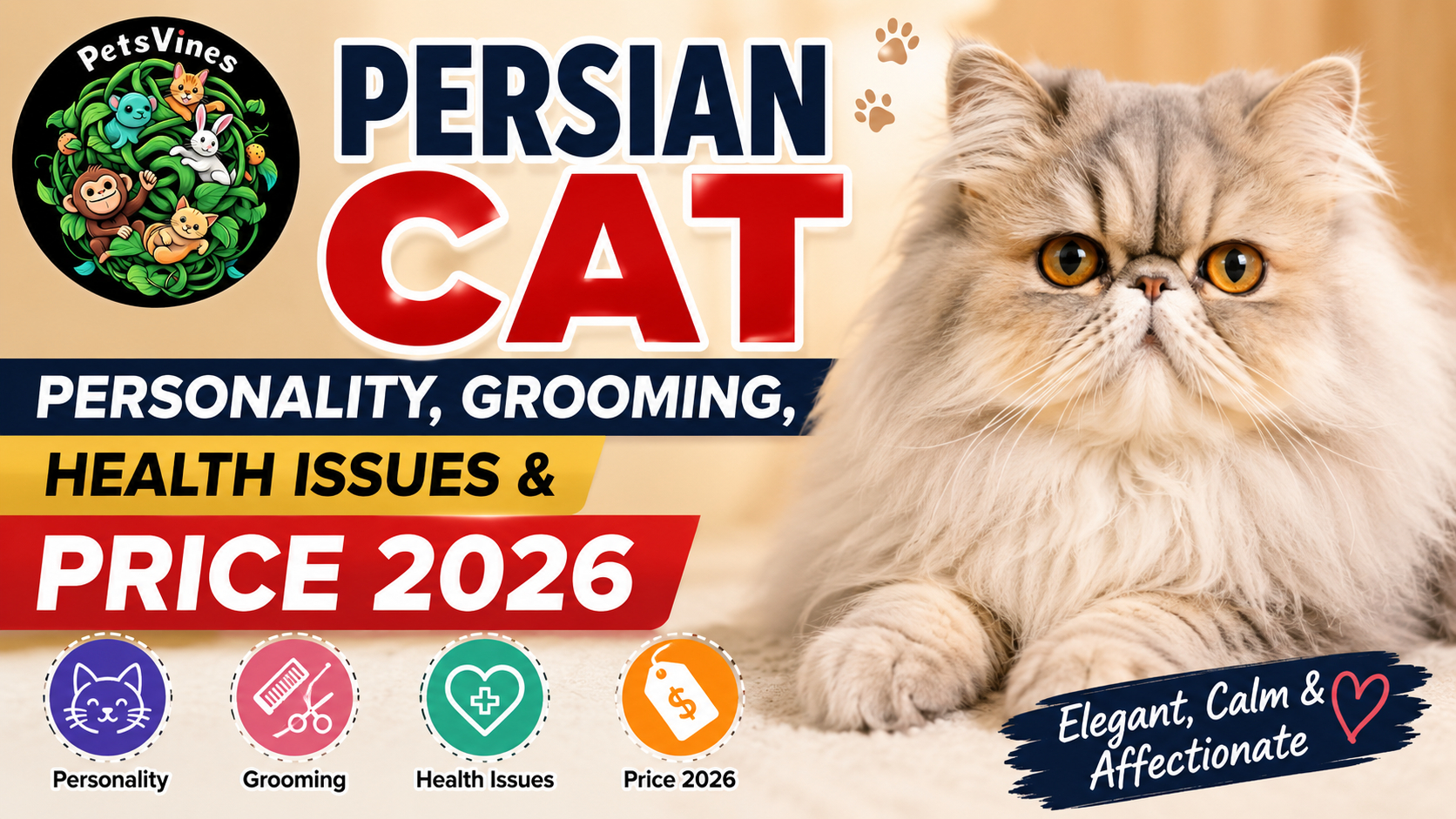
| Origin | Iran (Persia), developed in Europe |
| Size | Medium to large |
| Weight | 7 to 12 lbs |
| Lifespan | 10 to 15 years |
| Coat | Long, thick, dense, double coat |
| Temperament | Calm, quiet, gentle, sweet-natured |
| Price (breeder) | $1,500 to $3,000 |
| Grooming | Very high – daily brushing required |
| Good with children | Yes (calm children) |
| Good with other pets | Yes (calm pets) |
| Activity level | Low |
The Persian cat is the definition of refined elegance. Long-flowing coats, flat faces, enormous round eyes, and a temperament so serene it almost defies cat stereotypes. Persians are not the cats that will knock things off your shelves, sprint through the house at 3 AM, or demand constant entertainment. They are the cats that will drape themselves across a velvet cushion and make your living room look like a painting.
But underneath that glamorous exterior is a breed with very real, very specific needs. The same flat face that makes Persians so distinctive is also the source of some of their most significant health vulnerabilities. The same coat that makes them so breathtaking requires a daily commitment that not every owner is prepared for. This guide gives you the honest picture.
Persian Cat Personality
Persians are among the most laid-back of all domestic cat breeds. They tend to be quiet, preferring gentle meows to the loud, persistent vocalization of breeds like Siamese. They are affectionate with their families but on their own schedule rather than in the demanding, follow-you-everywhere style of Ragdolls or Maine Coons.
Key personality traits include:
- Calm and gentle: Persians rarely display the erratic bursts of activity typical of more energetic breeds. They are well-suited to quiet households and apartment living.
- Selective about company: Persians tend to bond deeply with a small number of trusted people rather than being universally sociable. They may be wary of strangers initially but warm up over time.
- Indoor-only personalities: Persians are not built for outdoor life. Their flat faces impair their ability to breathe effectively in physical exertion, their long coats collect debris and can become dangerously matted outdoors, and their docile temperament leaves them poorly equipped for self-defense.
- Good with calm children and calm pets: Persians do well with children who understand gentle interaction. They are less tolerant of rough handling or chaotic environments than a Ragdoll or Maine Coon.
Persian Cat Grooming: The Daily Commitment
The Persian coat is the most demanding of any popular cat breed. It is long, thick, double-layered, and highly prone to matting if not brushed daily. Without consistent grooming, Persian fur can mat quickly into painful, skin-pulling clumps that require professional removal or in severe cases sedation and clipping by a veterinarian.
Daily grooming with a wide-toothed comb and a slicker brush is the baseline standard for Persian coat maintenance. Pay particular attention to areas where friction causes matting most readily: behind the ears, under the armpits, along the belly, and around the collar. Many Persian owners schedule professional grooming every 4 to 6 weeks for a professional de-shedding treatment and sanitary trim. Some owners choose to keep their Persian in a “lion cut,” clipping the body coat short while leaving the head and tail, which dramatically reduces daily grooming demands.
Eye care is also daily maintenance for Persians. Their flat faces and prominent eyes produce tear overflow that stains the facial fur. Wiping the inner corners of the eyes with a clean, damp cloth daily prevents tear staining and the skin irritation that can develop if moisture accumulates in the facial skin folds. For a comprehensive grooming guide applicable to Persians, see our guide on how to groom a cat at home.
Persian Cat Health Issues
Persians are a brachycephalic breed, meaning their skull structure produces a flat, compressed face. This facial structure is the direct cause of several significant health problems that Persian owners must be aware of and monitor for throughout the cat’s life.
Brachycephalic obstructive airway syndrome (BOAS): The compressed nasal passages, elongated soft palate, and narrow nostrils that produce the Persian’s flat-faced appearance also restrict airflow. Persians breathe less efficiently than cats with normal facial structure. Symptoms include noisy breathing, snoring, exercise intolerance, and in severe cases open-mouth breathing and cyanosis (bluish gums). Surgical correction is sometimes necessary in severe cases. Hot and humid weather is particularly dangerous for Persians because their reduced airway capacity makes thermoregulation through panting much less effective.
Dental malocclusion: The compressed jaw means teeth are crowded and misaligned, leading to increased tartar accumulation, gingivitis, and periodontal disease. More frequent dental check-ups and professional cleanings are generally necessary for Persians compared to cats with normal facial anatomy.
Polycystic kidney disease (PKD): The most significant inherited health condition in Persians. PKD causes progressive formation of fluid-filled cysts in the kidneys, eventually leading to kidney failure. A DNA test can identify PKD-positive cats. According to the Cornell Feline Health Center, PKD was previously estimated to affect up to 40% of Persian cats before widespread DNA testing allowed responsible breeders to eliminate PKD-positive cats from breeding programs. Reputable breeders can provide documentation that both parents tested PKD-negative.
Progressive retinal atrophy (PRA): Hereditary degeneration of the retinal cells that progresses to blindness. DNA testing for PRA in Persians is available and responsible breeders screen for it.
Excessive tearing and eye conditions: The prominent, round eyes of Persians are susceptible to corneal ulcers, entropion (eyelid rolling inward), and persistent epiphora (excessive tear production). Regular eye examinations as part of annual veterinary check-ups are important.
Warning: Heat Danger for Persian Cats
Persians should never be left in hot cars, direct sunlight, or warm rooms without air conditioning. Their restricted airways make them significantly more vulnerable to heatstroke than cats with normal facial structure. In warm weather, always ensure Persians have access to cool, air-conditioned spaces.
Persian Cat Price 2026
| Source | Price Range 2026 | Notes |
|---|---|---|
| Reputable breeder (pet quality) | $1,500 to $2,500 | Should include PKD, PRA test results for parents |
| Reputable breeder (show quality) | $2,500 to $3,000+ | Champion bloodlines, full CFA/TICA registration |
| Rescue or breed-specific shelter | $100 to $500 | Often adults, usually include vaccinations |
| Backyard breeder (avoid) | Often lower | No health testing, higher lifetime vet costs |
Is a Persian Cat Right for You?
The Persian is ideal for calm households, apartment living, owners who enjoy or do not mind a daily grooming routine, people who want a gentle, quiet, indoor companion, and owners who can manage the ongoing health monitoring that brachycephalic cats require. They are not ideal for busy, high-energy households, owners who cannot commit to daily grooming, people who travel frequently without arranging specialized care, or environments with very young children or very active dogs.
FAQs
What is the personality of a Persian cat like?
Persians are among the most laid-back of all domestic cat breeds. They are calm, quiet, and gentle, preferring soft meows over persistent vocalization. They are affectionate with their families but on their own schedule rather than in the demanding follow-you-everywhere style of breeds like Ragdolls or Maine Coons. Persians tend to bond deeply with a small number of trusted people and may be initially wary of strangers before warming up over time.
Are Persian cats good for apartment living?
Yes, Persians are well suited to apartment living. Their low energy level, quiet nature, and preference for calm indoor environments make them one of the best breeds for smaller living spaces. They are not built for outdoor life due to their flat faces, which impair breathing during physical exertion, their long coats that collect debris outdoors, and their docile temperament that leaves them poorly equipped for self-defense.
How much grooming does a Persian cat need?
Persian cats require daily brushing as a baseline minimum. Their long, thick, double-layered coat is highly prone to matting and can develop painful skin-pulling clumps without consistent daily grooming using a wide-toothed comb and slicker brush. Most Persian owners also schedule professional grooming every 4 to 6 weeks for deep de-shedding, sanitary trims, and mat removal. Some owners opt for a lion cut, clipping the body coat short, which dramatically reduces daily maintenance between appointments.
Why do Persian cats need daily eye care?
Persians have flat faces and prominent round eyes that produce tear overflow, which stains the facial fur and can cause skin irritation if moisture accumulates in the facial folds. Wiping the inner corners of the eyes daily with a clean damp cloth prevents tear staining and the skin infections that develop when facial folds remain damp. Eye care is a non-negotiable part of daily Persian maintenance alongside coat brushing.
What health problems are Persian cats prone to?
Persians are prone to five significant health conditions. Brachycephalic obstructive airway syndrome (BOAS) restricts breathing due to compressed nasal passages and narrow nostrils. Dental malocclusion from the compressed jaw causes crowded teeth, tartar buildup, and periodontal disease. Polycystic kidney disease (PKD) causes progressive kidney failure and was previously estimated to affect up to 40 percent of Persians before DNA testing allowed breeders to eliminate it. Progressive retinal atrophy (PRA) causes hereditary blindness. Prominent eyes also make Persians susceptible to corneal ulcers, entropion, and excessive tearing.
Why do Persian cats have flat faces and is it a health concern?
The flat face in Persians is the result of decades of selective breeding for an increasingly extreme facial structure that became fashionable in show cats. This trait did not exist in the original Persian cats from Iran, which had normal muzzle lengths. The health consequences are significant and well documented, including restricted breathing, dental crowding, and eye vulnerability. The compressed nasal passages and elongated soft palate that create the flat face directly cause BOAS, making breathing less efficient throughout the cat’s life.
How dangerous is heat for Persian cats?
Heat is significantly more dangerous for Persians than for cats with normal facial structure. Their restricted airways from brachycephalic anatomy make thermoregulation through panting far less effective, putting them at serious risk of heatstroke in warm conditions. Persians should never be left in hot cars, direct sunlight, or warm rooms without air conditioning. In hot and humid weather, access to cool air-conditioned spaces is essential and non-negotiable.
What should I ask a Persian breeder before buying?
Always request DNA test documentation confirming both parents tested negative for PKD and PRA, as both conditions are hereditary and testable before breeding. A reputable breeder will provide these results readily along with vaccination records and health guarantees. According to the Cornell Feline Health Center, responsible breeding programs have significantly reduced PKD prevalence through DNA testing. If a breeder cannot provide health test documentation, do not purchase from them.
How much does a Persian cat cost in 2026?
From a reputable breeder, a pet-quality Persian costs between $1,500 and $2,500, which should include PKD and PRA test results for both parents. Show-quality Persians with champion bloodlines and full CFA or TICA registration range from $2,500 to $3,000 or more. Breed-specific rescues offer Persians for $100 to $500, usually adults with vaccinations included. Avoid backyard breeders offering cats below typical breeder pricing as these cats are very likely unhealth-tested and carry higher lifetime veterinary costs.
How often do Persian cats need a bath?
Persians generally need bathing once every 4 to 6 weeks because their long dense coat accumulates oil, dirt, and debris more readily than short-haired cats. Use a cat-specific shampoo, dry thoroughly with a low-heat dryer after bathing, and never leave a Persian with a wet coat as they chill easily. Resume daily brushing only after the coat is completely dry to avoid creating new mats in damp fur.
Are Persian cats good for first-time owners?
Persians can work for first-time owners who fully understand and are genuinely committed to the daily grooming requirement and the ongoing brachycephalic health monitoring they need. Their gentle, calm, and predictable temperament is a significant advantage for new owners. However, the daily grooming commitment and the need to manage heat safety and respiratory health monitoring make them less commonly recommended for first-time cat owners than lower-maintenance breeds like Ragdolls or British Shorthairs.
For more cat breed guides, explore the full PetsVines Cat Care hub.
Also Visit: Ragdoll Cat: Personality, Care Guide and Price 2026