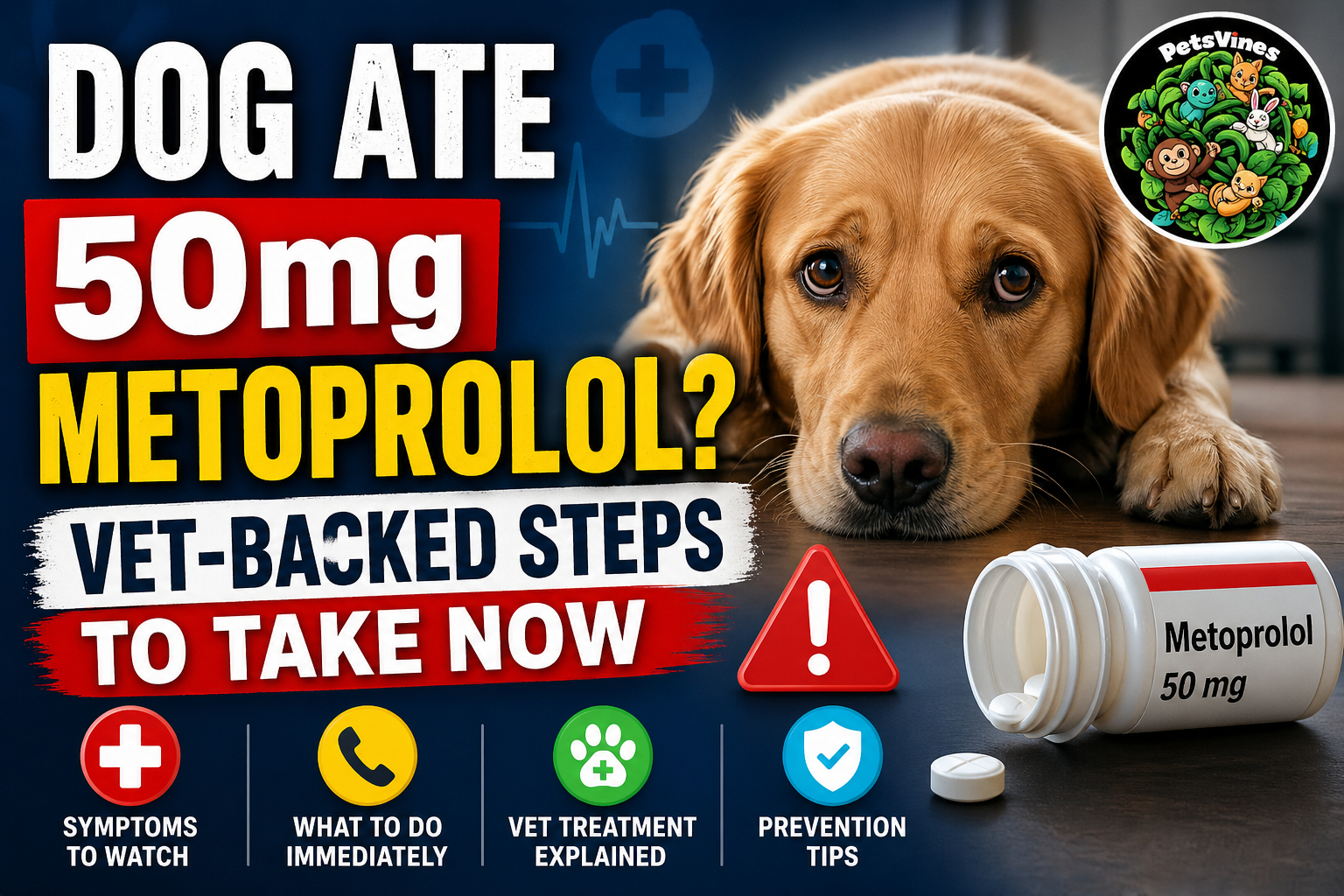
Dog Ate 50mg Metoprolol: You stepped away for a moment, came back, and found your dog chewing on your pill bottle. Your heart drops. The medication? Metoprolol — a beta-blocker you take for blood pressure or heart rhythm. And the dose? 50 mg.
This is one of those situations where staying calm and acting fast can genuinely save your dog’s life.
Metoprolol is one of the most commonly prescribed heart medications in the world for humans, and it’s also one of the medications that ends up accidentally ingested by curious pets far too often. According to the ASPCA Animal Poison Control Center, human prescription medications consistently rank among the top causes of pet poisoning calls every year.
This guide walks you through exactly what metoprolol does, why it’s risky for dogs, what symptoms to watch for, what treatment looks like, and — most importantly — what you need to do in the next few minutes.
For more trusted dog health guidance, visit PetsVines Dog Health Hub.
Is 50mg Metoprolol Dangerous for Dogs?
Yes — a 50 mg metoprolol tablet can be dangerous for dogs, especially small breeds. Metoprolol is a beta-blocker that slows the heart rate and lowers blood pressure. In dogs, even a single human-dose tablet can trigger bradycardia (abnormally slow heart rate), low blood pressure, weakness, and in severe cases, cardiovascular collapse. The risk depends on your dog’s weight, age, and overall health. Do not wait for symptoms to appear before acting — contact a vet immediately.
What Is Metoprolol, and Why Is It Risky for Dogs?
Metoprolol is a selective beta-1 adrenergic blocker. In humans, it’s prescribed to manage high blood pressure, angina, heart failure, and irregular heart rhythms. In veterinary medicine, it’s also sometimes used off-label to treat certain heart rhythm problems and hypertension in cats and dogs.
The key word here is prescribed carefully by a vet at doses calibrated specifically for each animal’s weight and condition. When a dog accidentally eats a human-prescribed 50 mg tablet — a standard adult human dose — the situation is very different.
Here’s what happens biologically: beta-blockers decrease the workload of the heart by altering the response to nerve impulses, and an overdose can very quickly lead to adverse effects. These drugs block the beta-1 receptors responsible for driving up heart rate during stress or exertion. In a dog’s system, this translates to a dangerously slowed heart rate, dropping blood pressure, and reduced ability of the heart to pump blood effectively.
Beta-blockers can poison a dog very rapidly, and it only takes a small amount to do so. A 50 mg dose — designed for an adult human — can be a significant overdose for most dogs, particularly smaller breeds.
Step-By-Step: What to Do If Your Dog Ate Metoprolol
Do not wait for symptoms. By the time your dog shows visible signs of beta-blocker toxicity, the drug is already well absorbed. Act in this order:
Step 1: Stay Calm and Note the Details
Before you call anyone, quickly gather this information:
- Your dog’s approximate weight
- The strength of the pill (50 mg)
- How many pills are potentially missing from the bottle
- When you think the ingestion occurred
- Whether your dog is showing any symptoms yet
This information will help the vet or poison control advisor give you the most accurate guidance.
Step 2: Call a Vet or Poison Control Immediately
Call one of these right now:
- Your regular vet or nearest emergency animal hospital
- Pet Poison Helpline: 1-855-764-7661 (available 24/7, fee may apply)
- ASPCA Animal Poison Control: 1-888-426-4435 (available 24/7, fee may apply)
The veterinarian will be able to tell you based on the amount of medication your dog received whether it is toxic and can make a treatment plan. Don’t try to manage this at home without professional guidance.
Step 3: Do Not Induce Vomiting Without Vet Approval
It may seem logical to make your dog vomit to remove the medication. Do not do this unless specifically directed by a vet. Inducing vomiting incorrectly can cause additional harm, and in some cases, it may not be appropriate depending on how much time has passed or your dog’s current condition.
If a vet advises inducing vomiting and you have 3% hydrogen peroxide at home, they may walk you through the process — but only under their guidance.
Step 4: Get to the Vet Clinic
Even if your dog appears normal, head to the vet. A very small amount of beta-blocker overdose can quickly result in toxicity. It is important to communicate with the veterinarian the type and amount of medication the dog ingested. Symptoms can be delayed for 30 minutes to a few hours after ingestion.
Symptoms of Metoprolol Poisoning in Dogs
Knowing what to look for helps you communicate clearly with your vet and monitor your dog during transport. Symptoms of beta-blocker poisoning in dogs include vomiting, nausea, decreased heart rate, lethargy, weakness, slow breathing, slow heart rate, seizures, and collapse.
Here’s a breakdown by severity:
Mild symptoms (appear within 30–60 minutes):
- Lethargy or unusual tiredness
- Vomiting or drooling
- Weakness in the legs
- Pale gums
Moderate symptoms (can escalate quickly):
- Noticeably slow heart rate
- Difficulty breathing or labored breathing
- Low body temperature
- Stumbling or loss of coordination
Severe symptoms (emergency — rush to the vet):
- Collapse or inability to stand
- Seizures
- Loss of consciousness
- Unresponsive to stimulation
The rate of symptom progression depends on the dog’s size and the dose ingested. A 10-pound Chihuahua that ate a 50 mg tablet faces a very different risk level than a 90-pound Labrador — though both still require urgent veterinary attention.
How Vets Diagnose Beta-Blocker Toxicity
When you arrive at the clinic, the veterinarian will not rely on symptoms alone. The veterinarian will perform a physical examination, including blood work, a biochemistry profile, and urinalysis. The veterinarian will be checking the blood potassium levels, as well as the blood glucose and plasma levels.
The veterinarian will also perform an electrocardiogram (ECG) to check the heart rate and function in order to determine a slowed heartbeat, severe low blood pressure, and any other symptoms that may be associated with an overdose of this type of medication.
Speed of diagnosis is everything here. The vet’s goal is to confirm the toxicity rapidly and move into treatment before the drug causes lasting cardiovascular damage.
How Is Metoprolol Poisoning Treated?
Treatment is multi-pronged and depends on how quickly your dog reaches the clinic and the severity of symptoms.
Decontamination
Gastric lavage, a procedure used to flush out the toxins that were ingested, may be performed. This will be followed up with the use of activated charcoal to help absorb any of the toxic substance. Vomiting may be induced in place of gastric lavage, and this depends on the amount ingested and what the veterinarian feels is necessary.
Activated charcoal is particularly effective when administered within the first hour or two after ingestion — another reason why getting to the vet fast matters so much.
IV Fluids and Electrolyte Management
Intravenous fluids will be given to keep the dog hydrated and to help excrete the substance during urination. Intravenous fluids are also very helpful to stabilize the electrolyte levels and to help the kidneys continue to function properly.
Calcium may also be administered intravenously to help stabilize blood pressure and strengthen cardiac output.
Medications to Counteract the Drug’s Effects
Depending on the dog’s heart rate and blood pressure readings, the vet may administer:
- Atropine — to counteract the slowing of the heart rate
- Glucagon — a hormone that can stimulate the heart independently of beta receptors
- Vasopressors — to raise critically low blood pressure
Insulin Therapy (Severe Cases)
In severe cases of beta-blocker toxicosis, insulin therapy may be given. This type of treatment option has recently emerged as being quite effective in treating severe beta-blocker toxicity. In some cases, IV lipid emulsion therapy is also used.
This advanced treatment — sometimes called “hyperinsulinemia-euglycemia therapy” — works by providing energy to heart cells in a way that bypasses the blocked beta receptors. It sounds complex, but it can be genuinely life-saving in critical cases.
Monitoring
The veterinarian will closely monitor the dog’s blood pressure and heart rate and will also monitor the bloodwork on a regular basis. Your dog may be kept in the hospital for 24 hours or longer, even if they appear to stabilize, to ensure no delayed cardiac effects occur.
Prognosis: Will My Dog Be Okay?
This is the question every pet owner desperately wants answered. The honest answer is: it depends — and timing is everything.
If the dog was able to receive immediate treatment, and the dosage level was not too high, the prognosis is fair to good. Unfortunately, an overdose of beta-blockers can prove fatal in many cases.
Dogs that receive treatment within the first hour or two after ingestion have significantly better outcomes. Larger dogs who ingested a single 50 mg tablet are in a different risk category than small breeds that ingested the same amount — but again, no dog should go untreated based on size alone.
Once home, the vet will provide specific aftercare instructions and will likely schedule follow-up appointments to confirm the heart has fully recovered.
Metoprolol vs. Other Beta-Blockers: Is It More or Less Dangerous?
Metoprolol is a selective beta-1 blocker, meaning it primarily targets the heart rather than the lungs. This makes it somewhat less dangerous than non-selective beta-blockers like propranolol, which can also cause severe respiratory complications. However, selective does not mean safe for dogs.
Other beta-blockers that fall into the same category include esmolol, nadolol, sotalol, timolol, carvedilol, and atenolol. If your dog has ingested any of these, treat the situation with the same urgency as metoprolol ingestion.
How to Prevent This from Happening Again
Accidents happen. But there are straightforward ways to make sure this doesn’t repeat itself.
Store medications securely. Keep all prescription medications — yours and your pet’s — in a cabinet with a latch or in a location completely out of your dog’s reach. Dogs can open pill bottles, knock containers off counters, and find dropped pills with alarming efficiency.
Never leave pills on counters or bedside tables. One dropped tablet on the floor is all it takes.
Use pill organizers with child-proof locks. Standard weekly pill organizers are easy for a determined dog to chew through.
Consider a dedicated, locked medicine cabinet. This is the most reliable method for households with curious or persistent pets.
For more dog safety tips and pet health resources, explore the full PetsVines resource library.
FAQ’s
My dog ate metoprolol but seems fine. Do I still need to go to the vet?
Yes, absolutely. Symptoms of metoprolol toxicity can be delayed by 30 minutes to several hours. A dog can appear completely normal while the drug is being absorbed. Do not wait for visible signs — call a vet or poison control immediately.
Can a large dog survive eating one 50mg metoprolol tablet?
A larger dog has a higher threshold, but there is no safe threshold for accidental ingestion of human beta-blockers. Even if the risk is lower for a large breed, the consequences of being wrong are too serious. Get your dog evaluated regardless.
Can I give my dog activated charcoal at home?
Do not administer activated charcoal without direct guidance from a veterinarian. Improper use can cause aspiration (inhaling it into the lungs) or electrolyte imbalances.
How long does metoprolol stay in a dog’s system?
Metoprolol is a short-acting medication, meaning effects typically last less than 24 hours — though effects may last longer in pets with kidney or liver disease.
Is metoprolol ever prescribed to dogs?
Yes, but only by veterinarians at carefully calculated doses for specific heart conditions. A 50 mg human tablet is not equivalent to a veterinary prescription dose.
When to Seek Emergency Care Immediately
Go to an emergency animal hospital right now if your dog shows any of these:
- Collapsing or inability to stand
- Seizures
- Gasping or labored breathing
- Unresponsive to their name or touch
- Blue-tinged gums (sign of oxygen deprivation)
These are life-threatening signs. Do not call first — drive.
Fast Action Saves Lives
If there’s one thing to take away from this article, it’s this: metoprolol poisoning in dogs is a genuine emergency, and the best thing you can do is act immediately, not wait. The difference between a full recovery and a tragic outcome often comes down to the first 30 to 60 minutes.
Keep the Pet Poison Helpline number saved in your phone: 1-855-764-7661. Keep your vet’s emergency number handy. And do a quick audit of your home today — make sure every medication you own is stored somewhere your dog absolutely cannot reach.
Your dog is counting on you. And now you know exactly what to do.
Also Visit: Dog Eating Lying Down: Causes, Concerns & What to Do