
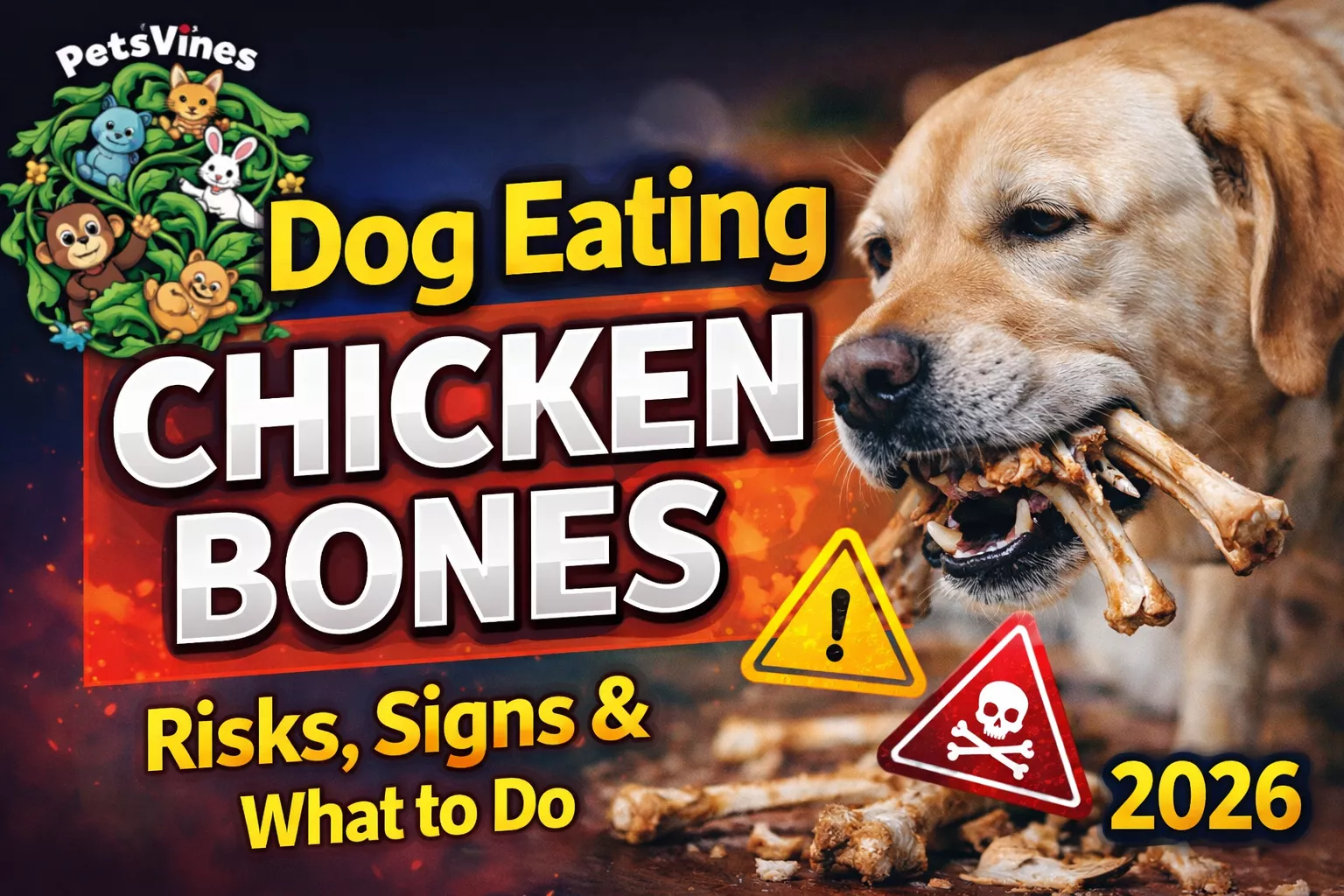
Dog Eating Chicken Bones: If your dog ate a chicken bone, stay calm but act quickly. Cooked chicken bones are the most dangerous — they splinter into sharp fragments that can puncture your dog’s mouth, throat, stomach, or intestines. Monitor your dog closely for symptoms like vomiting, gagging, lethargy, or bloody stool. If any of these appear, contact your vet or an emergency animal hospital immediately. Do not induce vomiting unless explicitly told to by a vet.
You turn around for two seconds and your dog has snatched a chicken bone off the counter, the trash, or right off your plate. It happens fast — and the panic that follows is completely understandable.
Here’s the thing: not every chicken bone incident ends in an emergency. But some do. And the difference between a dog that passes a bone safely and one that ends up in surgery often comes down to what the owner did — or didn’t do — in the hours immediately after.
This guide gives you the full picture. You’ll learn exactly why chicken bones are dangerous for dogs, how cooked and raw bones differ, the warning signs that mean your dog needs urgent care, and the step-by-step actions every pet owner should take. Whether your dog just grabbed a bone or you’re trying to be prepared, this is the article you need to read.
For more dog health guides and expert pet care advice, explore the full dog care resource hub at PetsVines.
Why Are Chicken Bones Dangerous for Dogs?
Chicken bones — especially cooked ones — are dangerous for dogs because they splinter easily when chewed. Those sharp fragments can cause choking, lacerations inside the digestive tract, and life-threatening blockages. Even a small bone can become a serious hazard depending on how it breaks and how much your dog weighs.
Dogs have strong jaws designed for crushing. That’s great for chew toys — not so great for brittle bones. When a cooked chicken bone meets a dog’s bite force, it doesn’t crumble cleanly. It shatters into jagged shards that can:
- Pierce the mouth, tongue, or gums on the way down
- Become lodged in the throat or esophagus, causing choking or breathing difficulty
- Puncture the stomach lining, leading to internal bleeding
- Create intestinal blockages that may require emergency surgery
- Perforate the intestines, which is a life-threatening condition called intestinal perforation
According to the American Veterinary Medical Association (AVMA), bone fragments are one of the leading causes of gastrointestinal foreign body obstructions in dogs — a condition that, left untreated, carries a significant risk of fatality.
Cooked Chicken Bones vs. Raw Chicken Bones: What’s the Difference?
This is one of the most common questions pet owners ask — and the answer matters.
Cooked chicken bones are significantly more dangerous. The cooking process dries out the bone, making it brittle and prone to splintering into sharp, jagged pieces. Whether it’s a roasted drumstick, a fried wing, or boiled broth bones, cooking transforms a flexible structure into a potential weapon inside your dog’s digestive system.
Raw chicken bones are softer and more pliable. They’re less likely to splinter as dramatically, which is why some raw-feeding advocates include them in a dog’s diet. However, “less dangerous” is not the same as “safe.” Raw bones still carry real risks:
- Bacterial contamination — Raw poultry frequently carries Salmonella and Campylobacter. These bacteria can cause serious illness in dogs and can be transmitted to humans who handle the dog or clean up after them. A 2018 study published in PLOS ONE found that dogs fed raw meat diets had significantly higher rates of Salmonella shedding in their stool.
- Choking hazard — Even pliable raw bones can lodge in the throat, particularly in smaller breeds.
- Intestinal blockage — Bone fragments from raw bones can still accumulate and cause obstructions.
- Tooth fractures — Hard bones, raw or cooked, can crack a dog’s teeth.
Cooked chicken bones should never be given to dogs. Raw chicken bones carry lower — but still real — risks, and should only be considered under direct veterinary guidance as part of a structured raw feeding plan.
My Dog Eating Chicken Bones — What Do I Do Right Now?
If your dog just ate a chicken bone, don’t panic — but don’t ignore it either. The most important first step is to stay calm, remove any remaining bones from reach, and assess whether your dog is showing immediate signs of distress. Then call your vet. Do not try to make your dog vomit unless your vet specifically instructs you to.
Here’s a clear, step-by-step action plan:
Step 1: Stay Calm and Assess the Situation
Panicking won’t help you or your dog. Take a breath and quickly assess:
- What type of bone was it? Cooked or raw? Large or small?
- How much did your dog eat? A small fragment vs. a full drumstick changes the risk level significantly.
- What size is your dog? A 70-pound Labrador swallowing a small wing bone faces a different risk than a 10-pound Chihuahua swallowing the same.
- Is your dog showing any immediate distress? Choking, gagging, pawing at mouth?
Step 2: Do NOT Induce Vomiting
This is critical. Many pet owners’ instinct is to make the dog vomit up the bone. Do not do this without veterinary instruction. Forcing vomiting can cause a sharp bone fragment to lacerate the esophagus on the way back up — potentially making the situation much worse than it already is.
Step 3: Call Your Vet or an Emergency Animal Hospital
Even if your dog seems completely fine, call your vet and describe the situation. They will ask about the bone type, size of your dog, and whether any symptoms are present. Based on that, they’ll advise whether you need to come in immediately, monitor at home, or bring the dog in for X-rays as a precaution.
If it’s after hours, contact an emergency veterinary clinic. Many offer 24/7 phone triage services.
Step 4: Monitor Closely for 48–72 Hours
If your vet advises home monitoring, watch carefully for the following warning signs over the next two to three days.
Warning Signs Your Dog Has a Problem After Eating a Chicken Bone
After a dog eats a chicken bone, watch for vomiting, gagging, loss of appetite, bloody stool, or signs of abdominal pain. These symptoms may indicate a perforation, blockage, or internal injury — all of which require immediate veterinary care.
Contact your vet or go to an emergency clinic right away if you notice any of the following:
- Vomiting — especially repeated vomiting or vomiting with blood
- Gagging or retching — could indicate something is lodged in the throat or esophagus
- Pawing at the mouth or face — a sign of oral discomfort or something stuck
- Coughing or labored breathing — possible sign of aspiration or esophageal obstruction
- Loss of appetite — especially if it persists beyond 12–24 hours
- Lethargy or unusual weakness — generalized sign of something being wrong internally
- Abdominal swelling or tenderness — may indicate perforation or blockage
- Constipation or straining — bone fragments may be causing a lower intestinal blockage
- Black or bloody stool — a serious sign of internal bleeding
Any one of these symptoms is reason to call your vet immediately. Multiple symptoms together are a veterinary emergency.
What Will the Vet Do?
If you bring your dog in after a chicken bone incident, the vet will typically:
- Perform a physical examination — checking the mouth, throat, and abdomen for tenderness or swelling
- Take X-rays — to locate bone fragments and check for obstructions or free air (which indicates perforation)
- Recommend endoscopy — in some cases, a scope can retrieve bone fragments from the esophagus or stomach without surgery
- Advise surgery — if there’s a blockage, perforation, or fragment that cannot be safely retrieved otherwise
The prognosis is generally very good when treatment is sought promptly. Delays in treatment significantly worsen outcomes — particularly if intestinal perforation occurs and leads to peritonitis (infection of the abdominal cavity).
Can a Dog Pass a Chicken Bone Naturally?
Yes, in some cases a dog can pass a small chicken bone naturally, particularly if it’s a soft raw bone and the dog is large. However, this should never be assumed. Always consult your vet — attempting to “wait it out” without professional guidance can be dangerous.
Small, relatively smooth bone fragments sometimes do travel through the digestive system without causing harm. Veterinarians may sometimes advise feeding a bulky meal — such as plain white bread or canned pumpkin — to help cushion a bone fragment and encourage it to pass more safely. However, this is only appropriate in low-risk situations and should only be done on your vet’s recommendation, not as a default home remedy.
Never assume a bone will pass on its own if your dog is showing any symptoms at all.
Are Any Bones Safe for Dogs?
This question comes up constantly among dog owners — and the answer is more nuanced than a simple yes or no.
Veterinarians generally advise against giving dogs any cooked bones of any kind. This includes chicken, turkey, pork, and beef bones. Cooking alters the structural integrity of the bone regardless of species.
When it comes to raw bones, opinions vary. Some veterinarians and raw-feeding advocates accept raw recreational bones (like raw marrow bones from beef) as generally safe for large dogs under supervision. However, even these come with caveats — they can crack teeth, carry bacteria, and should always be size-appropriate for the dog.
Safer alternatives to bones that most vets recommend include:
- Veterinarian-approved dental chews (look for VOHC — Veterinary Oral Health Council — approved products)
- Rubber chew toys designed for strong chewers
- Antlers or nylon chews (check with your vet for size-appropriate options)
- Bully sticks (in moderation, supervised)
If you’re ever unsure about what’s safe to give your dog, a good starting point is your vet and reliable resources like the AVMA’s pet owner guidance.
For more articles on dog nutrition, safety, and care, visit PetsVines — your trusted source for pet health.
FAQ’s
Can a chicken bone kill a dog?
In serious cases, yes. Intestinal perforation from a sharp bone fragment can be fatal if not treated promptly. However, many dogs that eat chicken bones — particularly small amounts of raw bone — pass them without incident. The key factor is getting veterinary guidance quickly.
What if my dog ate chicken bones and seems fine?
Even if your dog appears completely normal, call your vet. Internal injuries aren’t always immediately visible. Some obstructions and perforations take 12–48 hours to produce symptoms. Your vet may want to monitor the dog in clinic or advise home observation protocols.
Should I feed my dog bread after eating a chicken bone?
Some vets recommend feeding a small amount of soft bread to help cushion bone fragments in the digestive tract. However, this is not a universal recommendation — always call your vet first before giving anything.
How long does it take for a dog to pass a chicken bone?
If a bone fragment is going to pass naturally, it typically does so within 24–72 hours. Any symptoms before or during that window should trigger an immediate vet visit.
Are small chicken bones more dangerous than large ones?
Not necessarily. Small bones can become lodged in the throat or esophagus, while larger ones may fragment into multiple sharp pieces. Both present risks — the danger depends more on how the bone breaks and the size of the dog.
Chicken Bones and Dogs Don’t Mix?
The honest answer is this: chicken bones — especially cooked ones — should never be part of a dog’s diet. They pose a real, documented risk of injury that ranges from minor oral irritation all the way to life-threatening internal perforation.
If your dog has already eaten a chicken bone, don’t wait and hope for the best. Call your vet, describe the situation clearly, and follow their guidance. Fast action is the difference between a manageable situation and a surgical emergency.
Stay informed, stay prepared, and give your dog the safe, healthy life they deserve. For more expert dog care guidance, head over to the PetsVines dog care hub — packed with vet-informed articles for every stage of your dog’s life.