| Origin | Scotland (1961, natural mutation) |
| Size | Medium |
| Weight | 6 to 13 lbs |
| Lifespan | 11 to 14 years (often shorter due to OCD) |
| Coat | Short or long, dense and plush |
| Temperament | Calm, sweet, adaptable, gentle |
| Price (breeder) | $1,000 to $2,000 |
| Grooming | Low to moderate |
| Health concern | Osteochondrodysplasia in ALL Scottish Folds |
| GCCF/FIFe recognized | No – banned due to welfare concerns |
| Countries where banned | Australia, Belgium, Netherlands, Norway, Scotland |
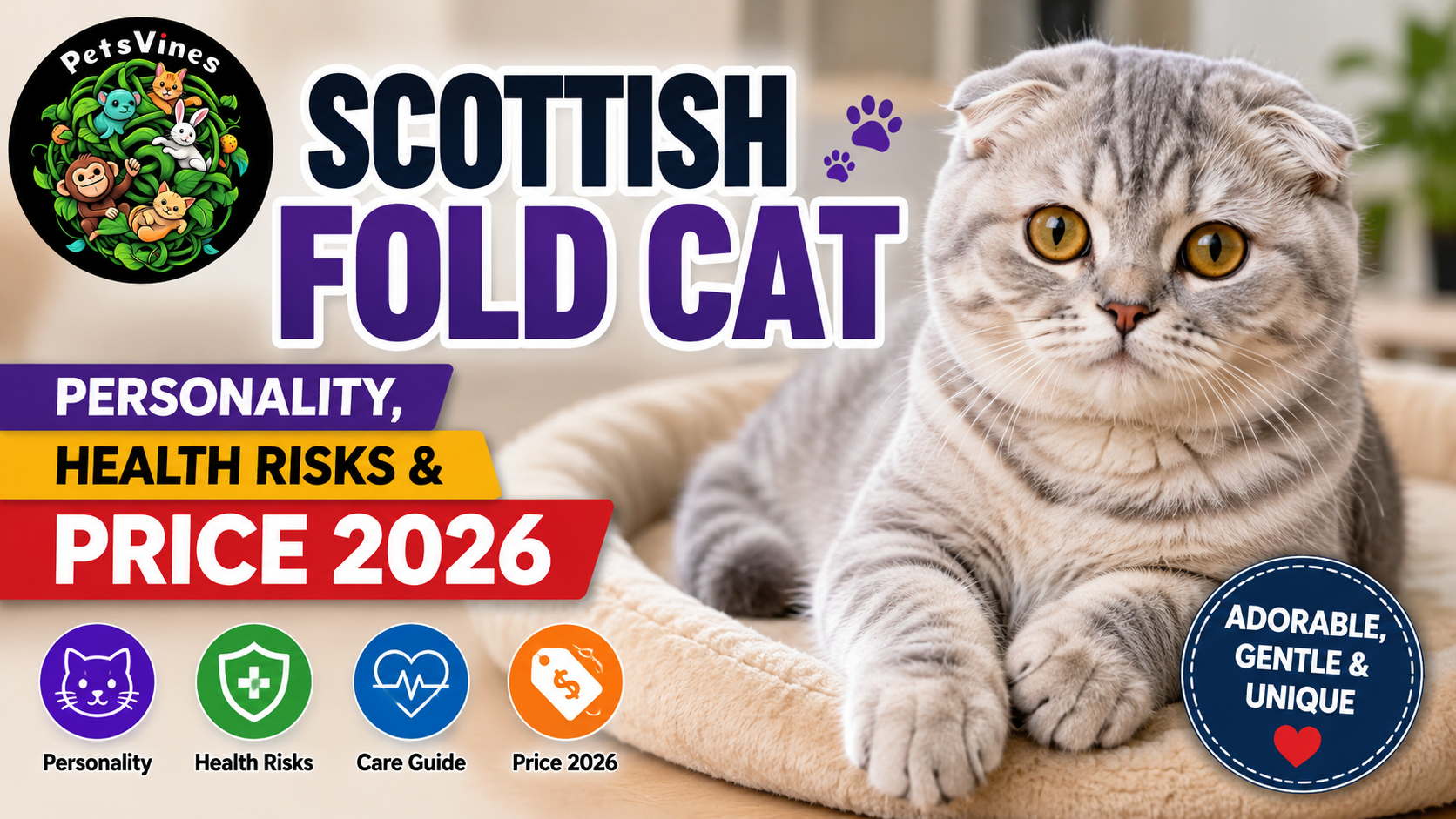
The Scottish Fold is one of the most instantly recognizable and one of the most ethically complex cat breeds in the world. Their folded ears give them an owl-like appearance that many people find irresistible. Taylor Swift’s famous Scottish Fold cats have added enormous celebrity visibility to the breed. But behind the endearing appearance lies a genetic reality that every prospective Scottish Fold owner must understand before making a decision.
This guide gives you the complete picture: the genuine charm of the Scottish Fold’s personality, and the unvarnished medical truth about what every single Scottish Fold cat experiences in their body, regardless of whether their ears are folded or straight.
The Scottish Fold’s Origin and the Genetic Problem
The Scottish Fold breed originated from a single barn cat named Susie, found in Scotland in 1961, whose ears had an unusual forward fold. Susie’s kittens demonstrated the same trait, and a breeding program was established. The breed was registered with the GCCF in the UK in 1966, but excluded from their registry in 1974 after research revealed the serious skeletal abnormalities associated with the fold gene.
The gene responsible for the folded ears (a dominant mutation in the TRPV4 gene) does not only affect ear cartilage. It affects cartilage development throughout the entire body. This results in a condition called osteochondrodysplasia (OCD), which causes abnormal development of bone and cartilage in the limbs, spine, tail, and joints. The result is chronic, often severe, degenerative joint disease that progresses throughout the cat’s life.
Warning: A Critical Medical Fact About Scottish Folds
According to International Cat Care and veterinary research: ALL Scottish Fold cats, both those with folded ears and those with straight ears that carry the fold gene, are affected by osteochondrodysplasia. There is no Scottish Fold cat without this condition. The fold mutation that causes the distinctive ears IS the same mutation that causes the skeletal disease. The two cannot be separated.
In one notable study cited in veterinary literature, 13 heterozygous Scottish Folds that their owners described as apparently healthy all had radiographic evidence of osteochondrodysplasia lesions ranging from mild to severe when X-rayed. Because cats are extraordinarily good at hiding pain, owners often do not recognize the signs of disease until it is advanced.
The Breed Ban Situation
The ethical concerns about Scottish Fold breeding have led to significant regulatory action internationally:
- The Governing Council of the Cat Fancy (GCCF) in the United Kingdom does not recognize the Scottish Fold and has not since 1974.
- The Fédération Internationale Féline (FIFe), the international cat registry, also does not recognize or allow Scottish Folds in competition.
- Scotland, the country of the breed’s origin, has banned breeding Scottish Folds.
- Australia, Belgium, Netherlands, Norway, and Austria have all enacted bans on breeding and in some cases selling Scottish Folds.
- TICA and the CFA in the United States continue to recognize the breed, though with restrictions requiring that Scottish Folds only be bred with straight-eared cats (Scottish Straights or British Shorthairs) to avoid producing homozygous kittens, who suffer the most severe form of OCD.
Scottish Fold Personality
Setting aside the ethical complexity of their breeding, Scottish Folds that you encounter as companion animals genuinely do have a lovely temperament. They are known for:
- Calm and adaptable: Scottish Folds tend to be relaxed, adaptable cats that adjust well to various living situations including apartments, families with children, and multi-pet households.
- Sweet and gentle: They are affectionate without being demanding, and tend to form close bonds with their primary people without the intense neediness of a Siamese or the persistent following of a Ragdoll.
- Quiet: Scottish Folds are not particularly vocal cats, communicating with soft meows rather than persistent yowling.
- “Buddha” sitting position: Scottish Folds are famous for sitting upright on their hindquarters with their front paws resting on their belly, a position that has been widely shared on social media. This posture is a consequence of their skeletal abnormalities making other positions uncomfortable, not an endearing quirk.
Caring for a Scottish Fold Who Already Has the Condition
If you already have a Scottish Fold or are committed to adopting one, responsible ownership means:
Regular veterinary monitoring: Annual X-rays from a young age allow you and your vet to track the progression of joint disease and manage pain appropriately. Do not wait for visible signs of discomfort: cats hide pain remarkably well.
Pain management: OCD causes real, significant, chronic pain. Work closely with your veterinarian to establish an appropriate pain management protocol. This may include anti-inflammatory medications, joint supplements (glucosamine and chondroitin), and in some cases prescription pain relief.
Environmental modifications: Reduce the need for jumping by providing ramps or steps to elevated surfaces. Keep litter boxes low-sided and easily accessible. Monitor for signs of discomfort when jumping, reluctance to use stairs, or stiffness after rest.
Weight management: Keeping your Scottish Fold at a healthy weight significantly reduces the stress on already-compromised joints. See our guide on how much to feed a cat by weight for portion guidance.
Scottish Fold Price 2026
| Source | Price Range 2026 | Notes |
|---|---|---|
| Reputable breeder (US) | $1,000 to $2,000 | Should only breed Fold x Straight, never Fold x Fold |
| Show quality | $2,000+ | CFA or TICA registration |
| Rescue | $100 to $400 | Increasing numbers surrendered due to health costs |
Making an Informed Decision
The decision about whether to own a Scottish Fold is a genuinely personal ethical one that reasonable people make different choices about. What should be universally true is that the decision is made with complete information about what OCD means for every Scottish Fold cat’s life, rather than being made based on social media images of charming folded-eared cats sitting in amusing positions.
If you do decide to get a Scottish Fold, adopt from a rescue rather than buying from a breeder, commit to the ongoing veterinary monitoring and pain management their condition requires, and consider the lifetime financial commitment of managing a cat with chronic joint disease.
FAQs
What is a Scottish Fold cat?
The Scottish Fold is a medium-sized cat breed originating from Scotland in 1961, known for its distinctive forward-folded ears caused by a dominant genetic mutation in the TRPV4 gene. The same mutation that produces the folded ears also causes osteochondrodysplasia, a painful degenerative disease affecting cartilage and bone throughout the entire body. Scottish Folds weigh 6 to 13 pounds, live 11 to 14 years on average, and have a calm, gentle, and adaptable temperament.
Do all Scottish Fold cats have health problems?
Yes, without exception. Osteochondrodysplasia affects every Scottish Fold cat, including those with straight ears that carry the fold gene. The mutation causing the distinctive folded ears and the mutation causing the skeletal disease are the same mutation and cannot be separated. In one study, 13 Scottish Folds described by their owners as apparently healthy all showed radiographic evidence of OCD lesions ranging from mild to severe when X-rayed.
What is osteochondrodysplasia and how does it affect Scottish Folds?
Osteochondrodysplasia (OCD) is a condition causing abnormal development of cartilage and bone throughout the body, not just the ears. In Scottish Folds it affects the limbs, spine, tail, and joints, resulting in chronic and often severe degenerative joint disease that progresses throughout the cat’s life. Because cats are exceptionally good at hiding pain, owners frequently do not recognize the signs of disease until it has already advanced significantly. Annual X-rays are the only reliable way to monitor progression.
Are Scottish Fold cats in pain?
The available evidence strongly suggests that most if not all Scottish Folds experience some degree of chronic pain from joint disease, even when owners cannot identify visible signs of discomfort. X-ray studies of apparently healthy Folds consistently reveal OCD lesions. Cats are exceptional at masking pain, and the absence of visible symptoms does not mean the absence of pain. The famous Buddha sitting position, where the cat sits upright on its hindquarters, is a consequence of skeletal abnormalities making other positions uncomfortable rather than an endearing quirk.
Where is it illegal to breed Scottish Fold cats?
Scotland, the country where the breed originated, has banned breeding Scottish Folds. Australia, Belgium, the Netherlands, Norway, and Austria have also enacted bans on breeding and in some cases selling the breed. The Governing Council of the Cat Fancy (GCCF) in the UK and the Fédération Internationale Féline (FIFe) internationally do not recognize the Scottish Fold and have not since 1974. TICA and the CFA in the United States continue to recognize the breed with restrictions requiring Fold-to-Straight crosses only.
What is the personality of a Scottish Fold like?
Scottish Folds are calm, adaptable, sweet, and gentle cats that adjust well to various living situations including apartments, families with children, and multi-pet households. They are affectionate without being demanding and tend to form close bonds with their primary people without the intense neediness of breeds like the Siamese. They are quiet cats that communicate with soft meows rather than persistent vocalization.
How much does a Scottish Fold cost in 2026?
From a reputable breeder in the United States, a Scottish Fold costs between $1,000 and $2,000, with show-quality cats registered with CFA or TICA costing $2,000 or more. Rescue adoption costs $100 to $400, and increasing numbers of Scottish Folds are being surrendered to rescues due to the significant veterinary costs associated with managing their chronic joint disease. A responsible breeder should only breed Fold-to-Straight crosses, never Fold-to-Fold, which produces the most severe form of OCD.
How should I care for a Scottish Fold’s joint disease?
Responsible care requires annual X-rays from a young age to track joint disease progression, not waiting for visible signs of discomfort. Work with your veterinarian to establish an appropriate pain management protocol that may include anti-inflammatory medications, joint supplements such as glucosamine and chondroitin, and in some cases prescription pain relief. Provide ramps or steps to elevated surfaces, use low-sided litter boxes, and maintain a healthy body weight to reduce stress on already-compromised joints.
Why are Scottish Folds popular despite their health problems?
Their distinctive owl-like appearance and sweet temperament are genuinely appealing, and high-profile celebrity ownership, most notably Taylor Swift’s Scottish Fold cats, has significantly raised the breed’s public profile. Many prospective owners are unaware of the health implications before purchasing. Demand driven by aesthetics continues to sustain breeding programs despite growing awareness of OCD and increasing regulatory action internationally.
Is it ethical to breed Scottish Fold cats?
This is a genuinely contested question in veterinary ethics. Organizations including International Cat Care and the Universities Federation for Animal Welfare (UFAW) take the position that it is not ethical to continue breeding cats with a known genetic defect that causes significant, painful, lifelong disease. Others argue that responsible breeding using only Fold-to-Straight crosses with health monitoring can minimize suffering. The position of the GCCF, FIFe, and several national governments is reflected in their bans on the breed.
What should I consider before getting a Scottish Fold?
Every prospective owner should understand that there is no Scottish Fold without OCD, that the condition causes chronic pain throughout the cat’s life, and that ongoing veterinary monitoring and pain management represent a significant long-term financial and care commitment. If you decide to proceed, adopting from a rescue rather than purchasing from a breeder is strongly recommended, as rescue adoption reduces demand that sustains breeding programs and gives an existing cat appropriate care for their condition.
Also Visit: Bengal Cat: Temperament, Care, Activity Needs and Cost 2026