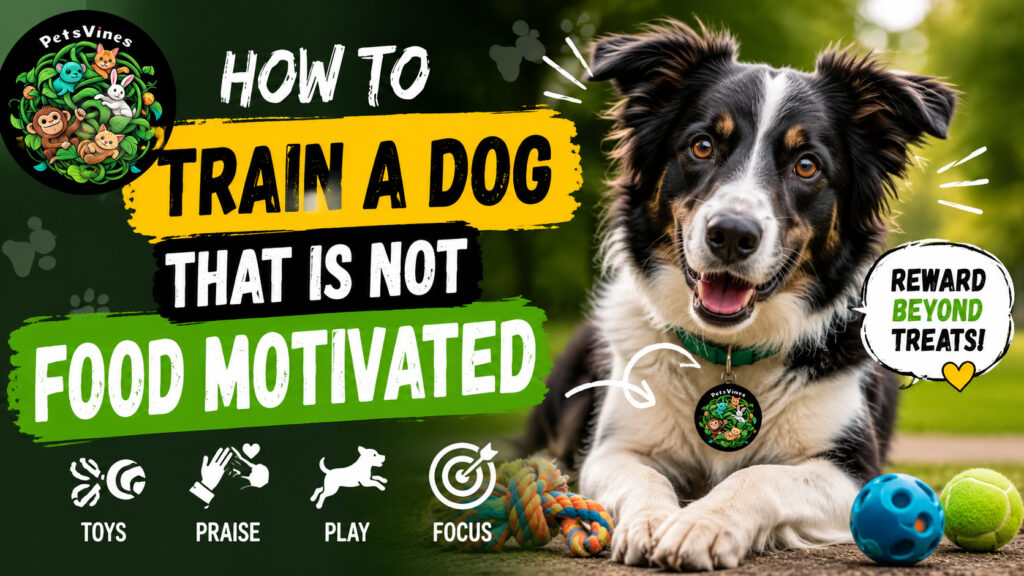
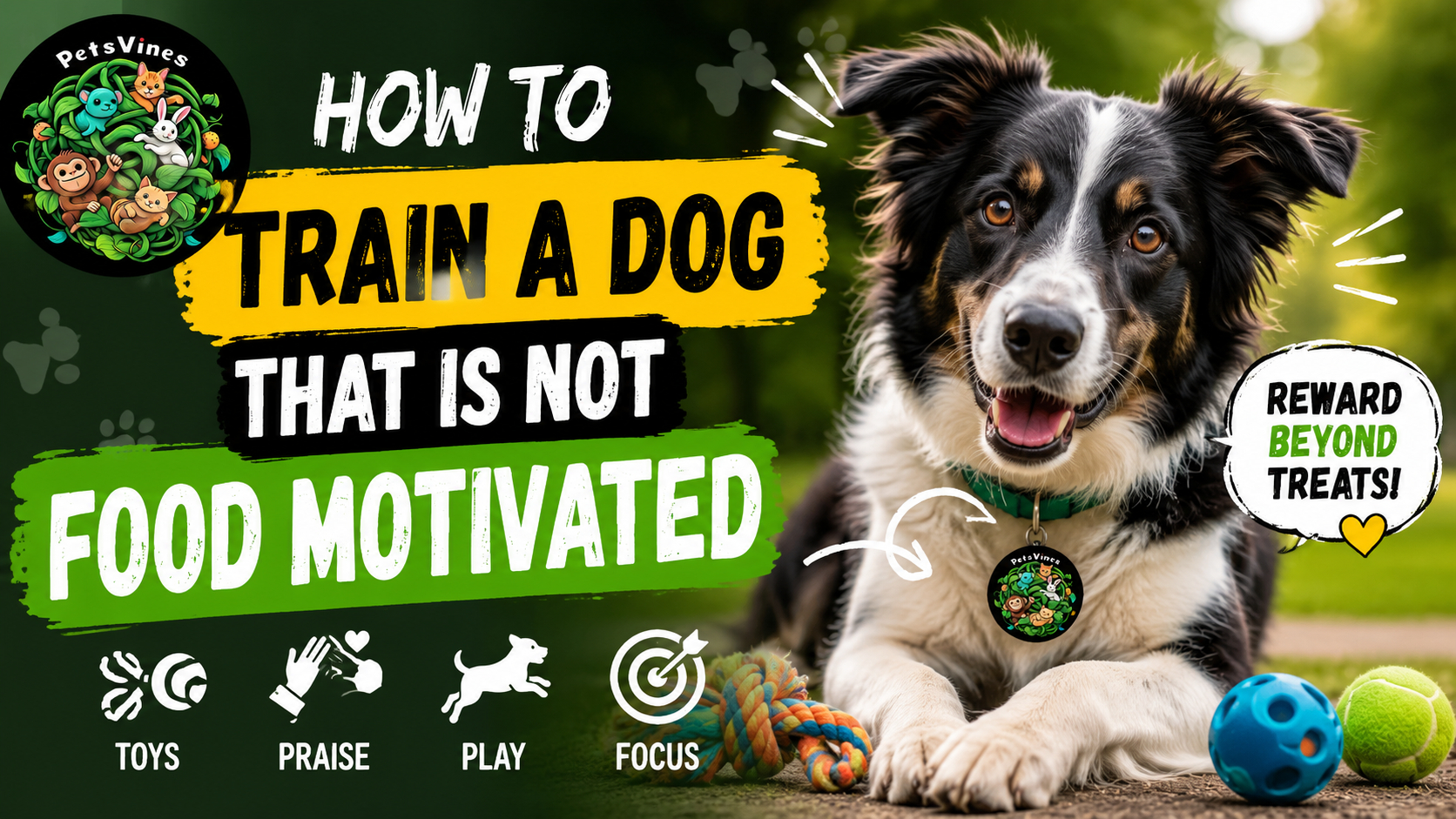
How to train a dog that is not food motivated, identify what your dog does value — such as toys, praise, play, or sniff time — and use that as the reward instead of treats. Combine positive reinforcement with short training sessions, a clear marker (like a clicker or “yes!”), and consistent practice. Understanding why your dog isn’t responding to food is the critical first step.
You’ve got the treats. You’ve got the patience. But your dog? They couldn’t care less about that chicken piece you’re holding up.
If this sounds familiar, you’re not alone. Many pet owners hit this wall and assume their dog is “untrainable” — but that’s rarely true. What it actually means is that you haven’t yet found the right currency for your dog.
The good news: food is just one tool in a large training toolbox. Behavioral modification can be achieved through positive reinforcement techniques that involve praise, play, toys, or affection — and these non-food rewards can be just as effective in encouraging desired behaviors.
In this guide, you’ll learn exactly why some dogs don’t respond to food rewards, how to diagnose the real cause, and nine practical, science-backed strategies to train a dog that is not food motivated — no treats required.
Why Is My Dog Not Food Motivated? (Start Here)
A dog may not be food motivated due to stress, being overfed, underlying illness, breed temperament, or a negative association with food from the past. Ruling out health issues first is essential before changing your training approach.
Before you overhaul your entire training strategy, it’s worth figuring out why your dog is turning their nose up at treats. The reason matters — a lot.
Your Dog May Be Stressed or Overstimulated
Medical illness, pain, gut health, and anxiety can decrease a dog’s desire to eat. When a dog is anxious or overwhelmed — say, in a new environment, a training class, or around strangers — their nervous system goes into a kind of survival mode. Eating becomes irrelevant when their brain is in overdrive.
This is actually one of the most common reasons dogs “suddenly” stop taking treats mid-training session. They were fine at home but shut down at the park. Sound familiar?
Your Dog Might Be Overfed or Free-Fed
The biggest mistake dog owners make is free-feeding — leaving a full bowl of kibble out for their dog at all times. Free-feeding massively reduces a dog’s interest in food. If your dog has unlimited access to their meals, why would a training treat feel special?
Breed Plays a Big Role
Some breeds are simply wired differently. Labradors and Beagles are notorious chowhounds who’ll work enthusiastically for a dry piece of kibble. Terriers, herding breeds like Border Collies, and guardian breeds like Anatolian Shepherds? They’d often rather work, play, or hunt than eat. That’s not a flaw — it’s just their biology.
A Hidden Health Issue Could Be the Culprit
It might not be as simple as your dog not being motivated by food — there could be other contributing factors including health issues. If your dog has always loved treats but has recently gone off them, a vet visit should be your first step — not a new training strategy.
Food Has Been Used to Trick Them
If you’ve ever used food to lure your dog into something unpleasant (like a bath, nail trim, or crate), your dog may have learned that treats predict something scary. In their mind, food = trap. This association can be reversed, but it takes time and patience.
The Science Behind Non-Food Training
Here’s what the research actually says: food is generally preferred by most dogs, but it is by no means the only effective motivator.
A study examining the efficacy of edible and leisure reinforcers with domestic dogs found that, overall, dogs showed a preference for food over leisure items — and food was found to be a more effective reinforcer for behavior compared to leisure items. However, this is a general finding. Individual dogs vary significantly, and for breeds with lower food drive, non-food rewards can be equally or more powerful.
More importantly, research on dog training methods found that owner ratings for their dog’s obedience correlated positively with the number of tasks trained using rewards (p < 0.01), but not with the use of punishment (p = 0.5). What this tells us: the type of reward matters less than the fact that you’re using reward-based training at all.
The American Veterinary Society of Animal Behavior recommends that canine training rely exclusively on reward-based methods — and that reward doesn’t have to be edible.
9 Proven Strategies to Train a Dog That Is Not Food Motivated
1. Find Your Dog’s “Currency”
This is the single most important step. Every dog has something they love — you just need to find it.
Understanding a dog’s individual personality and preferences is key to successful training. Using toys, praise, or physical affection as alternative rewards can significantly enhance their engagement and motivation.
Start by observing your dog when they’re off-leash and free. What do they choose to do? Chase things? Sniff? Dig? Wrestle? That activity is your training currency. Use access to it as the reward.
2. Stop Free-Feeding Immediately
If your dog has a full belly 24/7, food will never feel like a reward. Instead of free-feeding, put a set amount of food out at the same mealtimes every day. After a few minutes, pick up the bowl and put it away until the next mealtime.
Within a few days, your dog will start showing more interest in food — including training treats. This alone solves the problem for a surprising number of “non-food motivated” dogs.
3. Upgrade Your Treat Game
Before abandoning food entirely, try dramatically upgrading the value of what you’re offering.
Rather than feeding treats calmly from your hand, try tossing them to your dog — this is a great way to spark your dog’s play and prey drives. Catching airborne treats, chasing after them as they roll, and snuffling around to find treats with their nose all engage your dog’s natural desire to hunt and scavenge.
Try: real chicken, cheese, deli meat, freeze-dried liver, or sardines. These are orders of magnitude more interesting than a commercial training biscuit.
4. Use Toys as Rewards
For dogs who are more motivated by play than food, find a toy they love and use it as a reward during training sessions — just make sure your dog knows how to drop it on cue.
The key to making toys work as rewards is controlling access. If your dog has access to their favorite tug rope or ball 24/7, it loses its value. Keep the “training toy” put away and only bring it out during sessions. The moment it appears, training begins.
Some dogs will do backflips for a squeaky toy or a ball — use that energy to reinforce behaviors, and keep play sessions short so the toy stays rewarding.
5. Leverage Praise and Physical Affection — the Right Way
Verbal praise works — but only if your dog actually finds it rewarding (not all dogs do), and only if you deliver it with genuine enthusiasm.
Praise works best when paired with enthusiasm — a monotone “good dog” won’t cut it. Think big energy: high-pitched voice, a scratch behind the ears, crouching down to their level. For dogs that are social and people-oriented, this can be extremely powerful.
Watch your dog’s body language after you praise them. Do they wag, jump, lean into you? Good — praise is working. Do they look bored or walk away? Try a different approach.
6. Use Life Rewards (Environmental Rewards)
This is one of the most underused strategies in dog training, and it’s incredibly effective.
A “life reward” is access to something your dog already wants in that moment. Examples:
- Before a walk: ask for a sit — the walk itself is the reward.
- At the dog park: ask for eye contact — letting them run in is the reward.
- Sniffing a mailbox or bush: ask for a heel — then let them sniff for 30 seconds.
Allowing your dog access to things they enjoy as a reward — for example, a short playtime in the yard or access to a favorite mailbox to sniff — can serve as powerful motivation.
The beauty of this approach is that you don’t need anything in your hands. The whole world becomes your training tool.
7. Try Clicker Training
Clicker training is a powerful technique for non-food-motivated dogs because it separates the marker from the reward. You click at the exact moment the dog does the right thing, and then deliver whatever reward works for them — toy, praise, play, or a treat if they’re in the right headspace.
Clicker training is a popular positive reinforcement technique that can be highly effective for dogs that are not food motivated. By pairing the sound of a clicker with a desired behavior, you can communicate to your dog that they have performed correctly, regardless of whether food rewards are used.
The clicker creates clarity — and clarity speeds up learning dramatically. You can substitute “yes!” or a thumbs-up if you don’t have a clicker handy, as long as you’re consistent.
8. Keep Training Sessions Short and High-Energy
Boredom and fatigue are silent killers of a training session. Long, repetitive sessions make both you and your dog checked out.
Train in bursts of 5–10 minutes — long sessions equal a bored, frustrated dog (and human). Leave them wanting more.
End every session on a success. If your dog just aced three “sits” in a row, stop there. You want them to walk away from training thinking: that was fun, I want more of that.
9. Work With Their Instincts, Not Against Them
Herding breeds might love movement, retrievers might love fetch, and sighthounds might go wild for a flirt pole — use what your dog is naturally drawn to.
If you have a terrier, incorporate scent work. If you have a herding dog, teach direction cues and use movement as the reward. If your dog is a retriever who’s inexplicably uninterested in food, a short game of fetch after a successful exercise might be the most powerful reward you can give them.
Training becomes dramatically easier when you stop trying to fit your dog into a generic mold and start working with who they actually are.
Common Mistakes to Avoid
- Training when your dog is distracted or overwhelmed — Set them up for success in low-distraction environments first.
- Using the same reward every single time — Vary rewards to keep motivation high and prevent habituation.
- Repeating commands your dog is already ignoring — If they’re not responding, the environment is too distracting, not the command.
- Ending sessions on failure — Always find a way to finish on a win, even if you have to simplify the exercise.
- Assuming non-responsiveness = stubbornness — It usually means stress, confusion, or the wrong reward.
When to See a Vet or Professional Trainer
If your dog’s lack of food motivation is sudden — especially if they were previously food-driven — rule out medical causes first. Conditions like hypothyroidism, dental pain, nausea, or gastrointestinal issues can all reduce appetite.
If you’ve addressed the basics (meal schedule, stress, health) and still struggling, consider working with a certified positive reinforcement trainer. A professional can observe your dog’s behavior in context and identify motivators you might be missing.
For more in-depth guides on dog behavior, training tips, and breed-specific advice, visit PetsVines Dog Resource Hub — a comprehensive resource for pet owners who want to understand their dogs better.
Putting It All Together
Training a dog that doesn’t care about food can feel frustrating — but it’s also an opportunity. It forces you to build a richer, more creative relationship with your dog based on their unique personality, not a one-size-fits-all approach.
The core principle never changes: reward-based training works. Two separate questionnaire studies found that dogs trained using only positive reinforcement are more obedient than dogs trained with punishment. The reward just needs to be something your dog finds genuinely valuable — and that’s for you to discover together.
Start by identifying their currency. Adjust your feeding schedule. Try a toy or life rewards. Keep sessions short, fun, and consistent. And remember: the goal isn’t to make your dog eat treats — it’s to make training feel worth their time.
That’s a goal every dog can get behind.
FAQ’s
Q: Can any dog be trained without food rewards?
Yes. While most dogs have some food drive, non-food rewards like toys, play, praise, and life rewards can be just as effective when used correctly and consistently.
Q: My dog takes treats at home but refuses them outside. What’s wrong?
Nothing is “wrong” — your dog is likely stressed or overstimulated in outdoor environments. Build focus gradually by training in low-distraction areas and slowly increasing difficulty. Bring higher-value treats for outdoor sessions.
Q: How long does it take to see results with non-food training?
With consistent daily sessions of 5–10 minutes, most dogs show meaningful improvement within 2–4 weeks. Complex behaviors may take longer.
Q: Is clicker training effective for dogs not motivated by food?
Absolutely. The clicker simply marks the correct moment — the reward that follows can be anything your dog values, including toys, praise, or play.
Ready to Become a Better Dog Trainer?
Whether your dog goes crazy for a tennis ball, lives for a good ear scratch, or just needs the right motivation — the tools are out there. The key is understanding your individual dog, not copying someone else’s training plan.
Explore more expert dog care tips, breed guides, and training resources at PetsVines — your go-to destination for everything dog.
Have a question about your specific dog’s behavior? Drop it in the comments — we read every one.
Also Read: Dog Eating Litter Box? Causes, Risks & How to Stop It