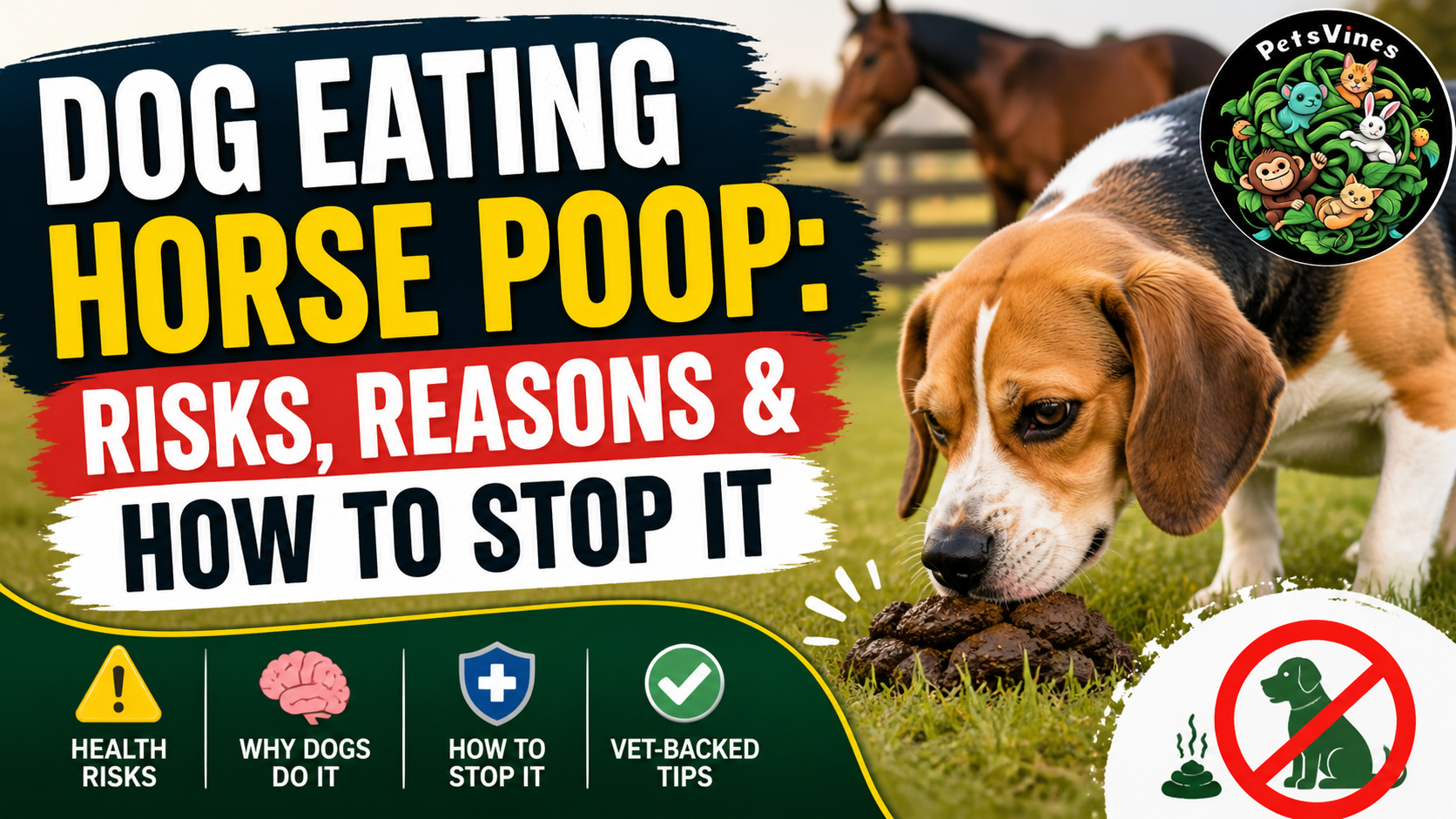
Dog Eating Horse Poop: Is it dangerous for a dog to eat horse poop? In most cases, a small amount of horse manure won’t seriously harm a healthy dog. However, the real danger lies in horse worming medications — particularly ivermectin — which can remain active in manure for up to 14 days after treatment. Certain breeds like Collies, Australian Shepherds, and Shetland Sheepdogs carry a genetic mutation (ABCB1/MDR1) that makes even small doses potentially fatal. Always contact your vet if you’re concerned.
You’re out on a trail ride or a countryside walk, your dog darts ahead — and before you can react, they’re happily munching on a pile of horse droppings. Cue the horror.
If you’ve witnessed this, you’re far from alone. Eating other animals’ feces, a behavior vets call coprophagia, is surprisingly common in dogs. An estimated 23–49% of domestic dogs have been reported to exhibit coprophagic behavior at some point in their lives, according to data published on ScienceDirect.
But when it comes to horse poop specifically, there’s more to worry about than just a bad taste and an awkward moment. The truth is, horse manure can be completely harmless — or it can put your dog in a life-threatening emergency. The difference often comes down to one critical factor: whether those horses have recently been wormed.
In this guide, you’ll learn exactly why dogs eat horse poop, which health risks are serious and which aren’t, what symptoms to watch for, and — most importantly — how to stop this habit before it becomes a dangerous one.
Why Do Dogs Eat Horse Poop?
Dogs eat horse poop because horse manure still contains partially digested grain, fiber, and nutrients that smell intensely appealing to a dog’s nose. Combined with ancient scavenging instincts, boredom, and learned behavior, this habit is surprisingly common — and understanding it is the first step to stopping it.
1. It Smells Like Food to Them
Horses are herbivores with relatively inefficient digestive systems. Their manure retains a significant amount of undigested grain, hay, and plant fiber — all of which smell strongly of food to a dog’s highly sensitive nose. To your dog, a fresh pile of horse dung is basically a fragrant, nutrient-rich snack. Disgusting to us. Completely logical to them.
2. Ancient Scavenging Instinct
Dogs descended from wolves — opportunistic scavengers by nature. In the wild, eating herbivore feces was a reliable source of nutrients, enzymes, and gut bacteria. That ancient instinct hasn’t been completely bred out of domestic dogs, even if their bowl is full at home. Research published in a peer-reviewed study on canine coprophagy found that coprophagic dogs overwhelmingly prefer fresh feces — with 85% consuming stools no more than 2 days old — suggesting this is a deeply ingrained, instinct-driven behavior rather than random opportunism.
3. Nutritional Deficiencies or Poor Absorption
Sometimes coprophagia signals an underlying issue. Dogs with conditions like exocrine pancreatic insufficiency (EPI), inflammatory bowel disease, or nutritional gaps may seek out feces to compensate for what their body isn’t absorbing. Any condition that compromises digestion — including protozoal parasites like Giardia, or pathogenic gut bacteria like Campylobacter and Salmonella — can trigger coprophagia even when a dog appears outwardly healthy. If your dog suddenly starts eating manure when they never did before, a vet check is warranted.
4. Boredom, Anxiety, and Learned Behavior
A 2018 study published in Veterinary Medicine and Science found that around 16% of dogs are classified as “serious” coprophagics — meaning they eat feces six or more times — and that dogs with this behavior were more likely to live in multi-dog households and be described as greedy eaters. Boredom, lack of stimulation, and copying other dogs are all common triggers.
5. Puppies Exploring the World
Puppies are curious oral explorers. Eating feces — including horse poop — is developmentally normal in young dogs and often diminishes as they mature. Nursing mothers naturally consume feces to keep the den clean, and some veterinary scientists believe that infant pets eating poop are naturally helping their body establish healthy gut bacteria.
Is Horse Poop Dangerous to Dogs? Breaking Down the Real Risks
Horse manure itself is not inherently toxic. The primary danger is ivermectin — a chemical found in many equine dewormers — which can remain active in horse feces for up to 14 days after treatment and is potentially lethal to certain dog breeds.
This is the section that matters most. Not all horse poop carries the same risk. The danger profile changes dramatically depending on:
- Whether the horse was recently dewormed
- Which dewormer was used
- Your dog’s breed and genetic makeup
- How much your dog consumed
The Ivermectin Threat: The Hidden Danger in Horse Manure
Ivermectin is one of the most widely used antiparasitic drugs in equine care. It’s effective, affordable, and common — which is exactly what makes it dangerous in this context.
Horse worming treatments containing ivermectin pass the chemical in manure for days after the animal has taken the medication, and there will be a high concentration of ivermectin in the feces in those initial days post-worming.
According to data from Norbrook (makers of Noromectin), levels of ivermectin are strong in horse feces for 3–4 days after dosing, levels in fresh poop break down rapidly in sunlight, and decrease to low by 14 days after dosing in horses and sheep.
A dog that eats this manure is directly ingesting ivermectin — sometimes at surprisingly high doses.
How Much Is Too Much?
Research cited by Equimed found that to consume a toxic dose, a dog would need to eat approximately 14 horse manure “balls” — roughly 1.4 pounds. However, a very small dog of around 5 pounds carrying the ABCB1 mutation would only need to eat 2 balls to receive a toxic dose.
The ABCB1 (MDR1) Gene Mutation: Is Your Breed at High Risk?
Certain dog breeds carry a mutation in the ABCB1 gene (also called MDR1), which affects how their bodies process certain drugs — including ivermectin. In these dogs, ivermectin crosses the blood-brain barrier far more easily, causing neurological toxicity at doses that would be harmless to other breeds.
High-risk breeds include:
- Border Collie
- Rough and Smooth Collie
- Shetland Sheepdog (Sheltie)
- Australian Shepherd
- Old English Sheepdog
- English Shepherd
- Merle Pomeranians
- Long-haired Whippets
A genetic test — available through Washington State University — can identify whether your dog carries the ABCB1 mutation, which is crucial for safe medication use and understanding risk exposure.
Symptoms of Ivermectin Poisoning in Dogs
Symptoms of ivermectin poisoning include dilated pupils, lack of balance, drooling, seizures, vomiting, and disorientation — and typically appear within 4 to 12 hours of ingestion. In severe cases, dogs can experience blindness, inability to rise, and coma.
These symptoms can resemble a stroke. If you suspect ivermectin toxicity, treat it as an emergency. If ingestion is detected within 4–6 hours, a vet may induce vomiting and administer activated charcoal to help reduce absorption. Treatment after that point depends on the severity of symptoms and may involve intravenous fluids, ventilation support, temperature regulation, and medication to control seizures. Ivermectin toxicity cannot be reversed.
A Real Case: Oliver the Australian Shepherd
In April 2014, an Australian Shepherd named Oliver began showing neurological symptoms — drooling, blindness, urinary incontinence, inability to rise — the day after his owner dewormed their horses with an ivermectin product. He was diagnosed with ivermectin toxicity, spent 7 days in the intensive care unit, and his veterinarian believed it could take another couple of weeks before he returned to normal. His case is a stark reminder of how quickly a routine walk near horses can turn dangerous.
Other Health Risks from Horse Manure
Ivermectin gets the most attention — and rightfully so — but it’s not the only concern.
Internal Parasites
Horse manure can harbor equine parasites including roundworms and Strongyles. While many are species-specific and cannot complete their life cycle in dogs, regular parasite prevention for your dog is sound practice regardless.
Bacterial Contamination
Horse feces can contain bacteria such as Salmonella, Campylobacter, and E. coli. Dogs are often resilient and may appear bright and well despite internal effects, but coprophagia increases their risk of contracting gastrointestinal infections and intestinal worms — and also raises the risk of zoonotic infection that can be passed from animals to people.
General Gastrointestinal Upset
Even without toxic chemicals or serious pathogens, eating horse poop can cause your dog a stomach ache, loose stools, or vomiting — especially if consumed in large quantities. Most healthy adult dogs recover without intervention, but it’s a habit worth discouraging firmly.
When Should You Call the Vet?
Don’t wait and see if your dog:
- Is a high-risk breed (Collie, Australian Shepherd, Sheltie, etc.)
- Consumed a large amount of horse manure
- Shows any neurological symptoms — stumbling, dilated pupils, drooling, tremors
- The horses were dewormed within the past 14 days
- Is a puppy or senior dog with a potentially weaker immune system
When in doubt, call your vet immediately. Describe how much was consumed, which horses they were around, and whether you know their deworming history. That information could save critical time.
For trusted, expert-backed dog health content, visit the PetsVines Dog Care Hub — a reliable resource for pet owners worldwide.
How to Stop Your Dog Eating Horse Poop: 7 Proven Strategies
The most effective approach combines consistent “leave it” training, close supervision or leashing near horses, and addressing any underlying nutritional or behavioral triggers. Management is more reliable than supplements alone — and starting early makes all the difference.
1. Train a Rock-Solid “Leave It” Command
This is your single most valuable tool. A well-trained “leave it” can redirect your dog before they even reach the manure. Practice in low-distraction environments first, then build up to real-world scenarios near horses. Reward generously with high-value treats every single time they comply.
2. Keep Your Dog on Lead Near Horses
Prevention is always easier than cure. In areas used by horses, keep your dog on a lead and maintain close physical control. Give them less slack as you approach any manure.
3. Use a Basket Muzzle for Persistent Cases
For dogs who simply cannot resist despite training, a properly fitted basket muzzle is a safe, humane option. It still allows panting and drinking but prevents feces ingestion. Use it as a management tool alongside ongoing training — not as a permanent fix.
4. Know the Horses’ Deworming Schedule
If you regularly walk near stabled or pastured horses, speak to the owner. Knowing when the horses were last wormed allows you to avoid the area during the highest-risk window — the first 14 days post-treatment.
5. Ensure Nutritional Completeness
Rule out deficiencies. Speak to your vet about your dog’s diet, and whether digestive enzyme support might be warranted — particularly if malabsorption is suspected.
6. Increase Mental and Physical Enrichment
A bored dog is a mischievous dog. Increase daily exercise, introduce puzzle feeders, try nose work or agility, and rotate enrichment toys regularly. Experts recommend supervising dogs closely and redirecting their attention immediately when they approach feces, while also keeping their environment clean to reduce opportunities.
7. Consider Taste Deterrents — Realistically
Coprophagia deterrent supplements can theoretically make manure taste unpleasant. However, research found that success in eliminating coprophagia with various behavioral procedures ranged from only 1 to 4% — underlining that no supplement replaces consistent management and training.
Explore more expert-backed dog behavior and care guides at PetsVines — your trusted home for responsible pet ownership.
FAQ’s
Can a dog get worms from eating horse poop?
Technically possible, but most equine parasites are species-specific and cannot complete their lifecycle in dogs. The more pressing concern is chemical toxicity from ivermectin rather than parasite transmission.
My dog ate horse poop and seems fine — should I still call the vet?
If your dog is a non-at-risk breed, consumed a small amount, and the horses weren’t recently dewormed, they’ll likely be fine. Monitor for 12–24 hours. If they’re a herding breed or the deworming status is unknown, call your vet.
How long does ivermectin stay in horse manure?
Highly active for 9–11 days post-dosing, and at reduced but detectable levels until around 14 days. A precautionary window of 2–3 weeks is recommended by some sources.
Is horse poop OK for dogs to eat occasionally?
No. Even if not acutely toxic, it can contain bacteria and parasites — and reinforces a habit that becomes dangerous the moment those horses are dewormed.
What if my dog is obsessed with eating poop in general?
This is coprophagia. Rule out medical causes with your vet first, then pursue behavioral modification with a trainer or veterinary behaviorist. It’s more common than most owners realize.
Key Takeaways
- Horse poop is usually not toxic in small amounts — but this changes completely if the horse was recently dewormed
- Ivermectin is the primary danger: active in manure for up to 14 days, potentially fatal to certain breeds
- Herding breeds (Collies, Aussies, Shelties) carry the ABCB1 mutation that makes them acutely sensitive — even small exposures can be life-threatening
- Act within 4–6 hours of suspected ingestion — that’s the window for effective intervention
- Prevention through training, leashing, and knowing deworming schedules is your best defense
Also Visit: Dog Eating Mouse Poison: Symptoms, Risks & What To Do