
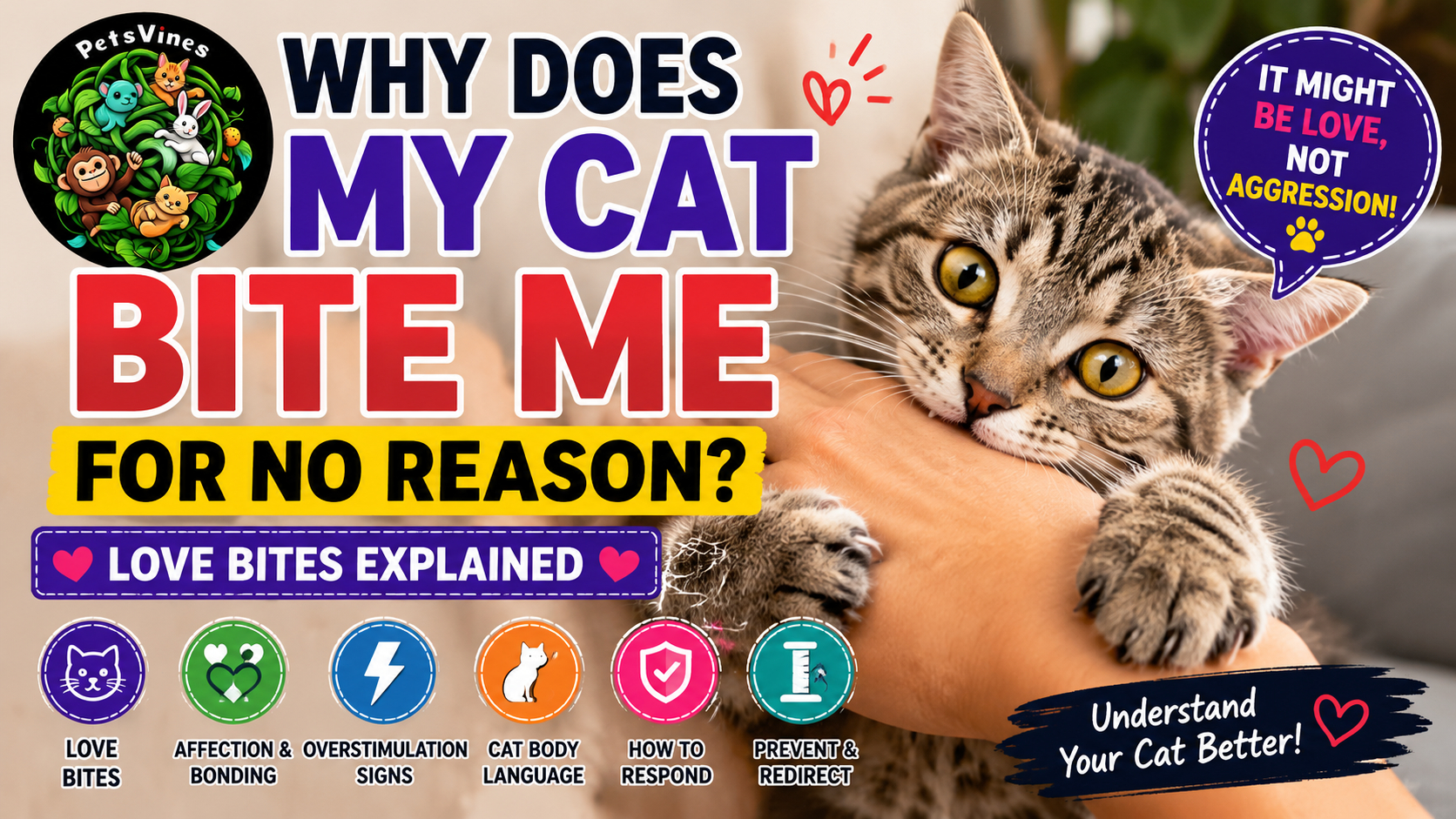
You are sitting with your cat, petting them while they purr on your lap. Everything seems fine. And then, without obvious warning, they turn and bite your hand. It seems random. It seems unprovoked. And it feels like a betrayal of the peaceful moment you were sharing.
Here is the reality: your cat almost certainly gave you warning signs before the bite. You simply did not know what to look for. According to Dr. Elizabeth Colleran, a veterinarian at Chico Hospital for Cats in California, “Cat love bites are a unique form of communication.” Every bite, including the ones that seem to come from nowhere, communicates something specific. Learning to read those pre-bite signals is one of the most practically useful things any cat owner can learn.
For related behavior explanations, also read our guide on what different types of cat purring mean, since purring pattern changes often accompany the warning signs before a bite.
The 5 Types of Cat Bites and What Each Means
1. Love Bites: Affection With Teeth
Love bites are gentle, brief, and do not break the skin. They most commonly occur during mutual grooming sessions where a cat alternates between licking you and nibbling, during petting when the cat turns and mouths your hand without aggression, or during close contact when a cat is deeply relaxed and communicating affection in the same way they would groom another cat.
According to PetMD, updated January 2026, love bites reflect bonding and affection in most cases, though they can also signal the beginning of overstimulation if the petting continues. The bite itself is the cat’s way of saying either “I really like you” in the language of feline mutual grooming, or “I have reached my limit, please pause.” Context and body language distinguish which message is being sent.
2. Overstimulation Bites: The Petting Paradox
This is the most common bite cat owners describe as coming from nowhere. The cat is purring, seemingly content, and then suddenly bites. The truth is that overstimulation bites always have warning signs. They are just subtle, occur over a short window, and are easy to miss if you do not know what you are looking for.
Cats have a petting tolerance threshold that varies significantly between individuals. When cumulative sensory input from petting exceeds this threshold, the cat experiences something similar to sensory overload. The bite is not aggression. It is a desperate communication that the interaction needs to stop right now.
| Warning Sign | What It Looks Like | When It Appears Before Bite |
|---|---|---|
| Tail twitching | Tail tip starts flicking or thumping against the surface | Usually 10-30 seconds before the bite |
| Skin rippling | Visible wave of skin movement along the back during petting | Immediately before bite, often just seconds |
| Ear flattening | Ears rotate sideways or flatten toward the head | 5-15 seconds before bite |
| Head turning | Head swings toward your petting hand | 1-5 seconds before bite, last warning |
| Cessation of purring | Purring abruptly stops mid-session | Often immediately before overstimulation bite |
| Body stiffening | Muscles tense, cat appears to freeze slightly | 5-10 seconds before bite |
The moment any of these signs appear, stop petting. Withdraw your hand slowly and calmly. Do not jerk away suddenly (which can trigger a predatory grab) and do not push the cat off. Simply stop the petting and let the cat reorient. Most cats will relax within 30 to 60 seconds of the stimulation stopping.
Over time, with consistent attention to these signals, most cats expand their petting tolerance because they learn that interaction does not continue past their comfort threshold. Trust is built by respecting the signals, not by ignoring them and continuing to pet.
3. Play Aggression Bites: Hunting Behavior Redirected
Play aggression bites are the unmistakable ones: the cat wraps both front legs around your arm or hand, bites firmly, and begins kicking with their back legs in rapid alternating strikes. This is not a love bite. This is predatory play behavior, the exact sequence a cat uses to bring down prey, redirected onto the nearest available target.
Play aggression is most common in young cats under 2 years old, cats that were not properly socialized with other cats during kittenhood, and cats whose owners have reinforced hand-play by using their hands as toys. Once a cat learns that hands are prey items, unlearning this association takes time and consistency.
How to address play aggression: Stop all hand-play immediately. Never use hands, fingers, or feet as play objects. When play aggression occurs, disengage completely (freeze, then calmly remove yourself from the situation) and resume interaction only after the cat has settled. Redirect all hunting play onto appropriate toys: wand toys, feather toys, and toy mice that allow the cat to complete the hunt cycle of stalk, chase, pounce, and catch. Two interactive play sessions of 15 to 20 minutes per day significantly reduce redirected play aggression.
4. Fear and Defensive Bites
Fear bites occur when a cat feels trapped, threatened, or unable to escape. They are almost always preceded by very visible warning signals that most people recognize even if they do not always respond to them: hissing, growling, raised hackles, a bottle-brush tail, flattened ears, and dilated pupils. A cat displaying these signs is communicating extreme discomfort and the bite follows if the perceived threat does not move away.
The appropriate response to a fearful cat is to give space. Do not try to comfort them by moving closer, which they experience as the threat advancing. Move away, speak calmly in a low voice, and allow the cat to exit the situation and decompress in a safe hiding space. Fearful cats need patience, consistent positive associations, and never forced interaction.
5. Pain-Related Bites
A cat that has never bitten before and suddenly starts biting during handling, particularly when touched in specific areas of the body, may be experiencing pain. According to Catster, “If your cat is hiding more often, being reclusive, or neglecting their care such as grooming, eating, or drinking, they may be experiencing a medical complication that causes them pain.”
Pain conditions commonly associated with sudden bite onset in previously non-biting cats include dental disease (biting during face or jaw petting), arthritis (biting during back or hip touching), urinary tract pain, and general internal pain from conditions like pancreatitis. A sudden change in bite behavior in an adult cat with no previous history of biting warrants a veterinary examination.
What to Do When Your Cat Bites
For love bites and minor bites: Stop the interaction immediately. Do not react loudly or dramatically, as excited reactions can escalate the behavior. Simply freeze briefly and then calmly disengage. Resume interaction after the cat resets.
For play aggression bites: Disengage completely. Do not continue interaction until the cat is calm. Provide a play session with an appropriate toy to channel the hunting energy.
For any bite that breaks the skin: Cat bites are medically significant. According to Dr. Kate KuKanich, a professor of small-animal internal medicine at the College of Veterinary Medicine at Kansas State University, “Cats have especially small teeth and that can cause an injection of bacteria deep into the skin.” Cat bite wounds become infected at a significantly higher rate than dog bites because their narrow teeth create deep puncture tracks that close over the surface while bacteria remain trapped inside. Wash the wound immediately and thoroughly with soap and water and seek medical attention promptly if the wound is deep or if signs of infection develop including redness, swelling, warmth, or fever.
Warning: Cat Bite Wound Care
Never ignore a cat bite that breaks the skin, especially on the hands or fingers. Cat bite infections caused by Pasteurella multocida bacteria can progress rapidly and may require intravenous antibiotics. Wash immediately with soap and water and see a doctor within 24 hours for any puncture wound from a cat bite.
What Never to Do When a Cat Bites
Physical retaliation or punishment, including scolding, grabbing, hitting, scruffing, or spraying with water, consistently makes biting worse rather than better. According to PetMD, physical retaliation can cause the cat to escalate to aggression from fear. The cat does not connect the punishment to the bite. They experience an unpredictable threat from a person they trusted, which increases anxiety, reduces trust, and increases the likelihood of future defensive biting.
FAQs
Why does my cat bite me for no reason?
There is no such thing as a cat bite that truly comes from nowhere. Every bite has a context, a triggering event, and warning signals that preceded it. The five main reasons cats bite are: love bites communicating affection during grooming, overstimulation from prolonged petting exceeding the cat’s sensory threshold, play aggression where hunting instincts are redirected onto hands, fear or defensive biting when a cat feels trapped or threatened, and pain-related biting when handling causes physical discomfort. Learning to read pre-bite body language is the most effective way to prevent bites.
What is the difference between a love bite and an aggressive bite?
Love bites are gentle, brief nibbles that do not break the skin and occur during mutual grooming sequences or relaxed petting, communicating affection in the same way cats groom other cats. Aggressive or overstimulation bites are firmer, break the skin, and are preceded by warning signals including tail twitching, skin rippling, ear flattening, head turning toward the petting hand, and abrupt cessation of purring. Play aggression bites involve the cat wrapping both front legs around the hand and kicking with back legs in a predatory sequence. Context and body language clearly distinguish each type.
What are the warning signs a cat is about to bite?
Six key warning signs appear before an overstimulation bite, typically in this sequence: tail tip twitching or thumping against a surface appears 10 to 30 seconds before the bite, skin rippling visibly along the back appears just seconds before, ear flattening or sideways rotation appears 5 to 15 seconds before, the head swings toward your petting hand 1 to 5 seconds before as a final warning, purring abruptly stops immediately before the bite, and the body stiffens with muscles tensing 5 to 10 seconds before. The moment any of these signs appear, stop petting and calmly withdraw your hand.
Why does my cat bite me and then lick me?
Biting followed by licking is classic love bite behavior, the exact sequence cats use during mutual grooming with other cats. The bite and lick together communicate affection and social bonding. The bite signals the end of one phase of grooming and the lick provides social reassurance. This sequence almost always indicates positive relationship dynamics and genuine affection rather than aggression or irritation.
Why does my cat bite my ankles when I walk by?
Ankle ambushing is predatory play behavior triggered by the movement of feet and ankles, which mimic the movement of small prey animals from a cat’s hunting perspective. It is most common in young cats with insufficient play outlets for their hunting instincts. The solution is increasing daily interactive play sessions with appropriate wand toys to channel hunting energy before it gets redirected onto moving feet. Never react by running away, which further simulates fleeing prey behavior and reinforces the ambush.
Why does my cat bite during petting even though they were purring?
This is the overstimulation bite, which occurs when cumulative sensory input from prolonged petting exceeds the cat’s individual tolerance threshold, creating a sensory overload response. The purring does not guarantee contentment throughout a petting session. Cats have varying petting tolerance limits, and the bite is a desperate communication that the interaction must stop immediately. With consistent attention to pre-bite warning signals and stopping before the threshold is reached, most cats gradually expand their petting tolerance as they learn that interaction is reliably paused before it becomes overwhelming.
What should I do immediately after my cat bites me?
For love bites and minor bites that do not break the skin, stop the interaction immediately without reacting loudly or dramatically, freeze briefly, then calmly disengage and allow the cat to reorient. For play aggression bites, disengage completely and redirect hunting energy onto an appropriate toy. For any bite that breaks the skin, wash the wound immediately and thoroughly with soap and water and seek medical attention promptly, particularly for deep puncture wounds on the hands or fingers, as cat bite infections can progress rapidly.
Are cat bites medically serious?
Yes. Cat bites that break the skin are medically significant and should never be ignored. Cats have narrow teeth that create deep puncture tracks which close over the surface while bacteria remain trapped inside, causing infections at a significantly higher rate than dog bites. Cat bite infections caused by Pasteurella multocida bacteria can progress rapidly and may require intravenous antibiotics. Any puncture wound from a cat bite warrants washing immediately with soap and water and a doctor visit within 24 hours, especially for bites on the hands or fingers.
Why does my cat bite me when I touch certain parts of their body?
A cat that has never bitten before and suddenly starts biting during handling, particularly when touched in specific areas, may be experiencing pain in that region. Common pain conditions associated with sudden bite onset include dental disease when the face or jaw is touched, arthritis when the back or hips are handled, urinary tract pain, and internal conditions such as pancreatitis. A sudden change in bite behavior in a previously non-biting adult cat always warrants a veterinary examination to identify and treat the underlying medical cause.
What should I never do when my cat bites me?
Never physically retaliate or punish a biting cat through scolding, grabbing, hitting, scruffing, or spraying with water. Physical retaliation consistently makes biting worse rather than better. The cat does not connect the punishment to the bite and instead experiences an unpredictable threat from a trusted person, which increases anxiety, erodes trust, and significantly increases the likelihood of future defensive biting. Calm disengagement and addressing the underlying cause of the bite are always more effective than any form of punishment.
How do I stop my cat from biting me during play?
Stop all hand-play immediately and permanently. Never use hands, fingers, or feet as play objects with a cat. When play aggression occurs, disengage completely by freezing and then calmly removing yourself until the cat has settled. Redirect all hunting play onto appropriate toys including wand toys, feather toys, and toy mice that allow the cat to complete the full predatory sequence of stalking, chasing, pouncing, and catching. Two interactive play sessions of 15 to 20 minutes per day significantly reduce redirected play aggression by giving hunting instincts an appropriate outlet.
For more cat behavior guides, explore the full PetsVines Cat Care hub.
Also Visit: Cat age calculator