
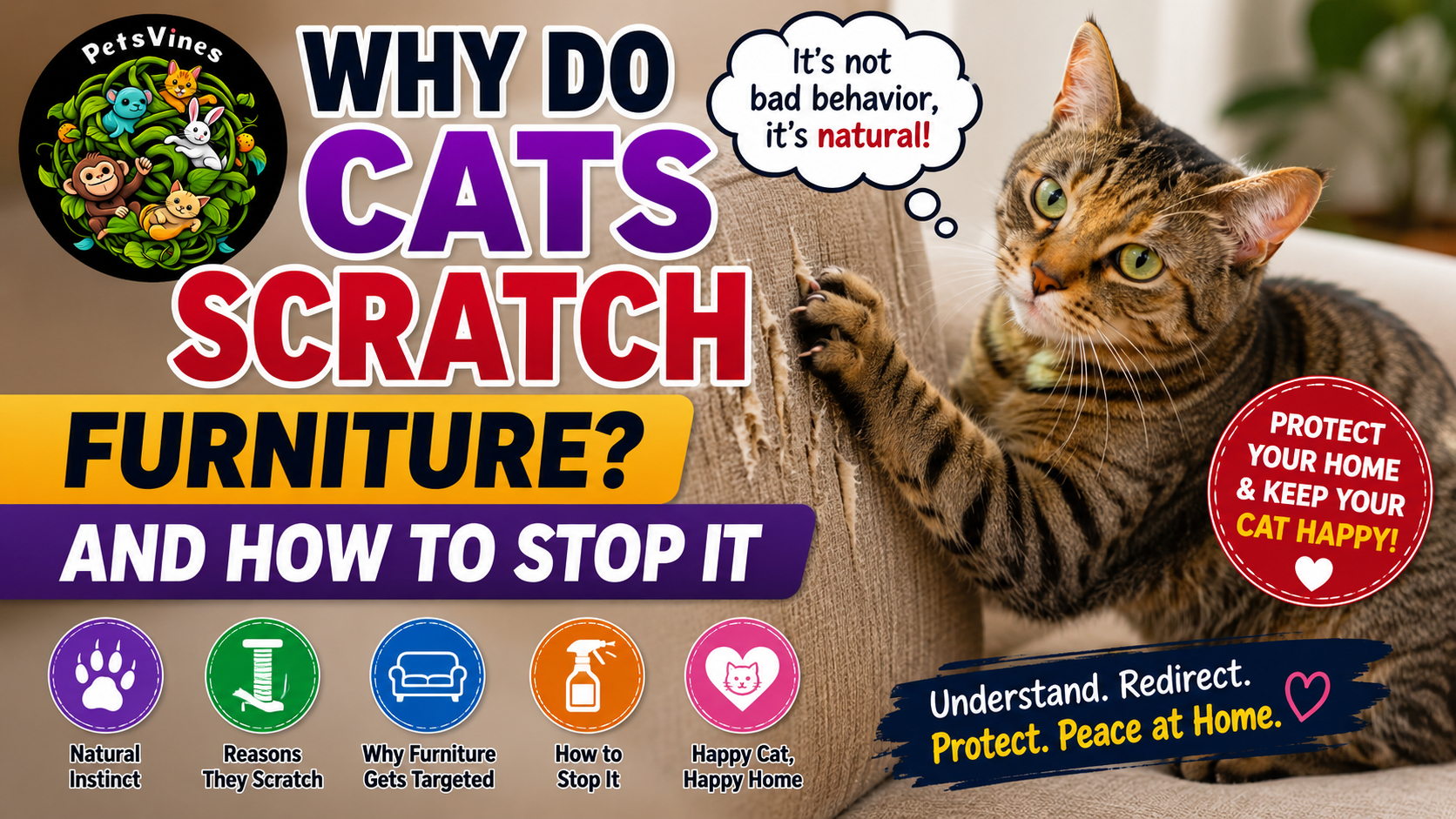
You hear the unmistakable sound of claws meeting fabric, look up, and see your cat working over the corner of your sofa with focused determination. It is one of the most common sources of frustration between cats and their owners, and one of the most frequently misunderstood behaviors in the feline repertoire.
The important thing to understand before doing anything else is this: your cat is not being spiteful. Your cat is not defying you. Your cat is not doing something wrong. Scratching is as natural and necessary to a cat as stretching is to a human. The problem is never the scratching itself. The problem is the choice of surface. And that is a problem you can solve.
Why Cats Scratch: The 4 Biological Reasons
1. Claw Maintenance
A cat’s claws are retractable, which means they spend most of their time protected inside sheaths with minimal contact with hard surfaces. Unlike a dog’s claws, which are worn down naturally by walking on hard ground, a cat’s claws do not self-maintain through normal activity. Scratching serves as the primary mechanism by which cats remove the dead outer sheath of each claw, revealing the new, sharper claw beneath. Without access to appropriate scratching surfaces, claws can become overgrown, curl inward, and cause pain or difficulty walking. This is why declawing, beyond its documented harm, also removes the cat’s primary claw maintenance tool.
2. Territorial Marking
Cats have specialized scent glands located in the pads of their paws that release pheromones when pressure is applied. Scratching deposits both a visual mark (the physical scratches on a surface) and a chemical mark (the pheromone signature) that communicate territorial ownership to other cats. According to PetMD, this pheromone contains information about a cat’s health, sex, and breeding status. This is why cats specifically target prominent surfaces in high-traffic areas of the home: near entrances, near sleeping spots, and in front of their preferred people. These locations are not random. They are strategically chosen for maximum territorial communication impact.
3. Full-Body Stretching
When a cat scratches a vertical surface, they extend their front legs fully upward and push their claws into the material, stretching the muscles and tendons of the legs, shoulders, and back simultaneously. This is why cats scratch so frequently immediately after waking from sleep, when muscles need to be re-engaged after a period of inactivity. The scratch-stretch combination is the feline equivalent of a morning yoga routine: it maintains flexibility, promotes circulation, and prepares the musculoskeletal system for activity. Denying a cat scratching opportunities denies them this essential physical maintenance.
4. Emotional Expression and Stress Management
Cats also scratch in response to emotional states. Excitement, frustration, anxiety, and stress all trigger increased scratching behavior. Indoor cats with limited environmental enrichment, cats in multi-cat households with tension, and cats responding to environmental changes like moving or new people in the home, all scratch more intensely as a stress-management behavior. This emotional dimension of scratching means that addressing underlying anxiety or enrichment deficits is sometimes as important as providing scratching surfaces.
Why Cats Choose Furniture Specifically
Understanding why cats choose your furniture over other surfaces explains why the placement and material of scratching posts matters so much. Cats choose scratching surfaces based on several specific criteria:
- Stability: Cats need a surface that does not move when they push against it. A wobbling scratching post is one of the most common reasons cats abandon it. Your sofa is heavy, stable, and goes nowhere when scratched, making it mechanically ideal.
- Texture: Cats prefer surfaces that provide satisfying resistance and allow the claw to catch and drag. Upholstery fabrics, sisal-textured materials, and wood all meet this criterion. Cheap carpet-covered posts often do not provide enough resistance.
- Height: For a full stretch, cats need a scratching surface tall enough to allow complete front leg extension. Most commercially available cat scratching posts are too short for an adult cat to scratch with a full stretch. Posts should be at minimum 28 to 32 inches tall.
- Location: Cats preferentially scratch in socially significant locations: near entrances, near sleeping spots, and in areas where they spend time with their people. A scratching post hidden in a back room away from where the cat normally spends time will be ignored in favor of the centrally located sofa.
How to Redirect Cat Scratching to Appropriate Surfaces
Redirection is the only effective long-term strategy. Punishment does not work because it does not address the underlying biological need, and it damages the trust between you and your cat. The goal is making the appropriate scratching surfaces more attractive than the furniture.
Step 1: Choose the Right Scratching Post
Sisal-covered posts are the most universally preferred scratching material among cats. Sisal rope provides the texture, resistance, and satisfying drag that cats look for in a scratching surface. Look for a post that is at minimum 28 to 32 inches tall, heavy enough to remain stable when used with force, and has a wide, stable base. Many cats also appreciate horizontal scratching pads made of corrugated cardboard, which serve different scratching positions and can be placed near furniture that is currently being targeted.
Step 2: Place Posts Strategically
Position new scratching posts directly next to the furniture currently being targeted. This is the single most important placement decision. The cat is scratching the sofa corner for territorial and convenience reasons. A post nearby gives them an equally prominent alternative in the exact location they want to scratch. Once the post is being used consistently, it can be gradually moved to a more convenient permanent location if needed, moving it one foot at a time over several weeks.
Step 3: Make the Post Appealing
Rub dried catnip into the sisal surface of a new post. Play near the post with a wand toy, allowing the cat to reach up against the post during play. Reward with treats and praise immediately when the cat uses the post. Never force a cat’s paws onto a post, as this can create an aversive association with the exact surface you want them to use.
Step 4: Deter Furniture Scratching Gently
While building the new scratching habit, protect targeted furniture with temporary deterrents. Plastic furniture protectors applied to the most-scratched corners work well. Double-sided sticky tape (cats dislike the tacky sensation on their paws) applied to fabric surfaces discourages scratching in those spots. Feliway Classic diffuser or spray (synthetic feline facial pheromone) applied to previously scratched surfaces reduces the cat’s felt need to re-mark them, as the pheromone signals that the territory has already been marked.
Never use punishment such as spraying with water, loud noises, or physical correction. These approaches do not teach the cat where to scratch. They only teach the cat to scratch when you are not watching.
What Never to Do
Warning: Never Declaw Your Cat
Declawing is the surgical amputation of the last bone of each toe. It is not a nail trim. The AVMA, AAFP, and the veterinary associations of most countries oppose declawing because it causes chronic pain, permanently alters gait mechanics, increases the likelihood of litter box avoidance, and creates behavioral issues including increased biting aggression. It is banned in the UK, Australia, and many other countries. Regular nail trimming and appropriate scratching post provision are the ethical alternatives.
FAQs
Why do cats scratch furniture?
Cats scratch furniture because scratching serves four essential biological functions: removing the dead outer claw sheath to expose sharp new claws, depositing territorial scent and visual marks through pheromone glands in the paws, stretching the muscles and tendons of the legs, shoulders, and back, and managing emotional states including excitement, anxiety, and stress. Scratching is a fundamental biological need, not spiteful or defiant behavior. The problem is never the scratching itself but the choice of surface.
Why does my cat scratch right in front of me?
Scratching in front of you is a social communication behavior, not defiance. Cats scratch in prominent locations to communicate territorial ownership, and you are one of the most important features of their social environment. Scratching in front of you is communicating to you, and to imagined competitors, that this space and this person belong to them. It is a sign of how significant you are to your cat’s sense of territory, not a challenge to your authority.
Why does my cat aggressively scratch new furniture?
New furniture represents unmarked territory to a cat. According to VCA Animal Hospitals, cats that scratch only new objects or furniture are likely marking previously unscented territory. This behavior typically passes once the cat has established ownership of the new item through repeated scent marking via the pheromone glands in their paws. It is not destructiveness but rather the cat’s instinctive process of registering the new item as part of their established territory.
Why does my cat ignore the scratching post?
The most common reasons cats ignore scratching posts are that the post is too short to allow a full front leg extension, the post wobbles when used with force making it feel unstable, the post is placed in a low-traffic or isolated location away from where the cat spends time, or the material does not provide satisfying resistance and texture. Try a taller sisal-covered post of at least 28 to 32 inches placed directly next to the furniture currently being targeted, rub catnip into the surface, and play near the post to encourage initial contact.
What type of scratching post do cats prefer?
Sisal-covered posts are the most universally preferred scratching material among cats. Sisal rope provides the texture, resistance, and satisfying drag that cats seek in a scratching surface. The post must be at minimum 28 to 32 inches tall to allow a full-body stretch, heavy enough to remain completely stable when used with force, and have a wide stable base. Many cats also appreciate horizontal corrugated cardboard scratching pads alongside vertical posts, as individual cats have strong preferences for one orientation or the other.
Where should I place a scratching post to stop furniture scratching?
Place new scratching posts directly next to the furniture currently being targeted. This is the single most important placement decision. The cat is scratching the sofa corner for territorial and convenience reasons, so a post in the exact same prominent location gives them an equally visible alternative. Once the post is being used consistently, it can be gradually moved one foot at a time over several weeks if a different permanent location is preferred. A post hidden in a back room or low-traffic area will always be ignored in favor of centrally located furniture.
How do I make my cat use a scratching post instead of furniture?
Rub dried catnip into the sisal surface of the new post to make it immediately appealing. Play with a wand toy near the post, allowing the cat to reach up against it naturally during play. Reward with treats and verbal praise immediately every time the cat uses the post. Simultaneously apply temporary deterrents to targeted furniture such as double-sided sticky tape or plastic furniture protectors on the most-scratched corners. Never force a cat’s paws onto the post as this creates an aversive association with the surface you want them to use.
Can I use a spray bottle to stop my cat scratching furniture?
No. Spray bottles are not an effective training tool for cats according to behavioral research. They teach the cat to avoid scratching when you are present, not to stop the behavior entirely, and they create anxiety and fear that can damage your relationship with your cat. Cats punished with spray bottles simply learn to scratch when you are not watching rather than redirecting to appropriate surfaces. Environmental management, strategic post placement, and positive reinforcement are consistently more effective approaches.
How many scratching posts does a cat need?
A general guideline is one scratching post per cat plus one additional. In multi-cat households, each cat should have access to at least one scratching post without having to navigate past another cat to reach it. Both vertical and horizontal scratching options should be available as individual cats have strong preferences for one orientation. Providing variety in height, texture, and orientation gives each cat the best chance of finding a post that fully satisfies their specific scratching preferences.
Should I trim my cat’s nails to stop furniture scratching?
Yes, regular nail trimming significantly reduces the damage from scratching without eliminating the behavior itself. Trimmed nails catch less in fabric and cause less structural damage when used on furniture. However, nail trimming alone does not address the underlying biological need to scratch, so it should be combined with appropriate scratching post provision and strategic placement for the most effective long-term approach.
Is declawing a solution for furniture scratching?
No. Declawing is the surgical amputation of the last bone of each toe, not a nail trim. The AVMA, AAFP, and veterinary associations of most countries oppose declawing because it causes chronic pain, permanently alters gait mechanics, increases the likelihood of litter box avoidance, and creates behavioral problems including increased biting aggression. It is banned in the UK, Australia, and many other countries. Regular nail trimming and appropriate scratching post provision are the ethical and effective alternatives that address the behavior without harming the cat.
Working With Your Cat’s Nature, Not Against It
Scratching is not a problem to be solved by eliminating it. It is a biological need to be met by directing it. The cat that shreds your sofa is not a bad cat. They are a cat whose needs are not being met by the current environment. Provide appropriate surfaces, place them strategically, make them appealing, and protect furniture during the transition. Most cats redirect completely within 2 to 4 weeks of a well-implemented strategy.
For more cat behavior guides and practical care resources, explore the full PetsVines Cat Care hub.
Also Visit: Why Do Cats Knead? What Your Cat Is Really Saying