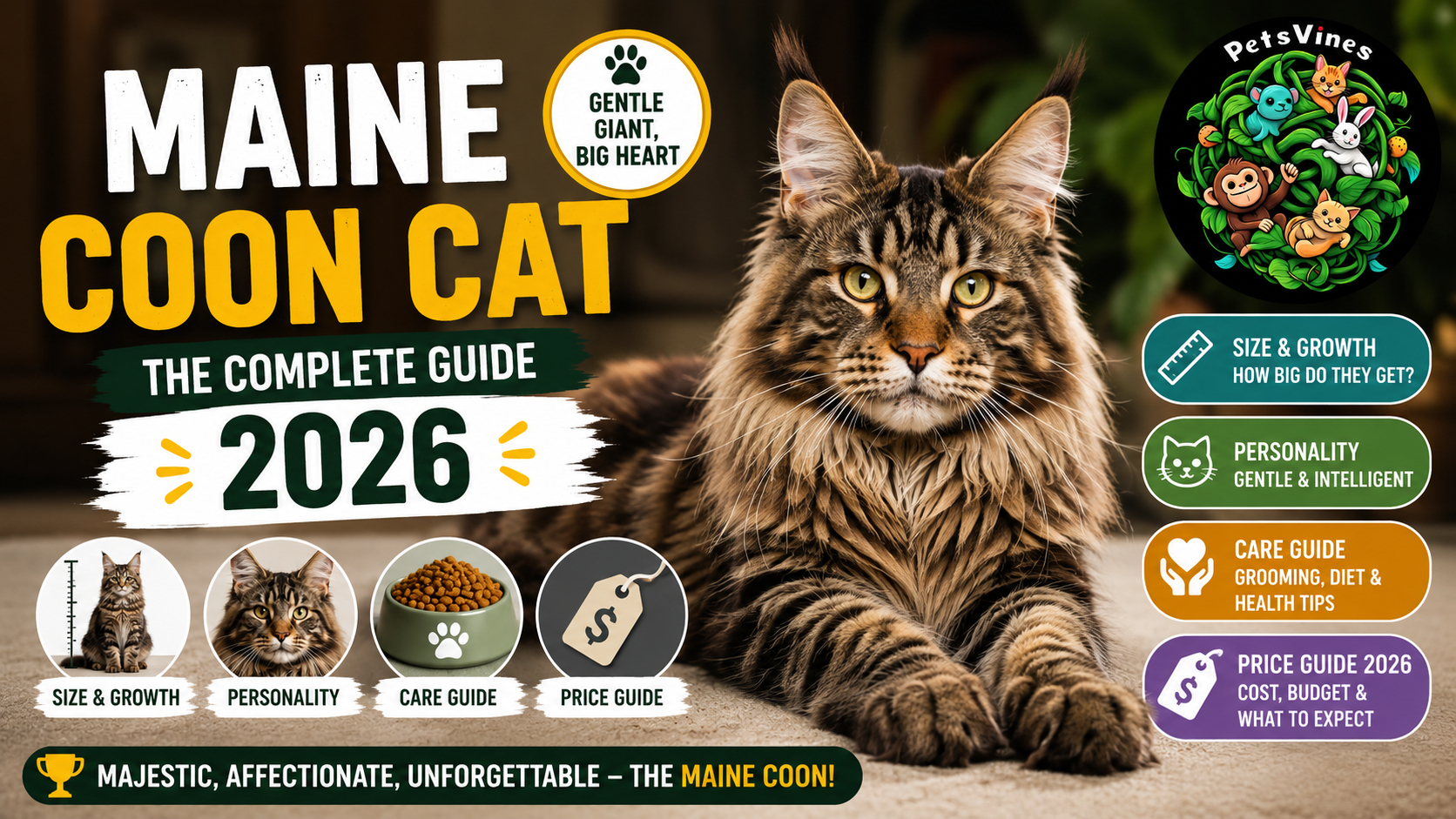
| Origin | United States (Maine) |
| Size | Large |
| Weight | Males 15-25 lbs, Females 10-15 lbs |
| Length | Up to 40 inches nose to tail |
| Lifespan | 12-15 years |
| Coat | Long, thick, shaggy, water-resistant |
| Temperament | Affectionate, playful, dog-like, sociable |
| Price (breeder) | $800 to $2,500 |
| Grooming | High – 2-3x weekly brushing |
| Good with children | Yes |
| Good with other pets | Yes |
| Activity level | Moderate to high |
There is no cat breed quite like the Maine Coon. Part dog, part cat, part woodland creature, this magnificent animal has a way of completely redefining what people expect from a feline companion. When you first meet one, the size alone is staggering. Then they follow you into the kitchen, chirp a greeting, and promptly drape themselves across your keyboard, and you understand exactly why they are consistently one of the most searched and most adopted purebred cats in the world.
This guide covers everything you genuinely need to know before bringing a Maine Coon home: how big they actually get, what their personality is really like to live with day to day, what their specific care needs are, and what to expect financially.
If you are still deciding on a breed, also read our guide to best cat breeds for first-time owners for a broader comparison across popular breeds.
Maine Coon Size: How Big Do They Really Get?
The Maine Coon is officially recognized as one of the largest domestic cat breeds in the world. According to Catster, male Maine Coons weigh on average 18 to 22 pounds at full maturity, though some individuals reach 25 pounds. Females are smaller, averaging 12 to 15 pounds. In terms of length, Maine Coons typically range from 30 to 40 inches from nose tip to tail tip, with the world record held by a Maine Coon at 47.28 inches, recognized by the Guinness World Records.
What surprises many new owners is how slowly Maine Coons grow. Unlike most cat breeds that reach adult size at 12 months, Maine Coons continue developing until they are 3 to 5 years old. This means you may bring home a kitten that seems large already, only to watch them keep growing for years. Plan your furniture, carriers, and litter boxes accordingly from the start.
| Measurement | Male Maine Coon | Female Maine Coon |
|---|---|---|
| Weight at maturity | 15 to 25 lbs (6.8 to 11.3 kg) | 10 to 15 lbs (4.5 to 6.8 kg) |
| Height at shoulder | 10 to 16 inches | 8 to 14 inches |
| Length (nose to tail) | 19 to 40 inches | 18 to 35 inches |
| Age at full maturity | 3 to 5 years | 3 to 4 years |
Maine Coon Personality: What It Is Really Like to Live With One
Maine Coons are frequently described as dog-like and this comparison is genuinely apt rather than hyperbolic. They tend to follow their owners from room to room, greet people at the door, and show an active interest in whatever you are doing. Unlike many independent cat breeds, Maine Coons seek engagement and companionship rather than merely tolerating human presence.
- Highly sociable: Maine Coons generally enjoy the company of family members, children, and even well-introduced dogs. They are one of the few breeds that routinely adapt well to multi-pet households.
- Playful well into adulthood: Unlike many breeds that become sedentary as adults, Maine Coons retain kitten-like playfulness throughout much of their lives. Interactive toys, wand toys, and puzzle feeders keep them engaged.
- Vocal but not loud: Maine Coons are known for their distinctive chirping and trilling vocalizations rather than loud persistent meowing. Many owners find their sounds endearing rather than intrusive.
- Intelligent and trainable: Maine Coons can learn to walk on a leash, play fetch, and respond to commands. This trainability makes them an excellent choice for owners who want more engagement than a typical cat provides.
- Water curious: Many Maine Coons are fascinated by water and will investigate dripping taps, splash in water bowls, or follow you into the bathroom. Their thick semi-water-resistant coats evolved partly for life in the cold wet climate of Maine.
Maine Coon Care Requirements
Grooming
The Maine Coon coat is long, thick, and highly prone to matting if not brushed 2 to 3 times per week. A stainless steel comb or slicker brush works well for daily maintenance, with a wider-toothed comb for working through the ruff and tail. Pay particular attention to areas behind the ears, under the armpits, and along the belly where the fur is longest and most prone to tangles.
The good news is that Maine Coon fur has a silky texture that is less prone to matting than breeds like Persians. With consistent brushing, most Maine Coon owners find the grooming process manageable and bonding rather than burdensome. For a complete grooming guide, see our article on how to groom a cat at home.
Diet and Feeding
A cat of this size needs appropriately sized portions. Maine Coons have higher caloric needs than average domestic cats due to their size and activity level. Adult males may need 300 to 400 calories per day depending on activity level. A high-quality protein-forward food appropriate for large breed cats is ideal. Many owners feed a mix of high-protein dry food and wet food to support hydration. See our full guide on how much to feed a cat by weight for portion calculations.
Exercise and Enrichment
Maine Coons need regular active play. Two interactive play sessions of 15 to 20 minutes per day are recommended using wand toys, laser pointers, or interactive puzzle toys. A tall, sturdy cat tree is essential because Maine Coons love to climb and observe from height. Standard cat trees may not accommodate their size: look for trees rated for 25 pounds or more with wide, stable platforms.
Maine Coon Health Issues
Hypertrophic cardiomyopathy (HCM): The most significant health concern in Maine Coons. HCM causes thickening of the heart muscle. A genetic mutation linked to HCM in Maine Coons (the MyBPC3 mutation) can be tested via DNA. Reputable breeders test breeding cats and should provide documentation. Annual echocardiograms from age 2 onwards are recommended by veterinary cardiologists for all Maine Coons.
Hip dysplasia: More common in Maine Coons than in most domestic breeds due to their size. Maintaining a healthy weight significantly reduces the impact.
Spinal muscular atrophy (SMA): A genetic condition causing muscle weakness. DNA testing can identify carriers. Responsible breeders test for this condition.
Polycystic kidney disease (PKD): Formation of fluid-filled cysts in the kidneys. Also testable via DNA before breeding.
Tip: Always Ask Breeders for Health Test Results
A reputable Maine Coon breeder will readily provide DNA test results for HCM, SMA, and PKD for both parents. They will also schedule echocardiograms for breeding cats. If a breeder cannot provide these documents, walk away.
Maine Coon Price: What to Expect in 2026
| Source | Price Range 2026 | Notes |
|---|---|---|
| Reputable breeder (pet quality) | $800 to $2,000 | Includes health tests, vaccinations, microchip |
| Reputable breeder (show quality) | $2,000 to $2,500+ | Champion bloodlines, full pedigree documentation |
| Rescue or breed-specific shelter | $100 to $400 | Patience required, usually adults not kittens |
| Backyard breeder (avoid) | Often below $800 | Likely no health testing, higher long-term vet costs |
Is a Maine Coon Right for You?
The Maine Coon is an excellent choice for families with children, households with other cats or cat-friendly dogs, owners who want an engaged and interactive companion, and people comfortable with moderate-to-high grooming commitment. They are not ideal for owners who travel frequently without arranging company for them, those who want an independent low-maintenance cat, or very small living spaces where a large active cat would feel confined.
FAQs
How big do Maine Coon cats get?
Maine Coons are one of the largest domestic cat breeds in the world. Males typically weigh 15 to 25 pounds at full maturity and can reach 30 to 40 inches in length from nose to tail tip. Females are smaller, averaging 10 to 15 pounds. The Guinness World Record for the longest domestic cat is held by a Maine Coon at 47.28 inches.
How long does it take for a Maine Coon to be fully grown?
Maine Coons reach full adult size at 3 to 5 years of age, making them one of the slowest-maturing domestic cat breeds. Unlike most breeds that reach adult size at 12 months, Maine Coons continue developing muscle mass and filling out for years after their first birthday. Plan your carriers, litter boxes, and cat furniture for their eventual adult size from the start.
What is the personality of a Maine Coon like?
Maine Coons are frequently described as dog-like, and the comparison is genuinely accurate. They tend to follow their owners from room to room, greet people at the door, and take an active interest in daily activities. They are highly sociable with family members, children, and other pets, playful well into adulthood, intelligent and trainable, and known for distinctive chirping and trilling vocalizations rather than loud meowing.
Are Maine Coons good for first-time cat owners?
Yes, Maine Coons are generally an excellent choice for first-time cat owners who want an engaged social companion. Their tolerant temperament, adaptability, and eagerness to interact make them forgiving of owners still learning cat communication. The main commitments to be aware of are the 2 to 3 times weekly grooming requirement and the need for regular daily interactive play sessions.
Are Maine Coons good with children and other pets?
Yes, Maine Coons are one of the top recommended breeds for families with children. Their patient, tolerant temperament means they generally handle the noise and unpredictability of children better than most other breeds. They also adapt well to multi-pet households and are one of the few cat breeds that routinely get along with well-introduced dogs.
How much grooming does a Maine Coon need?
Maine Coons require brushing 2 to 3 times per week to prevent matting in their long, thick coat. A stainless steel comb or slicker brush works well for regular maintenance, with a wider-toothed comb for the ruff and tail. Areas behind the ears, under the armpits, and along the belly need particular attention as these are most prone to tangles. The good news is that Maine Coon fur has a silky texture that is less prone to matting than breeds like Persians.
How much does a Maine Coon cost in 2026?
From a reputable breeder, a pet-quality Maine Coon costs between $800 and $2,000, while show-quality cats with champion bloodlines range from $2,000 to $2,500 or more. Breed-specific rescues offer Maine Coons for $100 to $400, though adults are more common than kittens. Avoid breeders selling below $800 as this often indicates no health testing, which leads to significantly higher veterinary costs long term.
What health problems are Maine Coons prone to?
The four most significant health concerns are hypertrophic cardiomyopathy (HCM), a heart muscle thickening condition with a testable genetic mutation; hip dysplasia, which is more common in Maine Coons due to their size; spinal muscular atrophy (SMA), a genetic condition causing muscle weakness; and polycystic kidney disease (PKD), causing fluid-filled kidney cysts. All four conditions have DNA tests available, and reputable breeders test all breeding cats for them.
What should I ask a Maine Coon breeder before buying?
Always request DNA test results for HCM, SMA, and PKD for both parents, along with echocardiogram records for the breeding cats. Reputable breeders will provide these documents readily. Veterinary cardiologists recommend annual echocardiograms for all Maine Coons from age 2 onwards. If a breeder cannot provide health documentation, do not purchase from them regardless of price or convenience.
Do Maine Coons need a lot of space?
Maine Coons do well in apartments as long as they have adequate vertical space through a tall, sturdy cat tree, regular interactive play sessions, and consistent company. They are active cats but their activity tends to come in bursts rather than continuously. A tall cat tree rated for 25 pounds or more with wide stable platforms is essential. An enriched indoor environment matters far more than raw square footage.
How much should I feed a Maine Coon?
Maine Coons have higher caloric needs than average domestic cats due to their large size and active nature. Adult males may need 300 to 400 calories per day depending on activity level. A high-quality protein-forward food appropriate for large breed cats is recommended, and many owners feed a combination of high-protein dry food and wet food to support both nutrition and hydration.
For more cat breed guides and care resources, explore the PetsVines Cat Care hub.
ALSO VISIT: Best Cat Food for Indoor Cats 2026: Low-Calorie, High-Protein Picks