
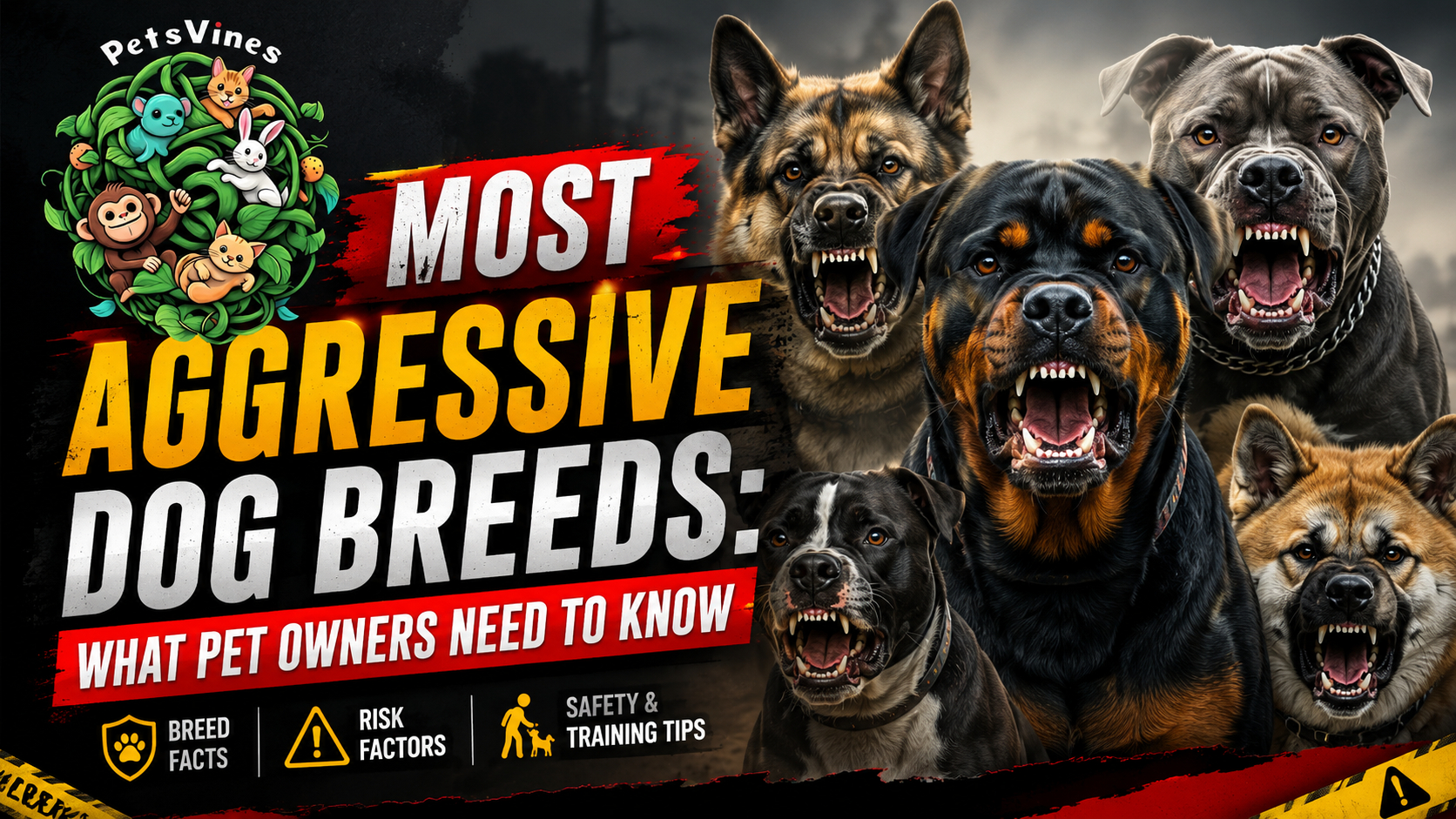
The most aggressive dog breeds — based on bite statistics and expert research — include the American Pit Bull Terrier, Rottweiler, German Shepherd, Doberman Pinscher, Chow Chow, Wolf-Dog Hybrid, Dogo Argentino, Cane Corso, Akita, and Siberian Husky. That said, aggression is shaped by genetics, training, socialization, and owner behavior, not breed alone. Any dog can bite; responsible ownership is the real prevention.
Every dog lover has heard the debate: are some dogs just born dangerous? The truth, as with most things in life, is more nuanced — but that doesn’t mean the data should be ignored.Dog bites are a serious global public health concern. In 2023 alone, the CDC reported 96 fatalities in the United States caused by dog bites — a staggering 174% increase in dog bite deaths over just five years. And preliminary data suggests things may be getting worse. A preliminary CDC report suggests 2024 could reach 113 dog bite deaths, which would be the highest ever recorded. If you’re a pet owner, or thinking of becoming one, understanding which breeds carry higher aggression risks isn’t about fear or prejudice. It’s about being informed, prepared, and responsible. The goal of this guide is exactly that: to give you real data, expert context, and practical advice, all in one place. Whether you already own one of these breeds or are considering adding one to your family, you’ll find everything you need here. For more trusted pet care information, visit PetsVines — a comprehensive resource for dog owners worldwide.
What Makes a Dog Breed “Aggressive”
A dog breed is considered aggressive when individuals within that breed are statistically more likely to bite, attack, or show threatening behavior toward humans or other animals. This is shaped by a combination of historical breeding purpose, genetics, and individual environment. No breed is aggressive by default — but some carry higher risk profiles that owners need to understand.
Some dog breeds have been specifically bred to have a stronger aggressive instinct for fighting, guarding, or hunting. Other breeds may have aggression inadvertently selectively bred into their genetics — for instance, when two individuals are mated for one trait, such as physical size, and both happen to have higher aggression levels, passing that tendency to their offspring.
Dogs, like people, are influenced by both genetic and environmental factors. A portion of a dog’s behavior can be attributed to innate characteristics decided at birth, while the other portion is determined by experiences with humans, other dogs, and their wider environment.
Key factors that contribute to dog aggression include:
- Breeding history — dogs bred for fighting, guarding, or hunting carry stronger instinctual drives
- Socialization — dogs not exposed to diverse people and environments early in life are far more likely to react fearfully or aggressively
- Training quality — positive reinforcement reduces incidents significantly
- Owner behavior — neglect, abuse, and chaining dramatically increase bite risk
- Sex and age — research has associated older age and being male with higher aggression in dogs
- Pain and health — aggressive behavior can also arise from pain, suggesting some aggressively behaving dogs may have conditions such as hip dysplasia or other painful health issues
The 10 Most Aggressive Dog Breeds: What the Data Says
Based on bite fatality data, expert reports, and breed behavior research, the breeds most frequently linked to serious or fatal attacks are Pit Bull Terriers, Rottweilers, German Shepherds, Doberman Pinschers, Chow Chows, Wolf-Dog Hybrids, Dogo Argentinos, Cane Corsos, Akitas, and Siberian Huskies. These breeds require experienced, responsible ownership.
1. American Pit Bull Terrier
The Pit Bull consistently tops virtually every serious dog bite study. Pit bulls were linked to 66% of fatalities — 346 out of 521 fatal attacks from 2005 to 2019. Although Pit Bulls and Rottweilers together make up only around 6% of dogs in the US, they are responsible for the majority of fatal attacks.
Originally bred in 19th-century Britain for bull-baiting and later dog fighting, the Pit Bull carries a powerful jaw, high pain tolerance, and an intense drive. When socialized from puppyhood and raised by responsible owners, many Pit Bulls are affectionate family dogs. But without proper training and boundaries, that same physicality becomes dangerous.
Bite force: Approximately 235–330 PSI Key risk factor: High prey drive, history of fighting-line breeding Many countries have banned or restricted this breed, including the UK, Germany, Australia, and New Zealand.
2. Rottweiler
Rottweilers are powerful, loyal, and naturally protective — qualities that made them valued as cattle drovers and police dogs. They’re also one of the most statistically dangerous breeds. Rottweilers alone were responsible for 51 deaths in recorded multi-year data, and together with Pit Bulls, the two breeds account for approximately 76% of all fatal dog attacks.
Rottweilers are calm and confident with a strong pack hierarchy — they need a clear, consistent leader. Without it, territorial aggression can become a serious issue, especially around strangers.
Bite force: Up to 328 PSI — one of the highest of any domestic breed Key risk factor: Territorial instinct, size, and raw physical power
3. German Shepherd
German Shepherds are among the world’s most intelligent, versatile, and widely kept breeds — and that versatility includes a real capacity for aggression when poorly trained or abused. According to the American Veterinary Medical Association (AVMA), German Shepherds are among the breeds most frequently represented in serious biting incidents.
Originally bred for herding, they are now the dominant breed in police and military work globally — which tells you something about both their trainability and their physical capability.
Bite force: Around 238 PSI Key risk factor: High intelligence combined with poor socialization can result in fear-based or dominant aggression
4. Doberman Pinscher
Sleek, powerful, and intensely alert — the Doberman was literally engineered to be the ultimate guard dog in 19th-century Germany. Pit bull terriers were the most likely to kill humans, followed by Rottweilers, German Shepherds, Dobermans, and Bullmastiffs, according to compiled breed data.
Modern Dobermans have been selectively bred to be less aggressive than their early predecessors, and well-raised individuals are loyal and affectionate. But they remain assertive, high-energy dogs who need confident, experienced owners.
Bite force: Around 229–305 PSI Key risk factor: Dominance aggression without firm, early training
5. Chow Chow
The Chow Chow is one of the oldest dog breeds in the world — and one of the least predictable around strangers. Their territorial nature, low tolerance for unfamiliar people, and aloof temperament make them one of the top aggressive breeds in owner-reported and insurance company data. Chow Chows are listed by the AVMA among breeds most frequently involved in serious biting incidents.
Unlike many large breeds, Chow Chows don’t typically signal aggression through growling first — they can snap or bite with little warning.
Bite force: Around 220 PSI Key risk factor: Naturally suspicious of strangers; poor socialization dramatically increases risk
6. Wolf-Dog Hybrid
Wolf-Dog hybrids are part wild animal — and that unpredictability is the core problem. While some hybrid owners report calm companions, experts consistently caution against keeping them as pets. They are difficult to socialize, retain strong predatory instincts, and are banned in many jurisdictions.
Key risk factor: Unpredictable temperament, wild prey drive, difficult to train
7. Dogo Argentino
Bred specifically for big-game hunting in Argentina, the Dogo Argentino is a muscular, fearless dog with a powerful bite and a deeply ingrained hunting instinct. It is banned in several countries, including the UK and Australia.
Bite force: Approximately 500 PSI Key risk factor: Extreme prey drive; without early socialization, aggression toward other animals and strangers is common
8. Cane Corso
The Cane Corso is a massive Italian mastiff with ancient roots as a war dog. They are highly protective of their families, deeply territorial, and capable of serious harm. Certain breeds like German Shepherds, Rottweilers, and similarly powerful working dogs are frequently on lists of aggressive dogs — many originally bred for guarding and protection work.
Bite force: Up to 700 PSI — among the highest of any domestic dog Key risk factor: Sheer size and power; needs experienced handling from day one
9. Akita
The Akita is a national treasure in Japan — and a seriously powerful breed with a naturally dominant temperament. They are deeply loyal to their family but notoriously reserved or aggressive with strangers and other dogs. Many countries list the Akita as a potentially dangerous breed.
Bite force: Around 350–400 PSI Key risk factor: Same-sex dog aggression; independent thinking makes training essential
10. Siberian Husky
Huskies might surprise you on this list — they’re often perceived as friendly and sociable. And in many ways, they are. But their high prey drive and pack mentality can make them unpredictable around small animals and young children. Pack attacks have become increasingly common in recorded data, representing up to 64% of fatal dog incidents.
Bite force: Around 320 PSI Key risk factor: High prey drive; not recommended for homes with small pets or very young children without proper supervision
The Breed vs. Owner Debate: What Science Actually Says
This is where the conversation gets complicated — and important.
The consensus among experts is that breed alone does not determine aggression; owner behavior, training, and neglect are the leading factors in most severe and fatal attacks.
A 2024 systematic review published in the scientific literature analyzed 19 studies over two decades, finding that aggression is influenced by many genes and is not caused by just one factor — but also that most studies had small sample sizes and relied on unclear methods to measure aggressive behavior, making firm conclusions difficult.
Here’s what we can say with confidence:
- Unneutered males drive the majority of serious incidents. Unneutered dogs drive 70% of bites, and neutering early can cut aggression by around 60%, according to the ASPCA.
- Chained dogs are significantly more dangerous. Chained dogs bite 2.8 times more than unchained dogs, and since 2003, chained dogs have been involved in the deaths of over 450 Americans.
- Media coverage skews public perception. A study from the Journal of Applied Animal Welfare Science found that Pit Bulls were overrepresented in media reports compared to other breeds involved in similar incidents — fostering fear and reinforcing stereotypes that don’t always reflect reality.
The bottom line: knowing a breed’s risk profile matters, but it’s only part of the picture. How you raise, train, and care for a dog will always be the biggest factor in how that dog behaves.
How to Manage Aggressive Dog Breeds Responsibly
Owning a high-risk breed isn’t irresponsible — being unprepared is. Here’s what responsible ownership looks like:
Early Socialization Is Non-Negotiable
Expose your puppy to as many different people, animals, sounds, and environments as possible between 3 and 14 weeks of age. This critical window shapes how your dog interprets the world for the rest of its life.
Consistent, Positive Reinforcement Training
Enrolling in obedience classes reduces bite incidents by around 40% across all breeds. Avoid punishment-based training with high-drive breeds — it can backfire and increase aggression.
Neuter or Spay Your Dog
As the data shows, this is one of the single most effective interventions for reducing aggression risk, particularly in male dogs.
Never Chain or Isolate
Chained, isolated dogs are far more likely to become aggressive. Your dog needs socialization, exercise, and mental stimulation.
Know the Warning Signs
Before a dog bites, it almost always signals. Learn to recognize: stiff body posture, fixed stare, raised hackles, low growling, showing teeth, or a tucked tail paired with snapping. Catching these early gives you time to intervene.
Invest in Proper Containment
Secure fencing, appropriate leash handling, and a well-fitted muzzle for public spaces are all sensible precautions with powerful breeds.
For deeper guidance on caring for your dog’s physical and behavioral health, explore the PetsVines Dog Care Resource Hub — packed with expert articles for dog owners at every level.
FAQs
What is the single most dangerous dog breed in the world?
Based on fatal bite statistics, the American Pit Bull Terrier is consistently involved in the highest number of fatal attacks. However, the Cane Corso has the highest recorded bite force of any domestic breed at up to 700 PSI.
Are small dogs aggressive too?
Small breeds like Chihuahuas actually top the charts for minor snapping — accounting for over 20% of stranger-directed aggression in a 2024 veterinary study. They simply cause less physical damage, so their bites are less often reported or taken seriously.
Can aggressive dog breeds be safe family pets?
Yes — with the right owner. Many families safely keep Rottweilers, German Shepherds, and Dobermans. These breeds often form incredibly strong bonds with their families. The key is early socialization, consistent training, and a lifestyle that meets their physical and mental needs.
What dog breeds are banned in the most countries?
The American Pit Bull Terrier is banned or restricted in the highest number of countries globally, followed by the Dogo Argentino, Japanese Tosa, and Fila Brasileiro.
Responsible Ownership Is the Real Answer
The data is clear: certain breeds carry higher statistical risk. Ignoring that does a disservice to both potential victims and the breeds themselves. But it’s equally clear that breed alone is never the whole story. Owner behavior, training, socialization, and responsible restraint are ultimately the leading factors in whether a dangerous incident occurs.
If you own or are considering a high-drive, powerful breed, commit to being an exceptional owner. Invest in training, socialization, proper containment, and veterinary care. The reward is a loyal, stable companion who reflects everything great about the human-dog bond.
Also Visit: How to Train a Dog with a Vibration Collar | Complete Guide