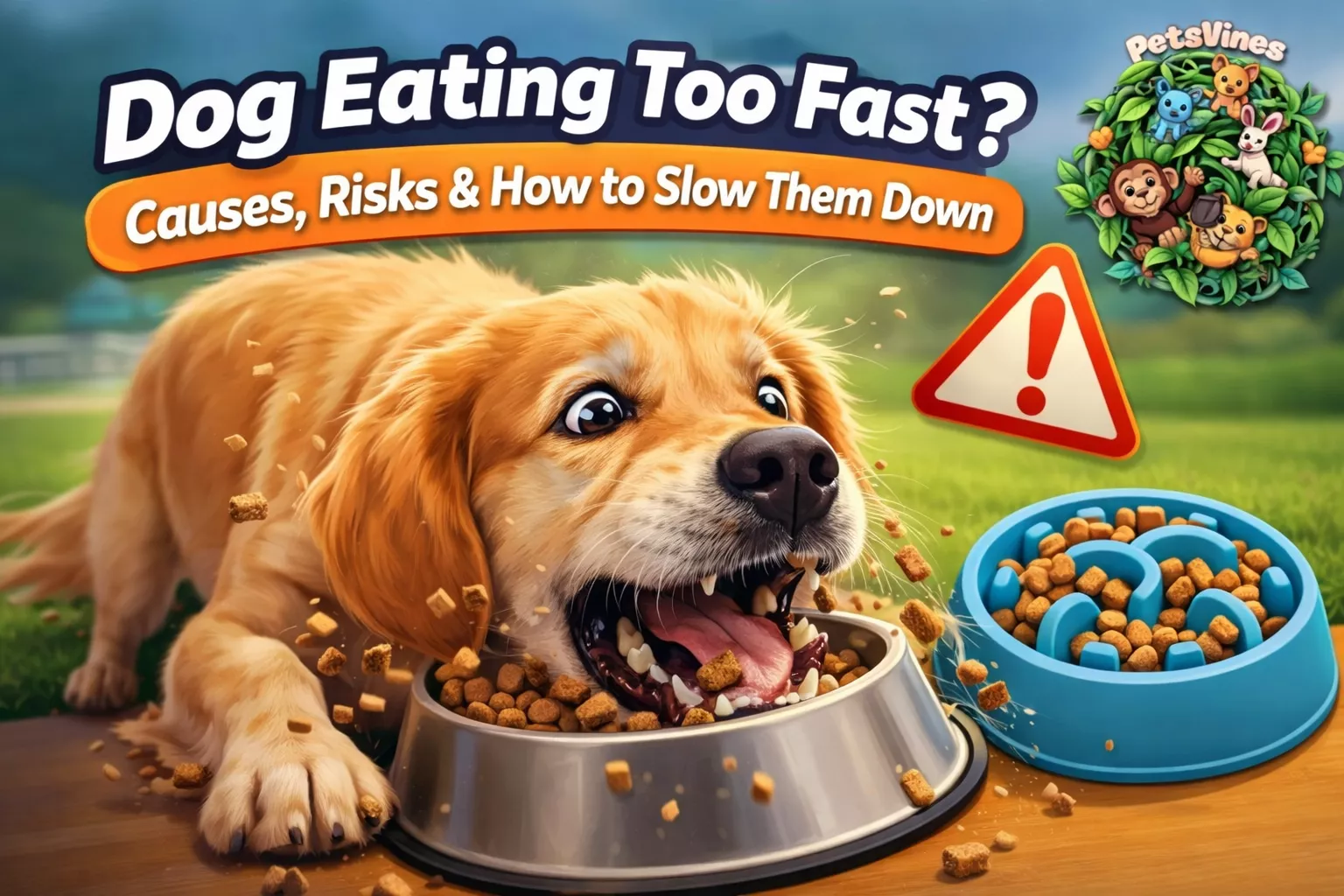
If your dog finishes their entire meal in under 30 seconds, you’re not alone — and you’re right to be concerned. While it might look amusing or even impressive, a dog eating too fast is one of the most common yet underestimated health risks in pet ownership.
It’s not just about bad manners at the bowl. Eating at high speed causes dogs to inhale large amounts of air along with their food, which can lead to dangerous consequences ranging from uncomfortable bloating to a life-threatening stomach twist known as GDV.
Dogs eat too fast due to instinctual survival behaviors, competition with other pets, anxiety, or underlying medical conditions. Fast eating causes dogs to swallow excessive air, leading to vomiting, choking, and a potentially fatal condition called gastric dilatation-volvulus (GDV or bloat). You can slow your dog down using a slow feeder bowl, puzzle feeder, hand feeding, or by splitting meals into smaller portions.
The good news? This is a fixable problem. Whether your dog is a lifelong speed-eater or recently developed the habit, there are several simple, vet-recommended strategies that actually work. In this guide, you’ll learn exactly why dogs eat so fast, what it’s doing to their body, and seven practical ways to slow them down — starting tonight.
For more expert advice on keeping your dog healthy and happy, explore PetsVines’ full dog care resource hub.
Why Do Dogs Eat So Fast? Understanding the Root Causes
Dogs eat fast because of deep-rooted survival instincts inherited from their wild ancestors, where food was scarce and competition was fierce. Modern dogs may also eat quickly due to competition with other household pets, anxiety, irregular feeding schedules, or medical conditions that increase hunger.
1. Survival Instinct and Pack Mentality
Dogs are descended from wolves, animals that had to consume kills quickly before other pack members or competing predators could take the food. Even though your dog’s kibble isn’t going anywhere, that ancient wiring is still very much active.
Puppies especially develop fast-eating habits when raised in large litters. When there are six siblings all competing for the same food source, eating as fast as physically possible is simply how you survive. This behavior is more common in puppies from large litters, where they had to eat quickly before a brother or sister got hold of the food — and it tends to stick well into adulthood.
2. Competition in Multi-Pet Households
Even if your dogs have never missed a meal in their lives, the presence of another dog nearby during feeding time can trigger competitive eating. Dogs are highly aware of each other’s food, and even a calm dog can start wolfing down meals simply because they perceive a threat to their bowl.
3. Irregular Feeding Schedules
Dogs that are fed once a day, or at inconsistent times, often arrive at the bowl in a state of genuine hunger — or heightened anticipation. The longer the gap between meals, the more urgency they feel. Risk increases when dogs eat one large meal per day, which is one reason vets consistently recommend multiple smaller meals rather than a single large one.
4. Medical Conditions That Drive Hunger
If your dog has recently developed fast eating after previously being a normal eater, it’s worth ruling out a medical cause. Conditions like diabetes mellitus, Cushing’s disease, hypothyroidism, and intestinal parasites can all cause excessive hunger. Your veterinarian may want to test your dog for diseases like diabetes mellitus or a hormone-related problem such as Cushing’s disease. If your dog is on any medication, the side effects may include increased appetite. Intestinal parasites can also rob your dog of nutrients, making them feel perpetually hungry.
5. Anxiety and Emotional Eating
Some dogs eat fast not because they’re hungry, but because feeding time triggers stress or excitement. Dogs that have been rescued from food-insecure situations, or those prone to anxiety, may use fast eating as a coping behavior.
Is It Actually Dangerous? The Real Health Risks of Fast Eating
This is where the conversation gets serious. A dog eating too fast isn’t just messy or undignified — it creates real, measurable health risks.
Choking and Gagging
The most immediate risk is choking. When food is swallowed whole without adequate chewing, large pieces can become lodged in the throat, causing your dog to gag, hack, and occasionally regurgitate the meal.
Vomiting and Regurgitation
Dogs that eat too fast frequently vomit within minutes of finishing their meal. This is the stomach’s way of saying “too much, too fast.” Chronic vomiting after meals — even if it seems minor — is a sign that something needs to change.
Bloating and Gas
When dogs gulp their food, they’re also gulping air. When dogs gulp their meal too quickly, they swallow air along with their food. Food and air expand in the stomach, causing pain and discomfort. This leads to visible bloating, excessive flatulence, and abdominal discomfort.
Gastric Dilatation-Volvulus (GDV) — A Life-Threatening Emergency
The most serious consequence of fast eating is GDV, commonly called bloat. This is not the “I ate too much” kind of bloat — it is a genuine veterinary emergency.
GDV occurs when the stomach fills rapidly with gas and then physically twists on itself, cutting off blood supply to major organs. GDV requires immediate medical and surgical intervention. Without it, the condition is fatal.
The statistics are sobering. A Tufts study found that 36% of dogs with GDV did not survive, often due to cost or poor prognosis. Dogs weighing over 100 pounds have approximately a 20% risk of bloat during their lifetime.
Research from Purdue University found that having a faster speed of eating was one of the factors significantly associated with an increased risk of GDV in large and giant breed dogs (Glickman et al., 2000 — Journal of the American Veterinary Medical Association).
While most evidence indicates that rate of eating has no direct effect on GDV risk, where significant effects were found, fast eating was implicated as a risk factor — and no studies found that slow eating increased risk. In other words, slowing your dog down can only help, never hurt.
Breeds most at risk for GDV include: Great Danes, Saint Bernards, Weimaraners, Irish Setters, Standard Poodles, Doberman Pinschers, and German Shepherds. However, any dog can develop GDV — even small breeds.
7 Vet-Backed Ways to Stop Your Dog Eating Too Fast
To stop your dog from eating too fast, use a slow feeder bowl, divide meals into smaller portions given 2–3 times daily, hand feed, scatter feed, use puzzle feeders, separate dogs during meals, and rule out any underlying medical causes with your vet.
1. Switch to a Slow Feeder Bowl
Slow feeder bowls are the most accessible and widely recommended solution. These bowls feature raised ridges, maze patterns, or obstacles that force your dog to work around barriers to reach their food.
Research confirms that slow feeder bowls are effective at reducing eating speed, and while dogs become quicker at eating as they gain experience with these devices, their consumption rate still remains slower than with a standard dog bowl.
In practical terms, a meal that takes 30 seconds in a regular bowl can take 5 or more minutes in a slow feeder — giving the stomach time to begin digesting before it becomes overwhelmed.
Look for: Maze-style or ridge-pattern bowls made from food-safe materials. Choose a bowl size appropriate for your dog’s breed and muzzle shape. Avoid very cheap plastic options that could splinter.
2. Divide Daily Meals Into Smaller, More Frequent Portions
One of the simplest changes you can make is to stop feeding one large daily meal. Instead, divide your dog’s total daily food intake into two or three smaller meals. This reduces the sheer volume hitting the stomach at once and takes the urgency out of each feeding.
Two to three small meals should be fed daily instead of one large meal to reduce the volume of food in the stomach at one time.
3. Use a Puzzle Feeder or Lick Mat
Puzzle feeders and lick mats take meal enrichment a step further. Food is hidden inside chambers or spread across a textured surface, and your dog has to problem-solve to access it. Beyond just slowing eating, these tools provide genuine mental stimulation — which many dogs are lacking.
This also mirrors natural foraging behavior. Wild dogs don’t eat from a bowl in 20 seconds; they hunt, search, and work for their food. Puzzle feeders tap into that instinct in a healthy way.
4. Hand Feed or Scatter Feed
Two zero-cost strategies worth trying:
Hand feeding — offer small amounts from your palm or by placing kibble down one piece at a time. This naturally controls pace, and as a bonus, builds positive associations between you and food.
Scatter feeding — spread kibble across a snuffle mat, the lawn, or a clean hard floor. Your dog has to sniff out and find each piece individually, turning a 30-second meal into a 15-minute activity. It’s enriching and genuinely effective.
5. Add a “Bowl Obstacle”
If you don’t have a slow feeder yet, a simple workaround is placing a large, smooth rock, a tennis ball, or an upturned smaller bowl inside your dog’s regular bowl. This creates physical barriers the dog must eat around. You can put a tennis ball in a normal bowl, which works on the same principle — if you place an obstruction between your dog and the food, they will have no choice but to slow down.
Make sure any obstacle is too large to swallow and is cleaned regularly.
6. Separate Dogs During Feeding Time
If you have multiple dogs, feeding them in the same space can silently drive competitive eating — even if no aggression is visible. A dog that eats calmly on its own might speed-eat dramatically when a housemate is nearby.
Try feeding each dog in a separate room, or at opposite ends of a large space with visual barriers between them. Giving each dog their own space may help a dog that is anxious about food feel less stressed. Many owners are surprised by how dramatically eating pace improves when dogs are fed separately.
7. Elevate the Bowl — With Caution
This one comes with important caveats. While elevated bowls were once widely recommended for large breeds to reduce bloat risk, more recent research has complicated the picture.
Eating from an elevated food bowl may actually increase — not decrease — the risk of gastric dilatation-volvulus in large and giant breed dogs.
For small and medium breeds, elevation may reduce strain on the neck and back. But if you have a large, deep-chested breed at risk for GDV, speak to your vet before introducing an elevated feeder.
When to See a Vet
Most fast eating is behavioral and fully manageable at home. But there are situations where a vet visit is the right call:
- Your dog has recently started eating faster without an obvious cause. VCA Animal Hospitals
- Fast eating is accompanied by lethargy, vomiting, or a visibly distended abdomen
- You notice your dog straining, pacing, or appearing distressed after meals — these can be early signs of GDV and require immediate emergency care
- Your dog seems perpetually hungry despite adequate food portions
Early diagnosis and treatment are crucial for a positive outcome. With medical and surgical intervention, the survival rate for GDV is greater than 80%. Every minute matters with this condition, so if you suspect bloat, don’t wait.
Quick Summary: Dog Eating Too Fast — At a Glance
| Problem | Cause | Solution |
|---|---|---|
| Inhaling food | Survival instinct / competition | Slow feeder bowl, scatter feeding |
| Vomiting after meals | Eating too fast | Smaller meals, puzzle feeders |
| Excessive gas/bloating | Swallowed air | Slow feeder, hand feeding |
| GDV risk | Large meals, fast eating, deep chest | Multiple small meals, vet consultation |
| Persistent hunger | Medical condition | Vet check — rule out parasites, hormonal issues |
FAQ’s
Q: Is it normal for dogs to eat really fast?
It’s common, but not ideal. Many dogs eat fast due to instinct or habit, but it carries real health risks and is worth addressing.
Q: Can fast eating kill a dog?
Yes, in severe cases. Rapid eating can contribute to GDV (gastric dilatation-volvulus), a life-threatening condition where the stomach twists. It requires emergency surgery and has a significant mortality rate if untreated.
Q: How long should it take a dog to eat?
Most vets suggest a healthy mealtime lasts at least 5–15 minutes. Under 2 minutes is generally considered too fast.
Q: Do slow feeder bowls actually work?
Yes. Research published in Veterinary Evidence confirms that slow feeder bowls are effective at reducing eating speed, even as dogs become more familiar with them over time.
Q: What breeds are most at risk from eating too fast?
Large, deep-chested breeds including Great Danes, German Shepherds, Weimaraners, Standard Poodles, and Doberman Pinschers face the highest GDV risk. However, all breeds benefit from slower eating habits.
Final Thoughts
A dog eating too fast is more than a quirky habit — it’s a behavior that deserves your attention and action. The risks, particularly GDV, are serious enough that even small changes to your dog’s feeding routine can make a significant difference to their long-term health and safety.
Start with something simple: a slow feeder bowl, split meals twice daily, or scatter feeding. Most dogs respond well to these changes within a week. For large or deep-chested breeds especially, these aren’t optional extras — they’re part of responsible pet ownership.
And when in doubt, your vet is always your best resource. A 10-minute conversation about your dog’s eating habits could prevent a life-threatening emergency down the road.
For more dog health tips, breed guides, feeding advice, and everything in between, Visit: PetsVines — your trusted companion in pet care.