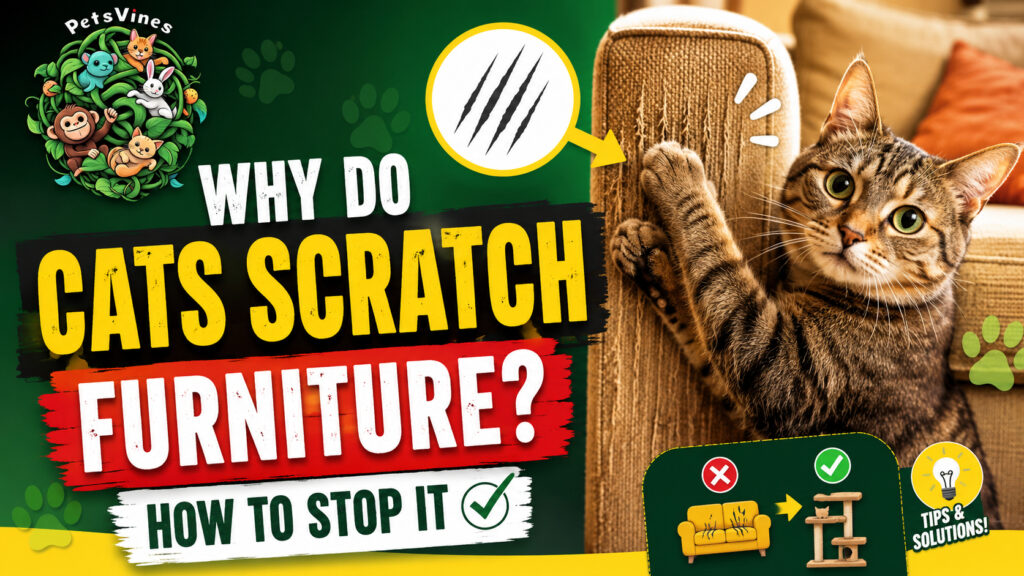
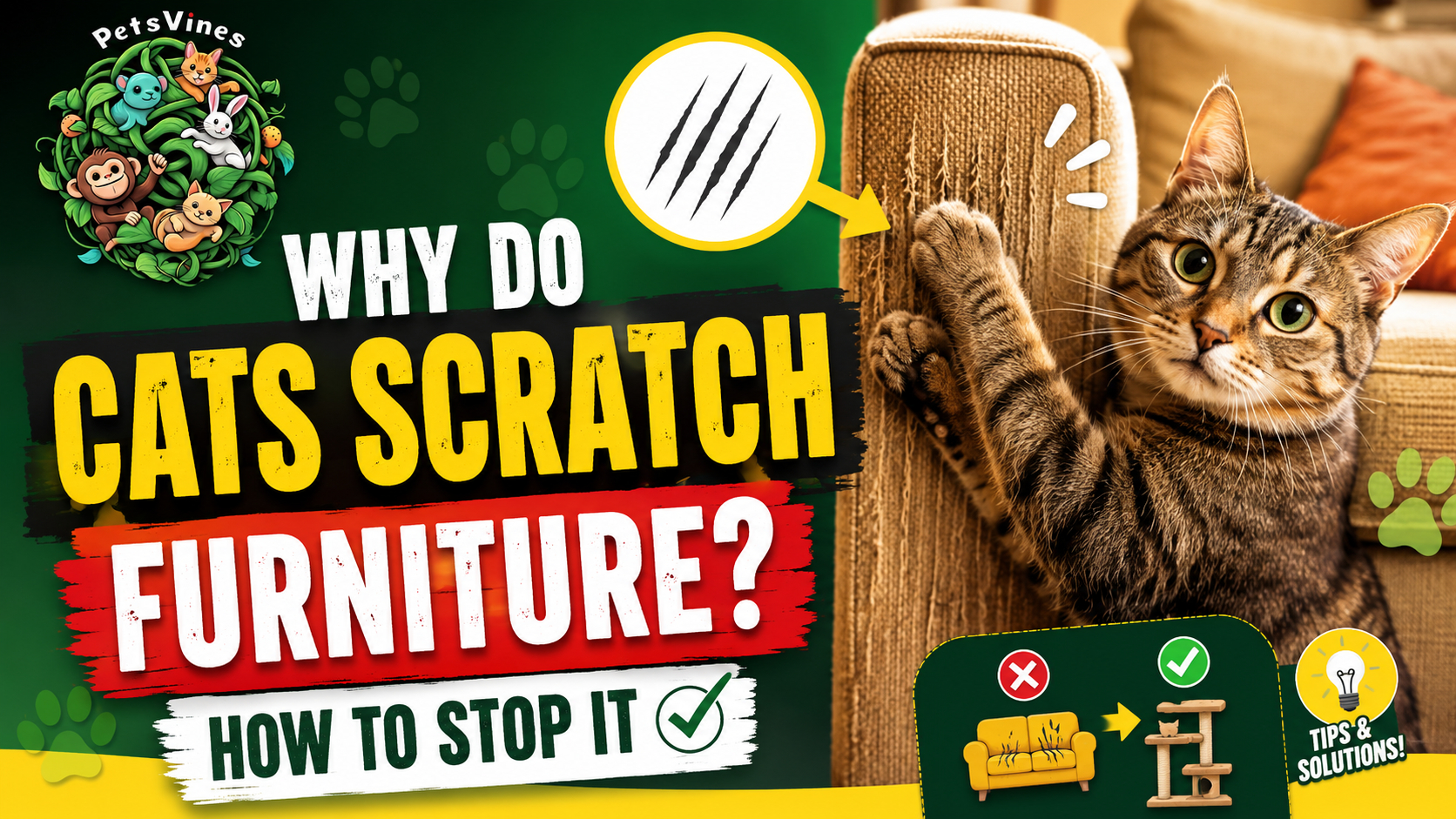
Cats Scratch Furniture is normal feline behavior. Cats scratch to maintain their claws, stretch their bodies, communicate through scent and visual marks, and express natural behavior. The goal is not to stop your cat from scratching altogether, but to teach your cat where scratching is appropriate.
The most effective approach is to make an attractive scratching post or pad easier and more rewarding to use than the sofa, chair, carpet, or other furniture your cat has chosen. This usually means matching the scratching surface to your cat’s preference, placing it near the problem area, and making unwanted furniture less appealing.
Why Do Cats Scratch Furniture?
Cats scratch furniture for several normal reasons. Scratching is not simply a destructive habit, and it does not mean your cat is trying to annoy you. Cats have a biological need to scratch, so completely preventing the behavior is neither realistic nor desirable.
According to the ASPCA, cats may scratch while playing, stretching, marking territory, or maintaining their claws. Scratching also removes worn outer layers of the claws. International Cat Care similarly describes scratching as a natural behavior that has physical and communication functions.
1. Scratching helps maintain the claws
When a cat scratches, the outer sheath of the claw can be removed, exposing the sharper claw underneath. The repeated pulling and raking motion is therefore part of normal claw maintenance.
This is one reason a cat may return to the same scratching surface again and again. A suitable scratching post gives your cat an appropriate place to perform this behavior.
2. Cats scratch to stretch
Have you ever noticed your cat scratching immediately after waking up? The movement allows the cat to extend the legs, shoulders, back, and body while pulling against a firm surface.
A tall, stable scratching post can be particularly useful for cats that enjoy standing upright and stretching their full bodies while scratching.
3. Scratching helps cats communicate
Scratching can also leave visual marks and scent from glands in the paws. This makes scratching part of feline communication and territorial behavior.
That helps explain why a cat may scratch in noticeable or socially important locations rather than choosing a hidden corner. A scratching post placed somewhere your cat already spends time may therefore be more successful than one hidden away in another room.
4. Scratching can be part of play and excitement
Some cats scratch when they become excited during play or activity. A scratching session may happen alongside running, climbing, chasing toys, or stretching.
If your cat frequently scratches after waking, playing, or interacting with you, providing a scratching surface nearby can give the behavior an appropriate outlet.
Why Does My Cat Scratch the Sofa Instead of the Scratching Post?
Your cat may prefer the sofa because it provides exactly the combination of texture, resistance, location, and stability that feels good to scratch. A scratching post that moves, falls over, has an unfamiliar texture, or is placed far from the preferred scratching location may simply be less appealing.
Cats can have individual preferences for scratching surfaces and directions. The ASPCA recommends trying different materials and orientations, including cardboard, carpet, wood, sisal, upholstery, vertical posts, horizontal pads, and slanted surfaces.
If your cat repeatedly scratches one particular piece of furniture, pay attention to what makes that location attractive. The height, texture, position, and stability can all provide clues about what type of scratching surface to offer.
How to Stop Cat Scratching Furniture
You can reduce cat scratching furniture by redirecting the behavior rather than trying to eliminate scratching. Start by providing a suitable scratching surface near the furniture your cat currently uses. Then gradually make the furniture less attractive while rewarding appropriate scratching.
1. Put a scratching post beside the furniture
Location matters. If your cat scratches the arm of a sofa, place a scratching post directly beside that area rather than expecting your cat to walk across the house to find it.
Once your cat consistently uses the alternative, you can experiment with moving the post a small distance at a time. Avoid moving it away too quickly if your cat returns to the furniture.
2. Choose the right scratching surface
There is no single scratching material that every cat will prefer. Try different options if your first choice is ignored.
- Sisal: A rough, durable material commonly used on scratching posts.
- Cardboard: Many cats enjoy horizontal cardboard scratchers.
- Wood: Some cats prefer a firmer, natural-feeling surface.
- Carpet or upholstery: Some cats may prefer softer or fabric-like textures.
- Horizontal pads: Useful for cats that scratch floors or rugs.
- Slanted scratchers: A middle option for cats that do not clearly prefer vertical or horizontal surfaces.
International Cat Care notes that a vertical scratching surface can be uncomfortable for some cats with joint pain, making a horizontal option worth trying for cats with mobility challenges. :contentReference[oaicite:0]{index=0}
3. Make the scratching post stable
A scratching post should not wobble or collapse when your cat puts its body weight against it. An unstable post can make the experience unpleasant and may cause your cat to return to solid furniture instead.
The ASPCA recommends sturdy scratching posts, and its general cat-care guidance notes that cats benefit from a stable post that allows them to scratch effectively.
4. Offer both vertical and horizontal options
If you do not know what your cat prefers, provide both types. Watch how your cat scratches furniture and use that behavior as your guide.
A cat that stands up and reaches high on a sofa may prefer a vertical post. A cat that scratches carpets or rugs may be more interested in a horizontal scratching pad.
5. Place scratching surfaces where your cat already scratches
Do not assume that the best place for a scratching post is an unused corner. Cats often scratch in locations they already find meaningful.
Consider placing scratching surfaces near sleeping areas, favorite resting spots, entrances to rooms, or the furniture your cat repeatedly targets. Scratching after waking is particularly common, so a scratcher near a preferred sleeping area can be useful.
6. Make furniture temporarily less attractive
While your cat learns to use the alternative, protect the furniture it repeatedly scratches. The ASPCA describes options such as covering or changing access to desirable scratching areas and using double-sided sticky tape as a deterrent.
The important point is to pair the deterrent with an appropriate scratching surface. Simply making the sofa unpleasant without providing another place to scratch does not meet your cat’s underlying need.
7. Encourage exploration without forcing your cat
You can make a scratching post more interesting by placing a favorite toy nearby or using an appropriate catnip product if your cat responds to catnip. Some cats may also investigate a scratcher more readily when it is positioned in an active area.
Do not grab your cat’s paws and force them against the scratching post. The ASPCA specifically warns against forcing a cat to drag its claws on a scratching post because this can frighten the cat and cause it to avoid the post.
Should You Reward a Cat for Using a Scratching Post?
Yes. Calmly rewarding appropriate scratching can help your cat build a positive association with the scratching area. A reward might be praise, play, petting if your cat enjoys it, or a small food reward.
Reward the behavior you want to see rather than punishing mistakes. If your cat scratches the sofa, calmly redirect the cat toward an appropriate scratching surface when practical.
This same principle applies to many feline behaviors. Understanding what the cat is communicating is usually more useful than treating the behavior as deliberate misbehavior. You can also learn more about why cats knead and how normal feline behaviors can have several functions.
What Should You Avoid When Trying to Stop Cat Scratching?
Some responses can make the problem worse or damage your relationship with your cat.
- Do not punish your cat for scratching. Fear or punishment does not teach the cat which surface is appropriate.
- Do not force your cat onto a scratching post. Your cat may associate the post with an unpleasant experience.
- Do not remove every scratching opportunity. Scratching is a normal behavior that cats need to express.
- Do not rely on one type of scratcher. Your cat may prefer a different material or orientation.
- Do not expect instant results. Established preferences can take time to redirect.
The ASPCA recommends teaching cats where and what to scratch rather than attempting to prevent scratching altogether. :contentReference[oaicite:1]{index=1}
Should You Trim Your Cat’s Claws?
Regular nail care can reduce the sharpness of the claws, but it does not replace scratching opportunities. Cats still need to express normal scratching behavior even when their nails are trimmed.
The ASPCA states that trimming a cat’s nails every two to three weeks can help keep them relatively blunt. If you are unsure how to trim claws safely, ask your veterinary team or an experienced pet-care professional to demonstrate the technique.
Never use nail trimming as a reason to remove your cat’s opportunity to scratch.
What About Declawing to Stop Furniture Damage?
Declawing should not be used as a routine solution for furniture scratching. It is a permanent surgical procedure rather than a behavior-training technique.
The ASPCA opposes declawing as a behavioral remedy and recommends nonsurgical approaches such as appropriate scratching surfaces, regular nail trimming, deterrents for furnishings, and behavior modification.
For most households, the better starting point is to understand the cat’s scratching preference and provide an appropriate outlet.
Can Stress Cause More Scratching?
Scratching has several normal functions, so an increase in scratching should not automatically be interpreted as stress. However, changes in the home can affect feline behavior, and providing appropriate environmental resources is an important part of good cat care.
In multi-cat homes, make sure cats have access to important resources without unnecessary competition. International Cat Care recommends providing resources such as scratching areas, resting places, hiding areas, food, water, and other environmental resources appropriately throughout the home.
If scratching suddenly changes alongside other concerning behavioral or physical changes, discuss the situation with your veterinarian. A sudden behavior change can have multiple possible explanations, and scratching alone cannot establish a medical diagnosis.
A Simple Plan to Protect Your Furniture
If you need a practical starting point, use this five-step approach:
- Identify the target: Note which furniture your cat scratches and whether the cat scratches vertically or horizontally.
- Match the scratcher: Choose a sturdy surface with a texture and orientation that resembles the preferred furniture.
- Place it beside the problem area: Make the appropriate choice easy to find.
- Protect the furniture: Temporarily cover or otherwise make the targeted surface less attractive.
- Reward appropriate scratching: Reinforce your cat when it chooses the scratcher.
If your cat is highly active, environmental enrichment can also matter. For example, breeds known for high activity may benefit from more opportunities for climbing, play, exploration, and scratching. Our guide to Bengal cat activity needs explains why meeting a cat’s behavioral needs is particularly important for energetic cats.
When Should You Ask a Veterinarian or Behavior Professional for Help?
Most furniture scratching can be addressed with environmental changes and appropriate scratching options. However, professional help is worthwhile if the behavior changes suddenly, becomes unusually intense, occurs alongside signs of pain or illness, or is part of a broader pattern of concerning behavior.
A veterinarian can help assess possible health-related concerns, while a qualified feline behavior professional can help when the problem is persistent or complicated by fear, conflict, or other behavioral issues.
It is also useful to look at the bigger picture. Scratching is only one part of feline communication and behavior. Understanding other common cat behaviors can help you respond to your cat more thoughtfully instead of assuming unwanted behavior is intentional.
FAQs
Why does my cat keep scratching the same furniture?
Your cat may repeatedly choose the same furniture because its location, texture, stability, or height is appealing for scratching. Place a suitable scratching surface directly beside it and make the furniture temporarily less attractive.
How do I stop my cat from scratching the sofa?
Place a sturdy scratching post beside the sofa, choose a surface your cat likes, protect the targeted area temporarily, and reward appropriate scratching. Do not punish or force your cat to use the post.
Do cats need scratching posts?
Yes. Scratching is a normal feline behavior associated with claw maintenance, stretching, play, and communication. Providing suitable scratching surfaces gives cats an appropriate place to express this behavior.
Why does my cat ignore the scratching post?
Your cat may dislike its material, orientation, location, size, or stability. Try another texture or a horizontal, vertical, or angled option and place it near an area your cat already scratches.
Should I punish my cat for scratching furniture?
No. Punishment can create fear without teaching your cat what to scratch instead. Redirect the behavior toward an appropriate scratching surface and reinforce the choice you want.
Bottom line: The best way to stop cat scratching furniture is not to stop scratching itself. Give your cat attractive, stable alternatives, place them where scratching already happens, protect furniture during the transition, and reinforce appropriate choices. With the right setup, you can protect your home while allowing your cat to perform an important natural behavior.
Also Visit: How to Cat-Proof Your Home: Safety Checklist 2026