
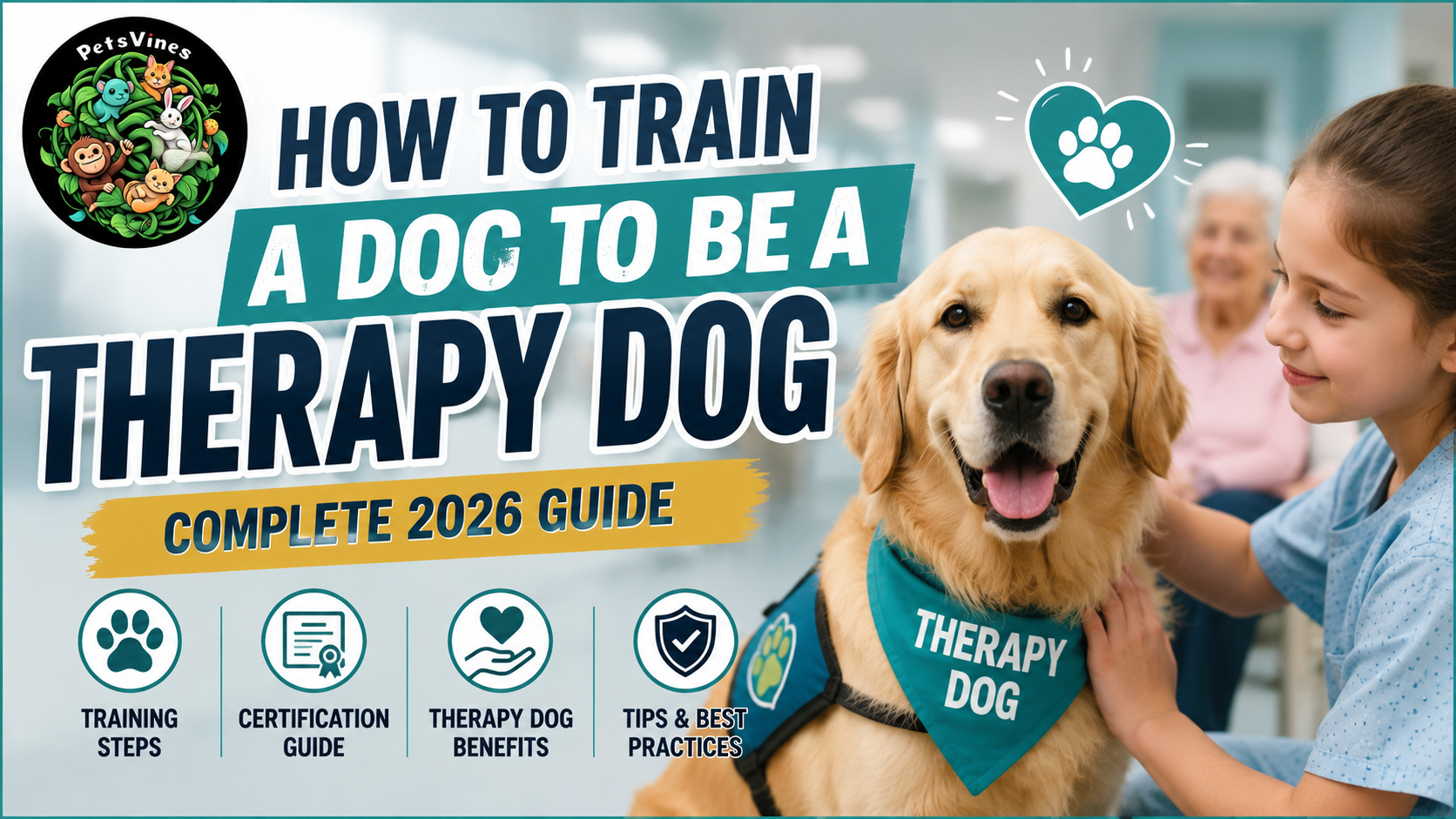
To train a dog to be a therapy dog, start by assessing your dog’s temperament for calmness and friendliness. Then master basic obedience commands, work toward passing the AKC Canine Good Citizen (CGC) test, and register with a recognized therapy dog organization. Your dog must be at least 1 year old, comfortable with strangers, and able to stay calm in unpredictable environments.
What if your dog could do more than brighten your day what if they could change someone’s life?
Therapy dogs visit hospitals, nursing homes, schools, and crisis centers, offering something no medication can replicate: unconditional warmth. They provide relief to people in anxiety-provoking situations, comfort those who are grieving or lonely, and offer affection in institutional settings like hospitals, nursing homes, and schools.
The demand for trained therapy dogs is growing fast. There are currently more than 50,000 therapy dogs in the United States alone, and the Animal-Assisted Therapy industry is projected to reach $110 million in revenue. Yet many pet owners with perfectly suited dogs have no idea where to begin.
This guide walks you through every stage assessing your dog, building the right skills, passing the required tests, and getting certified — so you and your dog can start making a real difference.
What Is a Therapy Dog (And What It Isn’t)?
A therapy dog is a trained, certified dog that visits facilities like hospitals and schools to provide comfort and emotional support to people. Unlike service dogs, therapy dogs are not assigned to one individual and do not have public access rights under disability law.
A therapy dog lends comfort and affection to people in facility settings or to certain individuals who require visitation to deal with a physical or emotional problem. Therapy dogs are not service dogs, who provide a specific service for a person with special needs under the Americans with Disabilities Act (ADA). They also aren’t emotional support animals, which require a mental health prescription but no special training.
Understanding this distinction matters because the training path, legal rights, and certification process differ significantly across these three categories.
Where Do Therapy Dogs Work?
Therapy dogs are welcomed in a wide range of settings globally:
- Hospitals and rehabilitation centers reducing patient anxiety and pain
- Schools and universities over 60% of US colleges have adopted therapy dog programs to reduce stress and anxiety
- Nursing homes and hospices over 60% of US hospice care providers that offer alternative therapies include pet therapy
- Disaster response sites supporting survivors and first responders
- Courtrooms and forensic interviews helping vulnerable witnesses feel safe
- Libraries through reading programs that boost children’s literacy confidence
Why Train Your Dog to Be a Therapy Dog? The Evidence Is Compelling
Training your dog to be a therapy dog benefits both the people they visit and the dog itself. Research shows therapy dogs help lower blood pressure, reduce anxiety, and release mood-boosting hormones in humans while the dogs themselves show elevated levels of feel-good hormones during visits.
The science behind therapy dog work is not soft or anecdotal it’s well-documented.
Studies have shown that therapy dogs also benefit from their work, with rates of endorphins and oxytocin measurably higher in therapy dogs compared to average family pets.
For the humans they visit, the benefits are equally striking:
- Patients with total joint replacement needed 50% less pain medication when canine therapy was incorporated into their care, according to a 2009 London study
- 90.4% of children completed their MRIs successfully after animal-assisted interventions
- Canine-assisted reading programs have been shown to boost reading fluency by 12–30%
- Owning or working with a dog has been proven to reduce the risk of heart disease by 36%
This is meaningful, purposeful work for both ends of the leash.
Does Your Dog Have What It Takes? Assessing Temperament First
Not every dog is suited for therapy work, regardless of breed or size. The most important quality is temperament a therapy dog must be calm, friendly, people-focused, and comfortable in noisy, unpredictable environments. Age, breed, and size are secondary considerations.
Before you invest time in formal training, honestly evaluate your dog’s natural personality. This step is critical and often overlooked.
Key Temperament Traits to Look For
A certified therapy dog must be friendly, patient, confident, gentle, and at ease in all situations. Therapy dogs must enjoy human contact and be content to be petted, cuddled, and handled sometimes clumsily by unfamiliar people, and they must genuinely enjoy that contact.
Ask yourself honestly:
- Does my dog seek out strangers for attention, or shy away?
- Does my dog stay calm when approached by children, people in wheelchairs, or individuals using walkers or crutches?
- Does my dog recover quickly after a startling noise or sudden movement?
- Can my dog ignore distractions (food on a table, another dog passing by) when asked to?
- Does my dog show any fear, aggression, or excessive anxiety in new places?
As expert trainer Linda Keehn, CPDT-KA, puts it: “It could be the nicest dog in your living room, but not elsewhere. Most often in a therapy situation, people just want a dog that sits next to them.”
Age and Breed Requirements
Most organizations require therapy dogs to be at least one year old. Breed and size don’t disqualify a dog trainers have certified dogs as small as a four-pound Yorkshire Terrier and as old as a 13-year-old Beagle. What matters is the dog’s willingness and natural ease with people.
For a broader look at dog behavior and breed characteristics that influence suitability, explore the dog guides and resources at PetsVines.
Step-by-Step: How to Train a Dog to Be a Therapy Dog
Step 1 — Build a Foundation with Basic Obedience
Before any certification is possible, your dog must have solid, reliable obedience skills. These aren’t optional extras they’re the baseline.
Your dog should respond consistently to:
- Sit, Stay, Down, Come in all environments, not just at home
- Leave it essential when entering facilities with food, equipment, or medication within reach
- Loose-leash walking no pulling, lunging, or jumping on people
- Greet politely four paws on the floor, calm approach to strangers
Train in varied environments: parks, car parks, busy streets, pet-friendly stores. A dog that only performs at home won’t pass real-world evaluations.
Step 2 — Work Toward the Canine Good Citizen (CGC) Certificate
Many therapy dog organizations require dogs to pass the AKC Canine Good Citizen (CGC) test for obedience, although some require a therapy-specific test in its place.
The CGC test is the global gold standard for well-mannered dogs. It evaluates 10 practical skills including:
- Accepting a friendly stranger
- Sitting politely for petting
- Appearance and grooming tolerance
- Walking on a loose leash
- Walking through a crowd
- Sit, down, and stay on command
- Coming when called
- Reacting calmly to another dog
- Reacting calmly to distractions
- Supervised separation from the handler
Many dog training schools run CGC prep classes. Even if your dog doesn’t need the AKC version specifically, this test is an excellent rehearsal for the real-world skills therapy work demands.
Step 3 — Practice in Real-World, High-Stimulation Environments
Passing an obedience test in a quiet hall is one thing. Staying calm in a hospital ward with beeping machines, wheelchairs, unfamiliar smells, and distressed people is another.
Gradually expose your dog to:
- Medical equipment sounds play recordings of hospital sounds at home
- People in wheelchairs, with crutches, or wearing medical masks
- Elevators and sliding doors
- Crowds and unpredictable children
- Sudden loud noises — clattering, alarms, crying
Use positive reinforcement at every stage. If your dog shows fear or stress, slow down. Never force a dog through an experience they’re not ready for a stressed therapy dog helps no one.
Step 4 — Choose and Apply to a Recognized Therapy Dog Organization
Once your dog is ready, you’ll need to register with an accredited organization. This is what makes your dog an official therapy dog, not just a well-behaved one.
Major organizations worldwide include:
- Alliance of Therapy Dogs (USA) — one of the largest certifying bodies
- Pet Partners (USA/International) — accepts multiple species, rigorous evaluation
- Therapy Dogs International (TDI) (USA)
- Pets As Therapy (PAT) (UK)
- Delta Society (Australia/New Zealand)
The Alliance of Therapy Dogs process involves a tester/observer in your area evaluating you and your dog, including a handling portion that tests basic good manners, demeanor, and handling skills. After that, you and your dog are supervised during three visits to medical facilities.
Step 5 — Pass Your Evaluation
Each organization runs its own assessment, but most include:
- Handling test — how your dog responds to being touched, groomed, and approached by strangers
- Obedience demonstration — sit, stay, come, leave it in a real setting
- Supervised facility visits — observed visits to hospitals, schools, or nursing homes
- Handler assessment — yes, you are evaluated too. Your body language, composure, and ability to read your dog matter greatly
Upon successful completion of supervised visits and submission of your application paperwork, you and your dog become certified.
Step 6 — Maintain Your Certification and Your Dog’s Wellbeing
Therapy dog work is rewarding — but it’s also emotionally demanding on the dog. After certification:
- Schedule regular vet check-ups and keep vaccinations current (required by most facilities)
- Watch for signs of stress in your dog — yawning, lip-licking, tucked tail, panting after calm situations
- Limit visit lengths — 45–60 minutes is typical; more can lead to burnout
- Balance therapy visits with unstructured play time at home
- Re-evaluate annually — most organizations require yearly recertification
For ongoing guidance on keeping your dog healthy, happy, and thriving throughout their therapy career, visit PetsVines for expert pet care advice.
Common Mistakes to Avoid When Training a Therapy Dog
Many well-meaning owners make these missteps. Knowing them in advance saves you time and protects your dog.
Rushing the process. Trying to certify a dog too soon — before they’ve truly mastered obedience and calm socialization — leads to failed evaluations and a confused dog.
Ignoring the dog’s reluctance. If your dog consistently shows hesitation or stress in therapy-like scenarios, respect that signal. Not every dog wants this job, and that’s completely okay.
Skipping real-world practice. Training only at home or in a quiet class does not prepare a dog for the sensory complexity of a hospital or school.
Neglecting the handler’s role. Therapy dog teams require both a well-trained dog and an ideal handler. Being empathetic is important, but so is staying calm and reading your dog’s stress signals accurately.
Overworking the dog. Compassion fatigue affects dogs too. A therapy dog that is burnt out becomes anxious, withdrawn, or reactive — the opposite of what therapy work requires.
How Long Does It Take to Train a Therapy Dog?
There’s no universal timeline, but here’s a realistic guide:
| Stage | Estimated Time |
|---|---|
| Basic obedience foundation | 3–6 months |
| CGC preparation and test | 1–3 months |
| Real-world socialization & exposure | 2–4 months |
| Organization registration & evaluation | 1–2 months |
| Total (from scratch) | ~6–12 months |
Dogs that already have strong obedience skills and calm temperaments can move through this faster. Younger or more reactive dogs may need longer.
FAQs
1. What is the difference between a therapy dog, a service dog, and an emotional support animal?
These three roles are often confused but are legally and functionally distinct. A service dog is trained to perform specific tasks for a person with a disability and has full public access rights under the ADA. An emotional support animal (ESA) provides comfort through companionship but requires no special training and has limited legal protections. A therapy dog is trained and certified to visit facilities and comfort multiple people — but unlike service dogs, they do not have unrestricted public access rights.
2. What age does a dog need to be to become a therapy dog?
Most therapy dog organizations require dogs to be at least one year old before they can be evaluated or certified. This is because younger dogs are often still developing emotionally and may not yet have the calm, stable temperament that therapy work demands. Some organizations prefer dogs to be 18 months or older before beginning formal evaluation. akctherapydogs
3. Can any breed of dog become a therapy dog?
Yes — breed is not a disqualifying factor. Therapy dogs come in all sizes and breeds; the most important characteristic is temperament. Golden Retrievers, Labrador Retrievers, and Cavalier King Charles Spaniels are popular choices due to their naturally gentle natures, but Poodles, Beagles, mixed breeds, and even small dogs like Yorkshire Terriers have been successfully certified. What matters is how your dog behaves, not what breed they are. therapydogs
4. How long does it take to train a therapy dog from scratch?
The timeline varies depending on your dog’s starting point, but realistically expect 6 to 12 months from basic obedience training to full certification. Dogs that already have strong foundational skills and a naturally calm temperament may be ready in 4–6 months. Dogs that need more socialization or confidence-building may take longer. Rushing the process often leads to failed evaluations or a stressed dog.
5. How much does it cost to certify a therapy dog?
Costs are generally modest. Typical expenses include:
- Obedience training classes: $100–$300
- AKC Canine Good Citizen (CGC) test fee: $15–$20 (USA)
- Therapy dog organization membership: $30–$75 per year
- Vet check-ups and vaccinations: Varies by country and provider
Overall, most pet owners can expect to spend $200–$500 to get their dog certified, with ongoing annual renewal fees that are usually under $100.
6. Do therapy dogs need to pass the Canine Good Citizen (CGC) test?
Many therapy dog organizations require dogs to pass the AKC Canine Good Citizen (CGC) test, although others require a therapy-specific test in its place. Even where it is not strictly mandatory, the CGC is highly recommended as preparation — it covers 10 real-world obedience and social skills that directly mirror what therapy work demands. Think of it as the foundation your dog builds everything else on. akc
7. Can a rescued or shelter dog become a therapy dog?
Absolutely. Many certified therapy dogs are rescues. What matters is temperament and training — not background or history. That said, rescued dogs with trauma histories, fear responses, or unknown behavioral triggers may require additional time and professional support before they are ready for the demands of therapy work. Work with a qualified trainer who understands trauma-informed animal behavior if your rescue dog has known anxiety issues.
8. What happens during a therapy dog evaluation?
Most organizations follow a similar evaluation structure:
- A handling test — assessing how your dog reacts to being touched, petted, and approached by unfamiliar people
- An obedience demonstration — sit, stay, come, leave it, and loose-leash walking in a real-world setting
- Supervised facility visits — typically 2–3 observed visits to a hospital, school, or nursing home
- A handler assessment — evaluating your composure, your ability to read your dog’s stress signals, and your communication skills as a team
Upon successful completion of supervised visits and submission of application paperwork, you and your dog become officially certified. therapydogs
9. How often do therapy dogs visit facilities?
There is no fixed requirement. Most therapy dog teams visit once a week or a few times per month, depending on the handler’s schedule and the dog’s comfort level. Sessions typically last 45 to 60 minutes — long enough to be meaningful, short enough to prevent emotional and physical fatigue in the dog. Quality of visits always matters more than frequency.
10. How do I know if my dog is stressed during therapy visits?
Learning to read your dog’s stress signals is one of the most important skills a therapy dog handler can have. Watch for:
- Yawning repeatedly outside of tiredness
- Lip licking or tongue flicking
- Whale eye (showing the whites of the eyes)
- Tucked tail or lowered body posture
- Panting in a calm, cool environment
- Turning away from people or trying to leave
If you notice these signs consistently during visits, reduce session length, increase rest days, and consult a certified trainer or veterinary behaviorist.
11. Do therapy dogs need annual recertification?
Yes, in most cases. Most reputable therapy dog organizations require annual renewal, which typically involves updated vet records confirming vaccinations and health status, and in some cases a brief re-evaluation. This ensures that therapy dogs continue to meet the behavioral and health standards required to work safely in facilities. therapydogs
12. Can my therapy dog visit any facility they want?
Not automatically. Even with certification, each facility must individually approve your therapy dog team before visits can begin. Hospitals, schools, and care homes have their own policies regarding animal visits, insurance requirements, and hygiene protocols. Contact facilities directly, present your certification documents, and follow their specific guidelines. Your certifying organization can often help connect you with facilities actively seeking therapy dog volunteers.
Also Visit: How Much Does Training a Dog Cost? 2026 Price Guide