
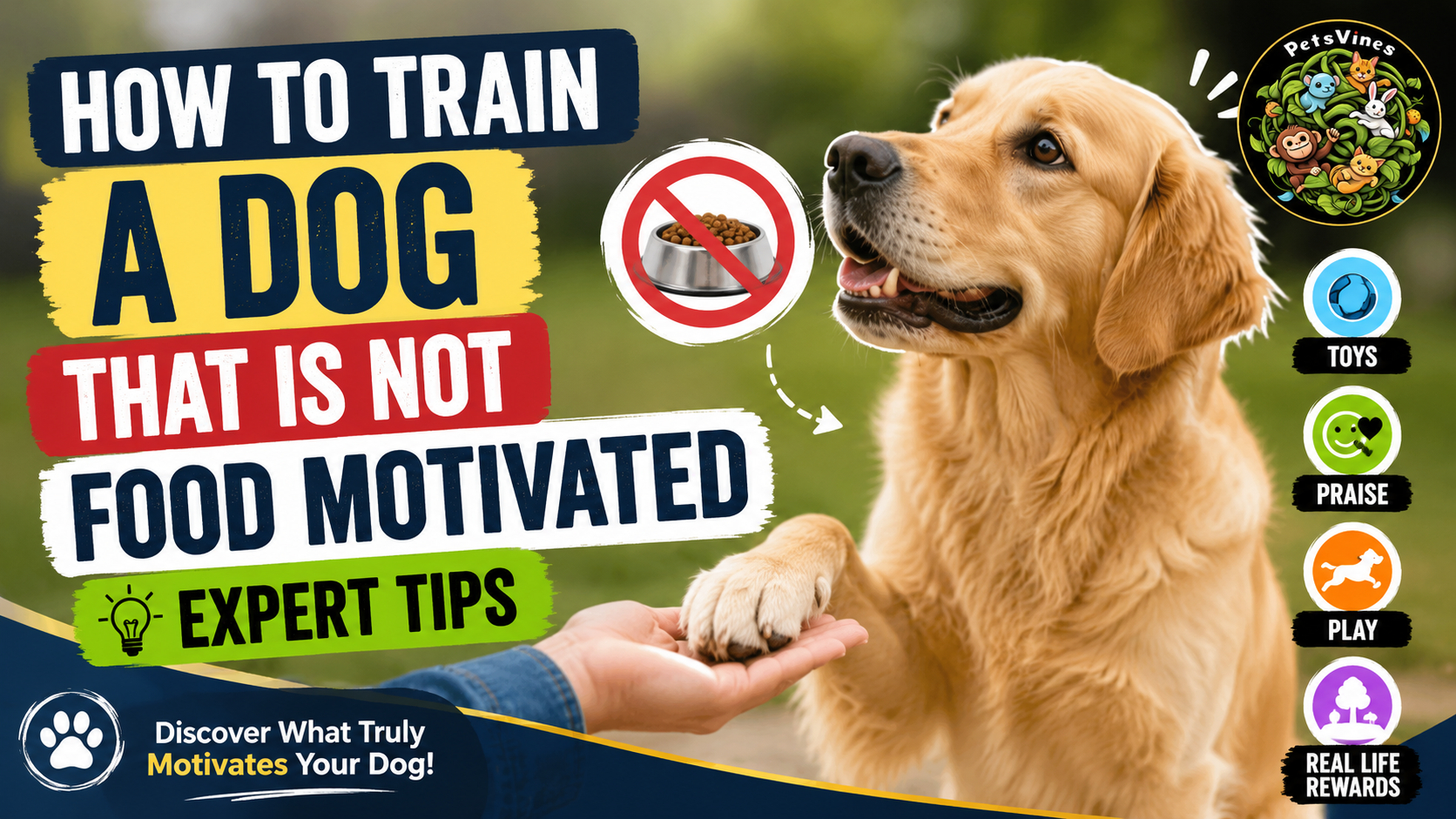
To train a dog that is not food motivated, identify what your dog genuinely enjoys, a favourite toy, a game of tug, verbal praise, physical affection, or the freedom to sniff. Use that reward consistently during short, positive training sessions. Rule out medical causes for food disinterest first, then build a reward hierarchy based on your dog’s unique preferences.
You pull out a treat. Your dog looks at it, looks away, and wanders off to sniff the baseboards.
Sound familiar? If you’ve been struggling to train your dog because they simply don’t care about food rewards, you’re not alone, and you’re definitely not out of options.
Most dog training guides assume every dog is bribeable with a piece of chicken. The truth is, some dogs are genuinely disinterested in food during training, especially in stimulating environments. Whether your dog is highly independent, breed-driven, overweight, anxious, or just plain picky, the solution isn’t to force food rewards that don’t work. It’s to find what does work.
This guide walks you through exactly how to train a dog that is not food motivated, with expert-backed strategies, alternative reward systems, and step-by-step training tips that actually stick. You’ll also learn why your dog might be refusing treats in the first place, which changes everything.
Why Some Dogs Are Not Food Motivated: The Real Reasons
Dogs may refuse food during training due to stress, being overfed, health conditions, high-distraction environments, or simply being a breed more driven by play or work than food. Identifying the root cause is the first step to solving it.
Before you overhaul your training strategy, it’s worth investigating why your dog doesn’t respond to food. The answer shapes everything that comes next.
1. Health or Medical Issues
A dog that has suddenly lost interest in food, specially one who previously took treats eagerly, may be dealing with an underlying health issue. Dental pain, gastrointestinal discomfort, nausea, hormonal imbalances like hypothyroidism, or anxiety can significantly suppress appetite.
According to trainers at the Animal Humane Society, medical illness, pain, gut health, and anxiety can all decrease a dog’s desire to eat, and a conversation with your vet should be the first step before changing any training approach. If your dog’s food disinterest is new or sudden, a vet visit comes before anything else on this list.
2. Free Feeding at Home
If your dog has access to a bowl of food all day, they’re simply not hungry during training. A dog that’s never truly hungry has little reason to work for kibble. Switching to scheduled mealtimes, and training before meals rather than after, can make a significant difference almost immediately.
3. Stress and Environmental Overwhelm
Many dogs shut down around food when they’re stressed or overstimulated. A training class, a busy park, or a new home can trigger a low-grade stress response that suppresses appetite entirely. This isn’t stubbornness, it’s biology.
If your dog consistently eats in some places but not others, it could be because they are stressed, overwhelmed, or over-excited in that environment, not because they’ve suddenly decided treats aren’t worth it.
4. The Treats Simply Aren’t Valuable Enough
Not all treats are created equal. Plain kibble in a high-distraction environment offers almost zero competition against the smell of another dog, the sight of a squirrel, or the excitement of somewhere new. This isn’t food disinterest, it’s a treat value problem.
Try upgrading to high-value rewards like real meats and cheeses in more stimulating environments, and always speak with your vet about safe higher-value options if your dog has a sensitive stomach or a limited diet.
5. Breed-Specific Drive
Certain breeds were developed for work rather than food-driven compliance. Border Collies, Siberian Huskies, Greyhounds, and many terrier and working breeds are often far more motivated by play, prey drive, or physical activity than by food. Understanding your dog’s breed history gives you a significant advantage in identifying the right motivator.
How to Train a Dog That Is Not Food Motivated: 7 Proven Strategies
Train a non-food motivated dog by using alternative rewards, toys, play, verbal praise, physical affection, or the freedom to sniff. Identify your dog’s personal “currency,” rank its value, and use it exactly as you would a treat: immediately, consistently, and enthusiastically.
Strategy 1: Run a Preference Assessment
Before choosing an alternative reward, test what your dog actually values. Animal behaviourists use preference assessments to identify the most effective reinforcers for individual dogs, and you can run a simple version at home.
Here’s how:
- Present your dog with 3–4 different items one at a time: a favourite toy, a tug rope, verbal praise, physical petting, a sniff opportunity, or a short game of chase.
- Note which ones your dog engages with enthusiastically and which they ignore.
- Rank them from most to least exciting.
Your dog’s top choice becomes your primary training reward. A 2023 peer-reviewed study published in Animals by researchers at the University of Florida confirmed that while most dogs showed a preference for food overall, individual variation was significant, and leisure items such as toys and play functioned as effective reinforcers for many dogs when the right items were identified.
Strategy 2: Use Toy Rewards and Play
For dogs with strong prey or play drive, a toy reward can be more powerful than food. Tug-of-war, fetch, and flirt poles are especially effective for terriers, herding breeds, and high-energy working dogs.
The key is making the toy reward feel like a jackpot, not a casual hand-off. When your dog performs a behaviour correctly:
- Instantly produce the toy with genuine excitement
- Play an enthusiastic 15–30 second game
- Calmly take the toy away to end the game (this actually builds its value for next time)
- Repeat
This approach is used extensively in competitive obedience, agility, and police K9 training, precisely because it works reliably in non-food-friendly environments.
For more ideas on keeping your dog mentally and physically engaged, explore the dog training and enrichment guides at PetsVines.
Strategy 3: Leverage Praise and Social Rewards
Some dogs, particularly people-oriented breeds like Golden Retrievers, Labradors, and Cavalier King Charles Spaniels, respond powerfully to human approval. But there’s a meaningful difference between flat, monotone “good boy” and genuine, animated praise. Dogs are exquisitely sensitive to tone, body language, and your energy.
Research on dog training methods found that 60% of dog owners used praise as a training reward, making it the single most commonly used reward type, more common even than food rewards at 51%. Make your praise feel like a real celebration: crouch down, use a high-pitched enthusiastic voice, and follow it with physical affection in your dog’s preferred spot, whatever that looks like for them.
Strategy 4: Use Sniff Rewards
Sniffing is one of the most mentally stimulating and satisfying activities a dog can do. For dogs unmotivated by toys or food, the opportunity to sniff freely can function as a powerful training reward.
After a successful behaviour, say “go sniff” and allow your dog 30–60 seconds of free exploration time in the grass, along a fence, or around a new object. Use a consistent release cue so your dog understands that sniffing is something they earn, not something that’s always freely available.
This approach works especially well for scent-oriented breeds like Beagles, Bloodhounds, Basset Hounds, and Dachshunds.
Strategy 5: Use Life Rewards (Real-World Reinforcement)
Real-world reinforcement also called “life rewards” is one of the most underused tools in everyday training. The idea is straightforward: your dog wants many things throughout the day. Make access to those things contingent on a behaviour.
Examples:
- “Sit” before the leash goes on → the reward is the walk itself
- “Wait” at the door → the reward is being released to go outside
- “Down” before greeting a visitor → the reward is getting to say hello
- “Check in” (eye contact) → the reward is being released to go sniff or play
This method integrates training seamlessly into daily life and works beautifully for dogs uninterested in food or formal training sessions.
Strategy 6: Proof Behaviours Across Environments
If your dog takes food at home but refuses it, and everything else, in new environments, the environment itself is the obstacle. Build up gradually rather than expecting full compliance in high-distraction settings right away.
- Train in the least distracting environment possible first (quiet room at home)
- Once behaviours are solid there, step up to mildly stimulating settings (your garden, front step)
- Gradually increase distraction levels as your dog builds confidence and habit
This process is called proofing, and it’s how professional trainers build truly reliable behaviour across all real-world contexts, regardless of what reward system they’re using.
Strategy 7: Keep Sessions Short and Always End on Success
Short, successful training sessions build momentum and keep motivation high, especially for dogs that don’t have a food incentive to push through longer, repetitive sessions.
Aim for:
- 3–5 minutes maximum per session for unmotivated or easily distracted dogs
- Always end while your dog is still engaged and succeeding
- Train 2–3 short sessions per day rather than one long block
- Never repeat a command more than twice, if your dog doesn’t respond, simplify the task and reward that
Ending on success creates positive associations with training itself, which matters even more when food isn’t part of the equation.
Building a Reward Hierarchy: The Secret Most Owners Miss
A reward hierarchy ranks your dog’s motivators from least to most valuable, so you can match the reward to the difficulty of the task, low-value rewards for easy known behaviours, high-value rewards for new or challenging situations.
| Tier | Reward | Use For |
|---|---|---|
| Low | Calm verbal praise | Easy, well-known behaviours at home |
| Medium | Short play session or favourite toy | New behaviours or mild distractions |
| High | Extended play, tug, or most-loved activity | Difficult behaviours or high-distraction environments |
Not every reward needs to be equally powerful. Match the reward to the moment, and save your highest-value reinforcer for when it truly counts.
Common Mistakes to Avoid
- Repeating commands, “Sit, sit, sit” teaches your dog that one cue doesn’t require a response.
- Training when your dog is tired or overstimulated, timing matters as much as the reward itself.
- Using the same reward every time, research from the University of Bern found that dogs show increased motivation when reward variety is introduced, so mixing it up keeps engagement higher.
- Getting frustrated, dogs read human emotion. Frustration makes training feel unpleasant and reduces willingness to engage.
- Skipping the vet, a medical cause for food refusal is easy to miss and changes your entire approach.
What the Research Says
The science here is clear: reward-based training works, and food is not the only valid reward.
A landmark study on dog training methods found that owners who trained using any type of reward had significantly more obedient dogs, and the correlation between reward-based training and obedience held regardless of the specific reward used.
The American Veterinary Society of Animal Behavior (AVSAB) explicitly recommends reward-based training as the most effective and ethical approach, and defines “rewards” broadly to include play, praise, and freedom, not just food.
Numerous organisations, including the American Veterinary Society of Animal Behavior, the Association of Professional Dog Trainers, and the RSPCA, all recommend the use of exclusively reward-based methods for dog training and rehabilitation.
For a deeper dive into positive reinforcement methods and what they mean for your dog’s wellbeing, the PetsVines resource hub is a great place to start.
When to Call in a Professional Trainer
If you’ve tried multiple reward types, ruled out medical issues, adjusted your environment, and are still hitting a wall, bring in a professional. Look for a certified trainer credentialled through the APDT, IAABC, or CCPDT who uses positive reinforcement methods.
A skilled trainer can identify your dog’s specific motivators through direct observation, refine your timing and technique, and build a training plan tailored to your dog’s individual profile. Even experienced dog owners work with trainers regularly, because expert eyes make an enormous difference.
Final Thoughts
Training a dog that isn’t food motivated isn’t harder, it just requires a different lens. The moment you stop trying to force food rewards and start discovering what genuinely excites your dog, training shifts from a frustrating battle into a real collaboration.
Your dog wants to connect with you. Toys, play, praise, sniffing, and real-life rewards are all legitimate, powerful, and science-backed tools. The only thing standing between you and a well-trained dog is finding their currency, and then using it consistently.
Start small. Stay curious. Celebrate every win.
Ready to Become a Better Dog Owner?
Explore our full collection of dog training tips, behaviour guides, and breed-specific advice at PetsVines → and build the relationship with your dog that you both deserve.
FAQs
Can you train a dog without food at all?
Yes. Many professional trainers, particularly in competitive dog sports and working dog fields, train entirely without food, using toys, play, and life rewards as their primary reinforcers. What matters is that the reward is genuinely meaningful to your dog.
Why does my dog take food at home but not outside?
Environmental stress or overstimulation is the most common cause. Your dog isn’t being stubborn, they’re overwhelmed. Build up to new environments gradually, starting in low-distraction settings.
What breeds are typically not food motivated?
Siberian Huskies, Greyhounds, many terrier breeds, Border Collies, and several herding and working breeds often prioritise play or prey drive over food. That said, individual personality matters more than breed generalisation.
How do I know what motivates my dog?
Run a preference assessment: offer different reward types one at a time and observe which ones your dog responds to with genuine energy and engagement. Your dog’s response tells you everything.
References:
- Lazaro et al. (2023). Efficacy of Edible and Leisure Reinforcers with Domestic Dogs. Animals, MDPI. Link
- Hiby, Rooney & Bradshaw (2004). Dog training methods: use, effectiveness and interaction with behaviour and welfare. Animal Welfare, Cambridge University Press.
- Bremhorst et al. (2018). Incentive motivation in pet dogs. Scientific Reports. Link
- Animal Humane Society. How to Train Non-Food Motivated Dogs
Also Visit: Most Aggressive Dog Breeds: What Pet Owners Need to Know