
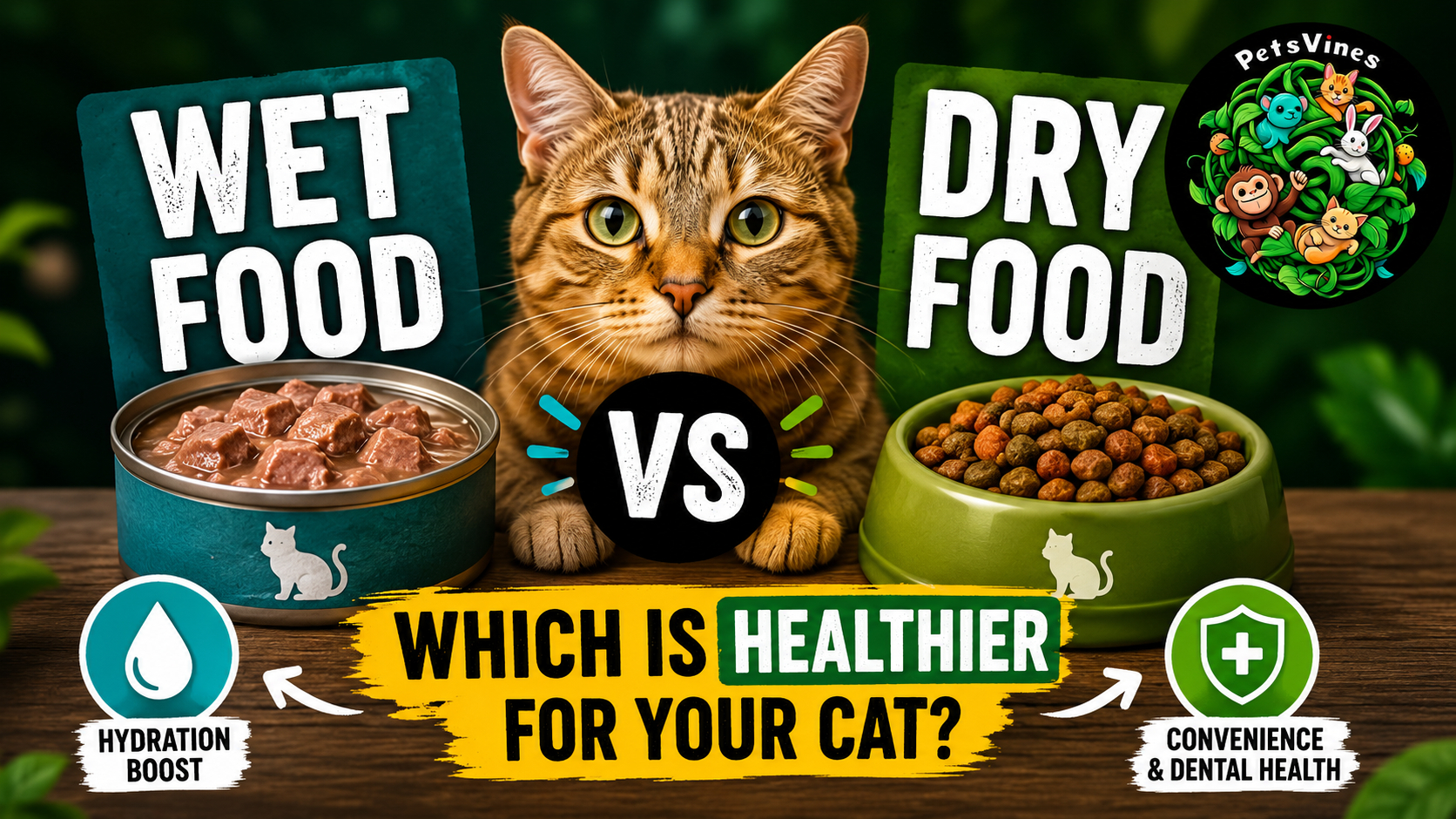
The wet versus dry cat food debate is one of the most common questions cat owners bring to their vets. Both options have genuine advantages. Both have real limitations. And the answer, like most things in feline health, is rarely one-size-fits-all.
This guide gives you the full picture: the nutritional differences, the hydration science, the dental and weight implications, and what veterinary research actually says. By the end, you will be able to make an informed choice for your specific cat rather than relying on marketing claims or outdated advice.
For context on how feeding decisions connect to your cat’s long-term health, also read our guide on how long cats live and the key factors that influence lifespan.
The Fundamental Difference: Moisture Content
The most important difference between wet and dry cat food is moisture. According to Just Cats Clinic, wet food typically contains 70 to 80 percent moisture, while dry kibble contains approximately 10 percent. This difference has direct and significant implications for feline health.
Cats evolved as desert predators. Their wild ancestors obtained almost all of their daily water from the prey they hunted, which contained roughly 70 percent moisture. Domestic cats have a notably weak thirst drive and do not instinctively drink enough water to compensate for the moisture missing from a dry food diet.
The consequence of chronic mild dehydration in cats fed exclusively dry food is measurable. Research supports a connection between low moisture intake and higher rates of feline lower urinary tract disease, urinary crystal formation, and the progression of chronic kidney disease. As the Cornell Feline Health Center notes, adequate water intake helps support kidney function and reduce urinary tract problems in cats.
| Factor | Wet Food | Dry Food |
|---|---|---|
| Moisture Content | 70-80% | 8-10% |
| Calorie Density | Lower per gram | Higher per gram |
| Cost | Higher per calorie | Lower per calorie |
| Shelf Life (open) | 1-2 hours maximum | Stays fresh for months |
| Dental Benefit | Minimal | Slight mechanical abrasion |
| Hydration Support | Excellent | Poor |
| Weight Management | Easier to control portions | Harder to prevent overeating |
| Suitability for Kidney Disease | Strongly preferred | Not recommended unless no alternative |
Wet Food: The Case For It
Superior Hydration
Cats eating wet food passively consume significantly more water every day compared to cats on dry food diets. For cats prone to urinary issues, for male cats who are particularly susceptible to urethral blockages, and for any cat with early kidney disease, this passive hydration may be the most impactful dietary change an owner can make.
Lower Calorie Density
Wet food contains more water and typically less fat and carbohydrate per gram than dry food, making it easier to feed appropriate calorie amounts. This is particularly relevant for cats prone to obesity, which affects an estimated 50 to 60 percent of domestic cats.
More Appealing to Picky Cats and Seniors
Cats with dental pain, reduced sense of smell, or decreased appetite often accept wet food more readily than dry kibble. If your cat has stopped eating, see our guide on why cats stop eating and when to see a vet.
Dry Food: The Case For It
Convenience and Cost
Dry food is significantly more affordable per calorie than wet food and far more convenient. It does not spoil for hours after being served, and a bag stores for months when sealed properly.
Dental Abrasion
Some dry kibble formulas provide mild mechanical abrasion that helps reduce tartar buildup on teeth. The American Association of Feline Practitioners (AAFP) notes that dental cleanings under anesthesia remain the most effective intervention for feline dental health, regardless of diet type.
Suitable for Puzzle Feeders
Dry kibble works well with puzzle feeders and slow-feed bowls, providing mental enrichment alongside meals. These tools slow eating speed, reduce vomiting from gorging, and provide cognitive stimulation that is particularly valuable for indoor cats.
What About a Mixed Approach?
Many veterinary nutritionists recommend combining wet and dry food. This provides the hydration benefits of wet food, the convenience and affordability of dry food, and gives cats variety in texture and flavor. Our full guide on how much to feed your cat by weight and life stage walks through the combined calorie calculation in detail.
Special Situations: When One Is Clearly Better
| Situation | Recommended Choice | Reason |
|---|---|---|
| Chronic kidney disease | Wet food strongly preferred | Hydration reduces kidney strain |
| Urinary tract disease or crystals | Wet food strongly preferred | Dilute urine prevents crystal formation |
| Obesity or weight loss needed | Wet food generally better | Lower calorie density, easier portion control |
| Dental disease management | Dry food has slight edge | Mechanical abrasion reduces tartar |
| Kitten under 12 months | Either, but wet has advantages | Higher moisture supports developing kidneys |
| Senior cat over 11 years | Wet food generally preferred | Hydration, palatability, easier to chew |
| Healthy adult with no issues | Either, mixed is ideal | Personal and financial preference valid |
Common Myths
Myth: Dry food cleans teeth effectively. Reality: While dry kibble provides mild abrasion, veterinary dentists generally consider this benefit minimal compared to actual dental cleanings.
Myth: Wet food causes diarrhea. Reality: A sudden switch from dry to wet food can cause loose stools during the transition, but well-formulated wet food is not inherently more likely to cause diarrhea. Transition gradually over 7 to 10 days.
Myth: Adding water to dry food equals wet food. Reality: This is not an effective substitute. Soaking dry food can cause it to spoil within an hour and does not replicate the natural moisture distribution found in wet food.
FAQs
Can I switch my cat from dry to wet food?
Yes, but transition gradually over 7 to 10 days. Cats that have eaten only dry food for years may initially resist wet food. Try warming it slightly or mixing in a small amount of low-sodium broth to make it more appealing during the switch.
How long can wet cat food sit out before it goes bad?
Opened wet food should not sit at room temperature for more than 1 to 2 hours. Refrigerate unused portions in a covered container and use within 3 to 5 days.
How much wet food does a cat need per day?
Most adult cats need approximately 200 to 250 calories per day. A typical 5.5-ounce can contains roughly 150 to 200 calories. The exact amount varies by your cat’s weight, age, and activity level.
Does dry cat food clean a cat’s teeth?
Only minimally. Some dry kibble formulas provide mild mechanical abrasion that can reduce tartar buildup, but veterinary dentists consider this benefit modest. Professional dental cleanings under anesthesia remain the most effective intervention for feline dental health regardless of diet.
Is wet food or dry food better for a cat with kidney disease?
Wet food is strongly preferred. Its 70 to 80 percent moisture content increases daily water intake, reduces the concentration of waste products filtered by the kidneys, and slows the progression of chronic kidney disease. Dry food is not recommended for cats with kidney disease unless no alternative is available.
Can I add water to dry kibble instead of buying wet food?
No, this is not an effective substitute. Soaking dry kibble does not replicate the natural moisture distribution found in wet food, and the soggy mixture can spoil within an hour at room temperature, creating a food safety risk.
Is wet food or dry food better for overweight cats?
Wet food is generally better for weight management. It has lower calorie density per gram due to its high moisture content, which means a cat can eat a satisfying volume of food while consuming fewer calories. Dry food’s higher calorie density makes portion control more difficult.
Why do cats have a weak thirst drive?
Cats evolved as desert predators whose wild ancestors obtained nearly all of their daily water from prey, which contains approximately 70 percent moisture. Because hydration came from food rather than drinking, domestic cats did not develop a strong instinct to seek out water independently, making dietary moisture critically important.
Is a mixed wet and dry food diet a good option?
Yes, many veterinary nutritionists recommend a combined approach. Feeding wet food daily provides essential hydration benefits while dry food offers affordability, convenience, and compatibility with puzzle feeders. Calculating the combined calorie total is important to avoid overfeeding.
Which is better for senior cats, wet or dry food?
Wet food is generally preferred for senior cats aged 11 and older. Older cats are more prone to dehydration, kidney disease, dental discomfort, and reduced appetite, and wet food addresses all four concerns simultaneously through its moisture content, palatability, and softer texture.
Making the Right Choice for Your Cat
The evidence strongly favors wet food as the primary diet for most cats, particularly because of its hydration benefits. But dry food is not harmful for healthy cats, and the practical benefits of convenience and cost are real. A mixed approach incorporating quality wet food daily while using dry food as a supplement is a sensible middle ground for most households.
Also Visit: Best Cat Food 2026: Vet-Recommended Brands for Every Life Stage