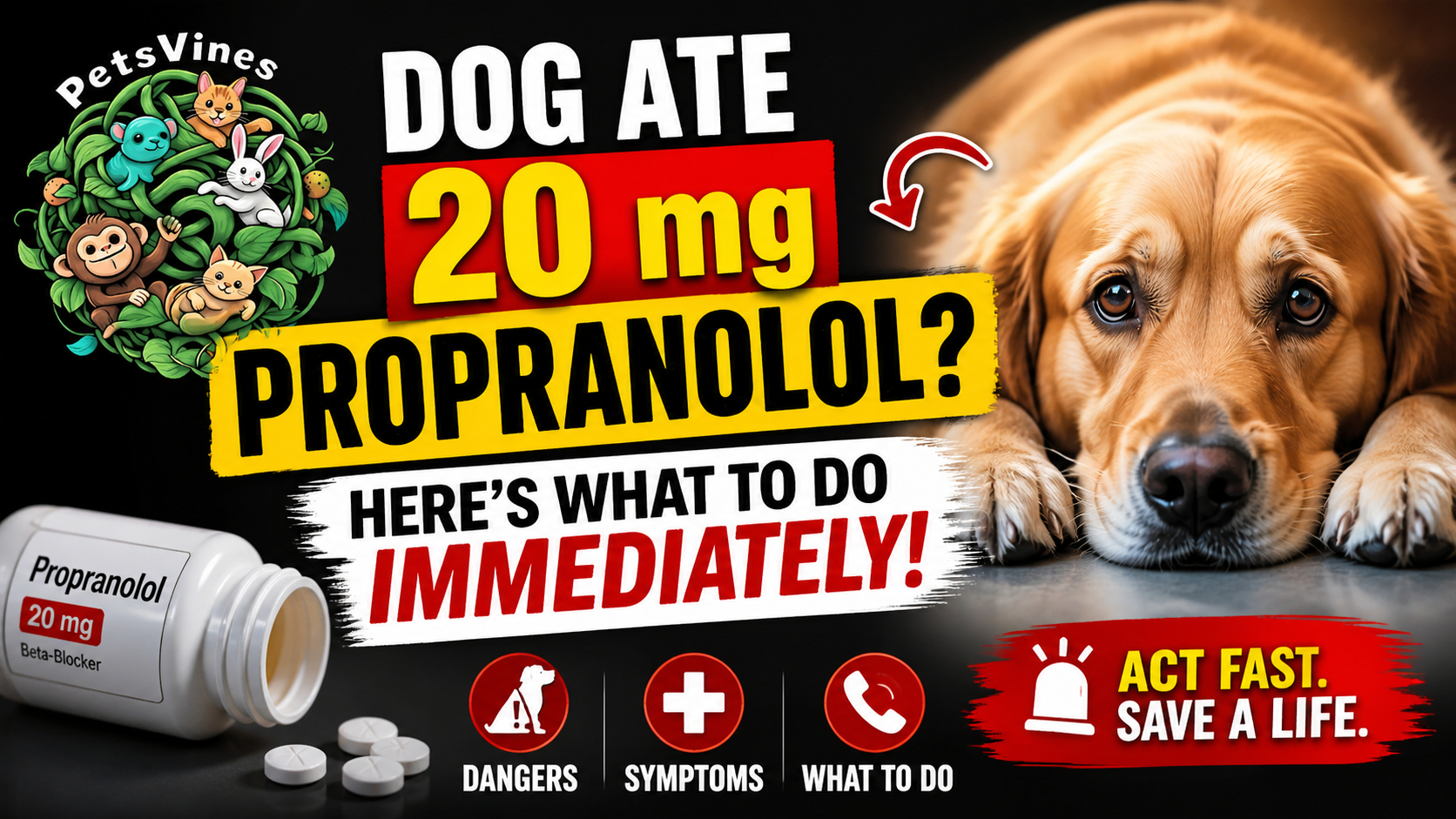
Dog Ate 20 mg Propranolol: You turned your back for a moment, and now your dog has gotten into your medication. You’re staring at an empty blister pack or a chewed-up pill bottle, trying not to panic — and searching for answers as fast as you can type.
If your dog ate 20 mg of propranolol, this is not a “wait and see” situation. Propranolol is a beta-blocker — a powerful cardiovascular medication — and dogs are significantly more sensitive to it than humans. Propranolol has a narrow margin of safety, meaning that only a small amount given over the prescribed dose can result in toxicity, and overdoses can be life-threatening.
This guide will walk you through exactly what propranolol does in a dog’s body, what symptoms to watch for, what the vet will do, and most importantly — what you need to do right now. Whether your dog is a 5-pound Chihuahua or a 70-pound Labrador, the advice here could save their life.
If your dog ate 20 mg of propranolol, contact your veterinarian or call the ASPCA Animal Poison Control Center (888-426-4435) or Pet Poison Helpline (855-764-7661) immediately. Do not wait for symptoms to appear. Propranolol has a narrow margin of safety in dogs — even small amounts can cause dangerous drops in heart rate and blood pressure. Time is critical.
What Is Propranolol and Why Is It Dangerous for Dogs?
Propranolol is a non-selective beta-blocker medication commonly prescribed to humans for high blood pressure, heart arrhythmias, anxiety, and migraines. When a dog accidentally ingests it, the drug suppresses heart function in ways that can rapidly become life-threatening.
How Propranolol Works in the Body
Propranolol blocks both beta-1 and beta-2 receptors — known as norepinephrine and epinephrine receptors — which are responsible for elevating the heart rate during stressful situations. Beta-blockers decrease the heart rate and thus the amount of oxygen required for the cardiovascular system to function properly.
In plain terms: propranolol slows everything down. For a dog who didn’t need that effect in the first place, the result can be a dangerously slow heart rate, a crash in blood pressure, and inadequate blood flow to vital organs.
Propranolol is not FDA-approved for veterinary use, but it is legally prescribed by veterinarians under what is known as “off-label” or “extra-label” use — meaning the doses are carefully calculated for each dog’s specific condition and body weight. An accidental ingestion of a human dose throws all of that out the window.
Is 20 mg of Propranolol Dangerous for a Dog?
The Short Answer
Yes — potentially very. The danger depends heavily on your dog’s body weight, but 20 mg is enough to cause serious cardiovascular effects in small to medium-sized dogs, and should be treated as an emergency in all cases.
Here’s a simplified way to think about it:
| Dog Weight | Risk Level at 20 mg |
|---|---|
| Under 10 lbs (under ~4.5 kg) | Very High — emergency immediately |
| 10–25 lbs (4.5–11 kg) | High — urgent veterinary care needed |
| 25–50 lbs (11–23 kg) | Moderate to High — contact vet right away |
| Over 50 lbs (23+ kg) | Moderate — still requires vet contact, monitor closely |
Note: These are general guidelines, not medical thresholds. Your dog’s age, health status, and other medications also matter enormously. Always call a vet.
Beta-blockers have a narrow margin of safety, meaning that only a small amount of the drug can result in severe poisoning. Even a dog on the heavier end of the scale should not be dismissed without a professional evaluation.
What Are the Symptoms of Propranolol Toxicity in Dogs?
Symptoms can appear within 30 minutes to a few hours of ingestion and may escalate quickly. The most dangerous effects target the heart, lungs, and blood sugar levels.
Watch for these warning signs:
- Lethargy or sudden weakness — your dog seems unusually tired or can’t hold themselves up
- Slow heart rate (bradycardia) — heart beating too slowly
- Low blood pressure (hypotension) — may show as pale gums, wobbly walking
- Vomiting or nausea
- Difficulty breathing, wheezing, or coughing
- Fainting or collapse
- Low blood sugar (hypoglycemia) — shaking, disorientation, seizures
- Seizures
- Heart failure or kidney failure in severe cases
The most common clinical signs of an overdose are listlessness and depression. Other possible problems due to a propranolol overdose include high potassium levels, fluid in the lungs, lower airway closure, seizures, or respiratory depression.
This short-acting medication should stop working within 24 hours, although effects can be longer in pets with liver or kidney disease. That means even if your dog seems okay at first, symptoms can emerge or worsen over several hours.
What Should You Do Right Now — Step by Step
Step 1: Don’t Panic, But Don’t Wait
Staying calm helps you act faster and more clearly. But this is not a situation to “monitor at home” unless a licensed veterinarian has assessed the risk and specifically told you that’s safe.
Step 2: Call for Help Immediately
Call one of these right now:
- Your veterinarian (first choice if they’re available)
- ASPCA Animal Poison Control Center: 888-426-4435 (consultation fee may apply)
- Pet Poison Helpline: 855-764-7661 (consultation fee may apply)
- Local emergency animal hospital if your vet is unavailable
When you call, have this information ready:
- Your dog’s weight and breed
- The exact medication and dose (20 mg propranolol)
- Approximately when they ate it
- Any symptoms you’ve already noticed
- Any other medications your dog is on
Step 3: Do NOT Induce Vomiting Without Vet Guidance
Inducing vomiting should never be done without veterinary advice, as it can sometimes cause more harm, depending on the substance ingested and the time since ingestion. A veterinarian will advise whether this is appropriate — and in many cases of cardiac medication ingestion, it’s not the safest first move.
Step 4: Get to the Vet as Fast as Possible
If directed to go in, don’t delay. Time is the most important factor in medication toxicity. The faster treatment begins, the better the outcome.
What Will the Vet Do? Understanding the Treatment
Treatment focuses on removing as much of the drug from the body as possible, stabilizing the cardiovascular system, and supporting your dog through any dangerous symptoms as they arise.
Aggressive and immediate treatment must be initiated, and includes decontamination, heart and blood pressure monitoring, aggressive IV fluids, blood work monitoring, and symptomatic supportive care.
Here’s what to expect at the clinic:
Decontamination
If ingestion was recent (typically within 1–2 hours), the vet may induce vomiting under controlled conditions or administer activated charcoal to absorb any remaining drug in the gastrointestinal tract.
Cardiac Monitoring
Your dog will likely be placed on an ECG (electrocardiogram) to continuously monitor heart rhythm and rate. Blood pressure monitoring will also be established.
Intravenous (IV) Fluids
IV fluids help maintain blood pressure and support organ function. Treatment may include activated charcoal, intravenous fluids, and monitoring heart function.
Medications to Counteract Effects
The vet may administer medications such as atropine (to raise heart rate), glucagon (a key antidote for beta-blocker toxicity that helps restore heart function), or vasopressors to stabilize blood pressure.
Hospitalization
Depending on the amount ingested and your dog’s condition, they may need to be hospitalized for 12–48 hours of monitoring. Overdoses of propranolol can be life-threatening and require hospitalization.
What If My Dog Seems Fine?
This is one of the most dangerous assumptions a pet owner can make with cardiac medications. Propranolol can have a delayed onset of serious effects, particularly in extended-release formulations. A dog may appear perfectly normal for the first hour before their heart rate begins to drop significantly.
Signs of potential toxicity include excessive bradycardia, lethargy, weakness, cold extremities, and respiratory difficulty. By the time these signs appear visibly, the drug has already had significant cardiovascular effects.
The bottom line: “Seems fine” does not mean “is fine.” Always contact a professional.
Can Dogs Recover From Propranolol Ingestion?
Yes — with prompt treatment, many dogs recover fully. The prognosis depends on:
- How much was ingested relative to body weight
- How quickly treatment was started
- Whether the dog has underlying health issues (heart disease, kidney disease, liver disease, asthma)
- Whether it was a standard or extended-release formulation (extended-release tablets are harder to decontaminate and can cause prolonged toxicity)
Dogs who receive care within the first 1–2 hours of ingestion generally have a much better outcome than those treated after symptoms have already progressed.
How to Prevent This from Happening Again
Medication accidents are one of the most common causes of pet poisoning worldwide. According to the ASPCA, human prescription medications consistently rank among the top toxin exposures reported to their Poison Control Center each year.
Here’s how to dog-proof your medications:
- Store all medications in a high cabinet with a childproof (and pet-proof) latch
- Never leave pills loose on countertops or nightstands — dogs are opportunistic and fast
- Use a pill organizer with a locking lid if you use one
- Never give your dog human medication unless a vet has specifically prescribed it for them at a confirmed dose
- Pick up any dropped pills immediately — this is how most accidental ingestions happen
- Warn guests to keep their medications secured in their bags or rooms
For more guidance on keeping your dog safe, the PetsVines dog health resource hub covers a wide range of health and safety topics tailored to dog owners.
FAQ’s
Q: My dog ate propranolol but seems totally normal — do I still need to call the vet?
Yes. Always call your vet or a poison control helpline regardless of how your dog appears. Symptoms can be delayed, and early intervention is far safer than waiting.
Q: Will one 20 mg propranolol pill kill my dog?
It depends on your dog’s size and health status. For a small dog, it can be life-threatening. For a large dog, it may cause serious but manageable symptoms. Either way, it requires immediate professional assessment — not guesswork.
Q: How long will propranolol stay in my dog’s system?
This short-acting medication should stop working within 24 hours, although effects can be longer in pets with liver or kidney disease.
Q: Can I give my dog anything at home to help?
No. Do not give food, water, milk, or any home remedy without vet guidance. Some substances can interfere with treatment or worsen absorption of the drug.
Q: Is there an antidote for propranolol poisoning in dogs?
There is no single specific antidote, but glucagon is considered one of the most effective treatments for beta-blocker toxicity. It must be administered by a veterinarian in a clinical setting.
Act First, Research Later
When your dog has eaten a cardiovascular drug like propranolol, the most important thing you can do is pick up the phone right now. Don’t finish reading articles. Don’t wait to see if symptoms develop. Don’t assume a single pill can’t cause serious harm.
If your dog has ingested propranolol, it is crucial to take them to the vet immediately, as this medication can be dangerous and even life-threatening to pets.
Call your vet, call an emergency animal hospital, or call the Pet Poison Helpline (855-764-7661). Get your dog seen. That’s the only action that matters right now.
Also Visit: Dog Ate 200mg Progesterone? What to Do Right Now